
25 Years after the Barcelona Process: The UfM on Women & Inclusive, Sustainable Development in the MENA Region
- With COVID-19 still spreading, and with regional inequalities rising, we have a responsibility to collaboratively tackle gender equality, economic empowerment and climate change.
- Evidence shows that in the pandemic, women’s livelihoods are more vulnerable to unemployment and economic instability.
- As we recover from this pandemic, we must leverage the opportunity to create new inclusive societies that ensure that young people and women can fulfil their potential as catalysts of change and contributors to the region’s economy as a whole.
8 October 2020. The COVID-19 pandemic has exacerbated existing inequalities. The impacts of crises are never gender neutral, and COVID-19 is no exception. Women and girls have been unequally affected by the economic and social hardships unleashed by the pandemic. Job creation has stalled and, even it has been pushed out of the headlines, climate change remains one of the biggest threats to the Mediterranean basin and the planet. In the midst of this pungent economic and social crisis, a resilience and sustainable response is vital.
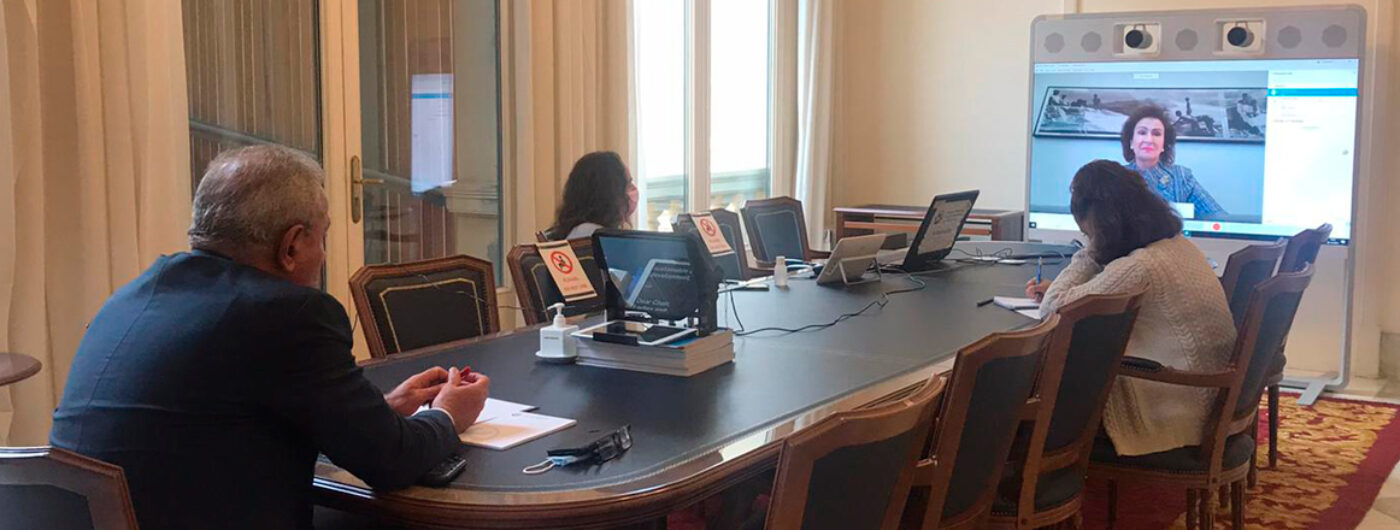
The 25th Anniversary of the Barcelona Process comes at a time of great disruption, but it also gives the chance for much needed conversations on the developmental challenges that the region still faces. To discuss this, the UfM Secretary General Nasser Kamel was invited to deliver a Keynote Speech at the Arab International Women’s Forum (AIWF) webinar ’25 Years after the Barcelona Process: The UfM on Women & Inclusive, Sustainable Development in the MENA Region’. The webinar aimed to discuss UfM’s action in the MENA Region since the 1995 Barcelona Process, with special focus on women, economic empowerment, and climate action.
During the introductory remarks, AIWF Founder and Chairman Haifa Fahoum Al Kaylani highlighted that the COVID-19 crisis was an opportunity to rethink women’s role in the economy and that it was “also compelling all stakeholders, governments, institutions and civil society to come together and prioritise creative policymaking through unprecedented cross-border collaboration, data-driven decision making, data sharing, and bold economic measures.”
Following her opening remarks, in his Keynote Speech, the Secretary General, Nasser Kamel underlined that the UfM has always put gender equality, women’s empowerment and the challenge of ending Violence Against Women and Girls at the centre of its agenda. Amidst a global pandemic and a strong economic crisis, a gender-aware response is particularly vital.
Women and girls have been mainly affected by the COVID-19 social and economic fallouts. According to UN Women and UNDP, by 2021 around 435 million women and girls will be living on less than $1.90 a day — including 47 million pushed into poverty as a result of COVID-19. Moreover, the UN estimates that women in the Arab world will lose more than 700,000 jobs. This is explained by the fact that some of the sectors hardest hit by the pandemic, characterized by low pay and poor working conditions, are women dominated sectors. In this context, women’s leadership and voices are paramount and will help to ensure a more equitable and better recovery.
A gender-awareness response to COVID-19 should rely also on reliable gender data collection and on the research on the gendered impacts of COVID-19. As a valuable contribution to achieve this objective, the UfM Member States endorsed a unique intergovernmental set of twenty indicators as part of the UfM Ministerial follow-up mechanism that will allow to aggregate relevant data, monitor progress, evaluate the gender gap and provide recommendations to policymakers and stakeholders.
All these challenges will be addressed and discussed in the framework of Women High Level Conference: “Accelerating Gender Equality in the context of the Covid-19 pandemic”
UfM Secretary General Nasser Kamel :“The Beijing Platform for Action and the targets of the SDGs continue to be relevant road maps for action, and it is more crucial than ever to achieve them. Without coordinated action to mitigate the gendered impacts of COVID-19, there is a risk that the fragile gender equality gains achieved over the past 25 years will be lost”.
Moreover, SG Kamel underlined the relevance on Social Economy, which alone constitutes more than 3.2 million enterprises and 15 million jobs across the Euro-Mediterranean region. Beyond delivering social and economic value, Social Economy is a smart way to recover from this pandemic by unlocking resources, creating sustainable employment and generating regional economic growth. Climate Change was also addressed as one the major threats to the planet. The COVID-19 pandemic has pushed key environmental challenges out of the agenda, while temperatures and sea levels continue rising. In this context, SG Kamel urged to tackle the effects of global warming before it takes an irreversible toll on the Mediterranean Basin and its population.
The speech ended on a very reflective and bold note, stating that settling for the status quo was no longer an option and highlighting that, if we wanted to tackle gender equality, economic empowerment and climate change, resilience and regional cooperation needed to be at the heart of the pandemic recovery.
As for digitalization and youth tech enterprises, the Secretary General stated that he was a strong believer on creative industries and digital economy as a crucial way to advance youth employment and economic growth. The UfM wishes to channel the potential of digitalization by bringing best practices to the region and by enhancing not only north-south cooperation but also south-south cooperation. The Secretary General underlined that, while furthering regional digitalization remains a priority, we must make sure that nobody is left behind. With reference to the role of the civil society, he asserted that the contribution of civil society has been pivotal in the development of the Euro-Mediterranean partnership since the inception of the Barcelona Process. The DNA of UfM is oriented towards empowering civil society as a whole because they are the drivers of any social, economic and political evolution.

