
• English
  • Français
  • العربية
Suivez-nous
Union pour la Méditerranée – UpMUnion pour la Méditerranée – UpMUnion pour la Méditerranée – UpMUnion pour la Méditerranée – UpM
  • Qui sommes-nous
    • L’Union pour la Méditerranée est une institution intergouvernementale réunissant les États membres de l’Union européenne et 16 pays du Sud et de l’Est de la Méditerranée dont le but est de promouvoir le dialogue et la coopération.

      PRÉSENTATION   

    • Qui sommes-nous

      • États membres
      • Structure
      • Partenaires
      • Histoire

      Transparence et responsabilité

      • Transparence et accès aux informations
      • Enquêter sur la fraude, la corruption et les manquements
    • Documents clés

      UfM Institutional Brochure UfM How we work

      VOIR PLUS   

  • Travailler avec nous
    • L’Union pour la Méditerranée agit par le biais de son Secrétariat général, établi à Barcelone en mars 2010. L’équipe du Secrétariat général compte des personnes de plus de 17 nationalités travaillant dans un environnement multiculturel promouvant la coopération, ainsi que la communication et les échanges interculturels.

    • Travailler avec nous

      • Postes vacants
      • Personnel détaché
      • Internships
      • Marchés publics
    • Notre méthodologie

      • Cadre politique
      • Plateformes régionales
      • Projets et initiatives
  • Notre action
    • La mission de l’UpM est de renforcer la coopération et le dialogue régional et favoriser la mise en œuvre d’initiatives et de projets concrets ayant un impact réel sur nos citoyens autour des trois priorités stratégiques de la région: le développement humain, la stabilité et l’intégration.

      PRÉSENTATION   

    • Développement inclusif

      • Développement économique et emploi
      • Enseignement supérieur et recherche
      • Affaires civiles et sociales

      Développement durable

      • Eau, Environnement et Économie Bleue
      • Transport et développement urbain
      • Énergie et action pour le climat

      Des initiatives qui créent des ponts

      • Journée de la Méditerranée
      • Capitales méditerranéennes de la culture et du dialogue
  • Contact
  • Centre d’information
    • Découvrez nos derniers communiqués de presse, notre identité visuelle, nos principales publications et documents institutionnels, nos photos, nos vidéos, etc.


      Télécharger la charte graphique et le logo de l’UpM (fichier Zip)    

    • Centre d’information

      • Coin média
      • Actualités
      • Agenda
      • Publications et documents clés
      • Histoires de coopération euro-Méd
    • L'UpM dans les médias

      9 May 2026 – Agence Europe (EN) – The fire season that never ends – by Joan Borrell Mayeur
      Voir l'article
      9 May 2026 – Agence Europe (FR) – Une saison des feux qui n’en finit pas – par Joan Borrell Mayeur
      Voir l'article
      7 May 2026 – Al-Dustour – حرائق غابات المتوسط على وشك أن تبدأ مجدداً… بلا حدود
      Voir l'article

Encourager la coopération régionale en matière d’agriculture, de développement rural et de migration dans la région méditerranéenne

Éducation supérieure et recherche

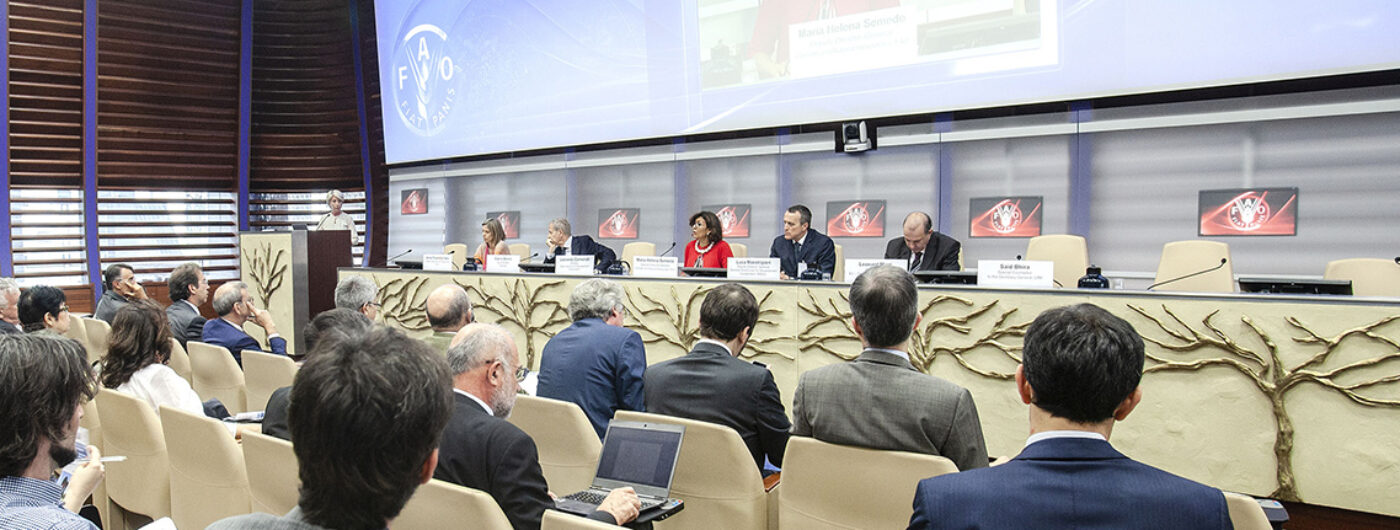
29 May 2018, Rome. A “better understanding of the drivers and impacts of migrations for forward-looking policies and programmes” was the main objective of the Forum on Agriculture, Rural Development and Migrations in the Mediterranean, jointly organised by the International Centre for Advanced Mediterranean Agronomic Studies (CIHEAM), the Food and Agriculture Organization of the United Nations (FAO), the Union for the Mediterranean (UfM) and the European University Institute- Global Governance Programme (EUI), under the patronage of the Italian Ministry of Foreign Affairs and International Cooperation (MAECI).

This first expert-level meeting took place at the FAO Headquarters and brought together experts from international institutions, development cooperation agencies, research centres, policy practitioners and civil society organisations.

The Forum provided a first overview of the challenges and opportunities associated to rural migratory dynamics in the Mediterranean as well as main policies and strategies designed to harness the potential of agriculture and rural mobility, collecting different perspectives from experts from the region.

As indicated in the UfM Roadmap for Action (2017), “the Mediterranean has always been an area of mobility and migration”. Nevertheless, as the current refugee and irregular migration crises clearly show, addressing the adverse drivers of migration is essential to regional stability. Likewise the CIHEAM Tirana Declaration (2016) states that “agriculture and food security are closely related to reconciliation, peace and stability in the Mediterranean region, and must be considered as priority sectors for these countries and for the international cooperation”.

Migration has a strong agricultural and rural dimension. A large share of migrants originate from rural areas, characterized by growing rates of poverty and unemployment. The implications of this phenomenon are significant in terms of food production, natural resource management, skill management, education, territorial integration, social protection, Diasporas, gender, and inclusive development. It follows that investing in sustainable agriculture and rural development, climate change adaptation and resilient livelihoods is a crucial component of any plan to tackle the current migration challenges in the Mediterranean region.

At the crossroads of three continents, all Mediterranean countries are areas of origin, destination and transit of migratory flows coming from sub-Saharan Africa, the Middle East and Central Asia. Even if agriculture and rural livelihoods are priority fields in policy agendas in all countries across the region, public investments have consistently decreased in recent decades. In this context, regional processes may help tackling long-term drivers by creating synergies and fostering projects devoted to social and inclusive development.

If well managed, internal and external migrations can contribute to economic growth, poverty reduction and food security of the Mediterranean region, through knowledge, skills and technology transfer. But the potential benefits of migratory movements must be actively promoted through policies that jointly harness its potential and minimize its negative effects.

The complexity of migratory dynamics and their significant impact on the future of agrarian and rural systems across the Mediterranean, call for dialogue and exchange at regional level among countries of origin, transit and destination, across different levels of governance as well as across policy sectors. Moreover, research and innovation play a relevant role in understanding the heterogeneous drivers and patterns of rural migration, thus the need for strengthening nexus between policy, cooperation and research.

The participants of the Forum proposed concrete recommendations for moving forward regional cooperation in this respect, which could serve as a basis for future research activities and joint initiatives.

As part of its work on Migration, FAO is co-chairing, together with the International Organization for Migration, the Global Migration Group, a consortium of UN agencies advising member states on the Global Compact for Safe, Orderly and Regular Migration due to be adopted in December 2018. In this context, the recommendations stem from the Forum will be channeled into the Global Compact negotiation process, if and as required by Member States.

More information

Speech by Saïd BHIRA, Special Advisor to the Secretary General for Higher Education and Research, UfM: https://www.dropbox.com/s/mfa0ms9eie00r8h/Said_Speech.mp4?dl=0


Partager:

Dernières Nouvelles

La Plateforme régionale de l’UpM sur l’autonomisation des femmes fait le point sur le suivi de l’égalité entre les femmes et les hommes
27 / 05 / 2026
Combler le déficit de compétences numériques et renforcer les solutions d’e-gouvernance : promouvoir la transformation numérique grâce à une conférence de l’UpM à Antalya
21 / 05 / 2026
Voir plus

Inscrivez-vous à notre lettre d’information


Agenda

11th UfM Regional Platform on Trade, Investment and Industry
03 / 06 / 2026
UfM Senior Officials Meeting (SOM) June 2026
10 / 06 / 2026
Voir plus
Co-financé par l'Union européenne
  • Qui sommes-nous
    • États membres
    • Gouvernance
    • Partenaires
    • Histoire
    • Transparence et responsabilité
      • Enquêter sur la fraude, la corruption et les manquements
    • Enquêter sur la fraude, la corruption et les manquements
  • Transparence et accès aux informations
  • Notre action
    • Développement économique et emploi
    • Enseignement supérieur et recherche
    • Affaires civiles et sociales
    • Eau, environnement et économie bleue
    • Transport et développement urbain durable
    • Énergie et action pour le climat
  • Des initiatives qui créent des ponts
    • Journée de la Méditerranée
    • Capitales méditerranéennes de la culture et du dialogue
  • Notre méthodologie
    • Cadre politique
    • Plateformes de dialogue regional
    • Les projets et initiatives de l’UpM
  • Travailler avec nous
    • Postes vacants
    • Personnel détaché
    • Internships
    • Marchés publics
    • Réseau d’experts
  • Centre d’information
    • Coin média
    • Actualités
    • Agenda
    • Publications et documents clés
    • Histoires de coopération euro-Méd
  • Contact
  • Réseaux sociaux
    • Facebook
    • Twitter
    • Youtube
    • Linkedin
    • Flickr
  • English
  • Français
  • العربية
  • English
  • Français
  • العربية
Union pour la Méditerranée – UpM

Nous utilisons des cookies pour vous offrir la meilleure expérience sur notre site.

You can find out more about which cookies we are using or switch them off in .

Powered by  GDPR Cookie Compliance
Résumé de la politique de confidentialité

Ce site utilise des cookies afin que nous puissions vous fournir la meilleure expérience utilisateur possible. Les informations sur les cookies sont stockées dans votre navigateur et remplissent des fonctions telles que vous reconnaître lorsque vous revenez sur notre site Web et aider notre équipe à comprendre les sections du site que vous trouvez les plus intéressantes et utiles.

Cookies strictement nécessaires

Cette option doit être activée à tout moment afin que nous puissions enregistrer vos préférences pour les réglages de cookie.

Statistiques

Ce site utilise Google Analytics pour collecter des informations anonymes telles que le nombre de visiteurs du site et les pages les plus populaires.

Garder ce cookie activé nous aide à améliorer notre site Web.