
La jeunesse au cœur de toutes nos actions. Le Plan d’intégration de la jeunesse de l’UpM (2026-2030) constitue un engagement visant à intégrer durablement les perspectives des jeunes dans la coopération euro-méditerranéenne – non pas comme un simple complément, mais comme un pilier fondamental.
Les jeunes représentent une part importante de la population euro-méditerranéenne. Ils comptent parmi les plus touchés par les défis les plus urgents de la région : précarité économique, changement climatique, mobilité limitée et obstacles persistants à la participation à la prise de décision. Pourtant, leurs voix, leur expérience et leur énergie restent sous-exploitées dans les politiques et les programmes censés leur venir en aide.
Le Plan d’intégration de la jeunesse de l’UpM comble cette lacune. Il fait passer les questions relatives à la jeunesse d’une approche marginale à une approche globale, en les intégrant dans les processus de conception des programmes, d’élaboration des politiques, de mise en place de partenariats et d’évaluation des résultats de l’UpM.
Qu’est-ce que le Plan d’intégration de la jeunesse ?
Une feuille de route
Des actions concrètes, des responsables clairement identifiés et des indicateurs mesurables dans cinq domaines d’action, couvrant la période 2026-2030.
Élaboré avec les jeunes
Élaboré en collaboration avec un groupe de travail sur la jeunesse composé de huit représentants de toute la région, dont les contributions ont façonné les priorités, la structure et le cadre de responsabilité du plan.
Ancré dans les engagements régionaux
Aligné sur le Nouveau pacte pour la Méditerranée, la Stratégie des Nations unies pour la jeunesse à l’horizon 2030 et la Nouvelle vision de l’UpM.
Ce que le Plan d’intégration de la jeunesse vise à accomplir
L’intégration de la jeunesse n’est pas un axe de travail isolé. C’est une méthode de travail. Le Plan traduit ce principe en trois objectifs concrets :
Rendre l’intégration de la jeunesse opérationnelle grâce à des priorités claires, des normes minimales et des outils pratiques intégrés dans les processus opérationnels clés du secrétariat de l’UpM.
Institutionnaliser une participation significative des jeunes en mettant en place des mécanismes cohérents qui permettent aux jeunes de façonner la prise de décision, la programmation et les partenariats au-delà d’une simple consultation.
Renforcer la responsabilité et l’apprentissage grâce à un cadre axé sur les résultats, des indicateurs adaptés aux jeunes et des boucles de rétroaction continues qui permettent de suivre les progrès et de favoriser l’amélioration au fil du temps.
Ce qui nous guide
Cinq domaines. Une seule orientation.
Le PIJ s’articule autour de cinq domaines d’intervention, chacun comportant des actions prioritaires, des indicateurs et des responsabilités clairement définies.
01 Gouvernance et prise de décision adaptées aux jeunes
Veiller à ce que les perspectives des jeunes éclairent systématiquement les politiques, les stratégies et les processus institutionnels de l’UpM.
Les actions clés comprennent l’intégration d’un langage adapté aux jeunes dans les déclarations ministérielles et les plans d’action, ainsi que la mise en place de mandats formels et de canaux de retour d’information pour les mécanismes externes de conseil et de consultation des jeunes.
02 Une participation significative et structurée des jeunes à travers les plateformes de l'UpM
Passer d’un engagement ponctuel des jeunes à une participation prévisible et influente sur l’ensemble des plateformes, initiatives et processus politiques de l’UpM.
Parmi les mesures clés figurent la mise en place de projets pilotes de modèles de participation des jeunes en cohortes ou sous forme de délégations, adaptés au contexte de l’UpM et à la diversité des États membres, ainsi que l’introduction de procédures de conception conjointe de l’ordre du jour, accompagnées d’un retour d’information documenté à l’intention des jeunes sur la manière dont leurs contributions ont été prises en compte.
03 Inclusion, équité et représentation de la diversité des jeunes
Veiller à ce que la participation reflète toute la diversité des jeunes de la région euro-méditerranéenne, notamment ceux qui sont le plus souvent laissés pour compte.
Parmi les mesures clés figurent l’élaboration de stratégies de sensibilisation ciblées pour atteindre les groupes de jeunes sous-représentés, tels que les jeunes des zones rurales, les jeunes femmes, les jeunes en situation de handicap et les jeunes arabophones, ainsi que la mise à disposition de supports et d’événements destinés à favoriser l’engagement des jeunes, disponible à minima en arabe, en anglais et en français.
04 Capacités institutionnelles, culture et outils pour l'intégration de la dimension jeunesse
Doter le secrétariat de l’UpM des compétences, des outils et de la culture nécessaires pour intégrer systématiquement la dimension jeunesse dans toutes les fonctions et tous les programmes.
Parmi les mesures clés figurent la mise en place d’une boîte à outils pratique pour l’intégration de la jeunesse, comprenant des notes d’orientation et des listes de contrôle à l’intention du personnel, ainsi que l’intégration d’un plan standard d’engagement des jeunes dans toutes les propositions de projets et de programmes de l’UpM dès la phase de conception.
05 Responsabilité, apprentissage et visibilité de l'intégration de la dimension jeunesse
Rendre les progrès réalisés en matière d’intégration de la dimension jeunesse mesurables, transparents et rendus publics.
Parmi les mesures clés figurent l’intégration de la jeunesse dans les rapports annuels de l’UpM, accompagnée de résumés périodiques destinés au grand public, ainsi que la documentation et le partage systématiques des bonnes pratiques et des enseignements tirés au sein de l’ensemble de l’écosystème de l’UpM.
Élaboré en collaboration avec des jeunes de toute la région
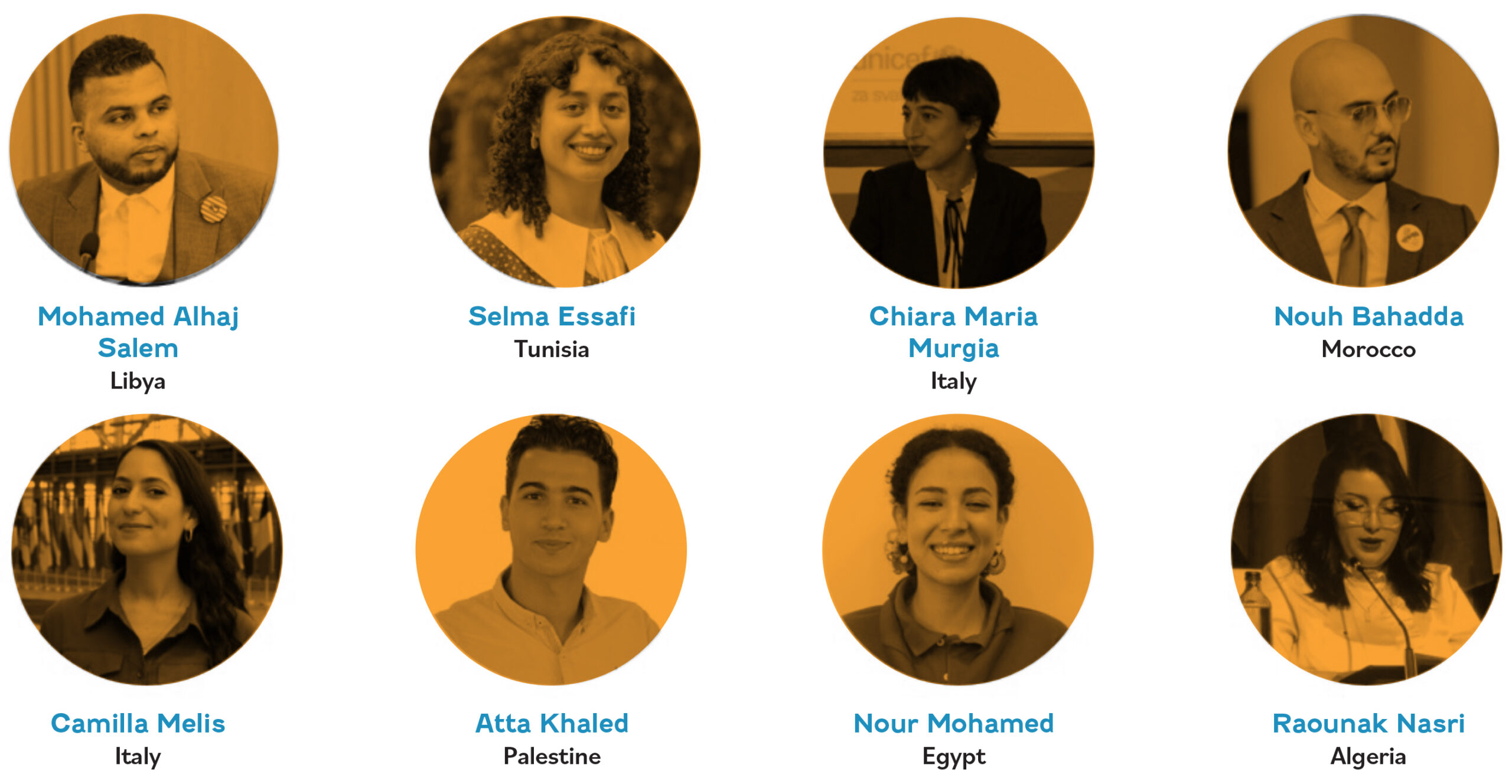
Le PIJ a été élaboré en collaboration avec un groupe de travail sur la jeunesse composé de huit membres représentant l’Algérie, l’Égypte, l’Italie, la Libye, le Maroc, la Palestine et la Tunisie.
Nommés par l’UpM, ses partenaires et les conseils de la jeunesse, les membres du groupe de travail ont joué un rôle de caisse de résonance stratégique tout au long du processus : ils ont examiné la méthodologie, animé des discussions de groupe avec des organisations de la société civile dirigées par des jeunes et façonné l’architecture finale du Plan.
Ancré dans des cadres régionaux et internationaux
Le PIJ s’aligne sur trois cadres de référence clés :

