
• English
  • Français
  • العربية
Follow us
Union for the Mediterranean – UfMUnion for the Mediterranean – UfMUnion for the Mediterranean – UfMUnion for the Mediterranean – UfM
  • Who we are
    • The Union for the Mediterranean is an intergovernmental institution bringing together the European Union Member States and 16 countries from the Southern and Eastern shores of the Mediterranean to promote dialogue and cooperation.

      OVERVIEW   

    • Who we are

      • Member States
      • Meet the team
      • Partners
      • History

      Transparency and accountability

      • Transparency and access to information
      • Investigating fraud, corruption and misconduct
    • Key documents

      UfM Institutional Brochure UfM How we work

      More documents   

  • What we do
    • The UfM seeks to enhance regional cooperation, dialogue and the implementation of concrete projects and initiatives with tangible impact on our citizens to address three strategic objectives: human development, stability and integration.

      OVERVIEW   

    • Inclusive development

      • Economic Development and Employment
      • Higher Education & Research
      • Social & Civil Affairs

      Sustainable development

      • Water, Environment and Blue Economy
      • Transport & Urban Development
      • Energy & Climate Action

      Initiatives that build bridges

      • Day of the Mediterranean
      • Mediterranean Capitals of Culture and Dialogue
    • How we work

      • Policy Frameworks
      • Regional Platforms
      • Projects and Initiatives
  • Work with us
    • The UfM Secretariat is the operational platform of the Union for the Mediterranean. The staff of the UfM is made of more than 17 nationalities working in a multicultural environment that fosters cooperation and intercultural communication and exchange.

    • Work with us

      • Vacancies
      • Secondments
      • Internships
      • Procurement
  • Info centre
    • Find our latest press releases, press invitations, visual identity, key institutional documents, photos and other relevant information


      DOWNLOAD THE UfM VISUAL IDENTITY GUIDELINES AND LOGOS (ZIP FILE)   

    • Info centre

      • Media corner
      • News
      • Agenda
      • Publications and key documents
      • Stories of Euro-Mediterranean Cooperation
    • UfM in the Media

      9 May 2026 – Agence Europe (EN) – The fire season that never ends – by Joan Borrell Mayeur
      View article
      9 May 2026 – Agence Europe (FR) – Une saison des feux qui n’en finit pas – par Joan Borrell Mayeur
      View article
      7 May 2026 – Al-Dustour – حرائق غابات المتوسط على وشك أن تبدأ مجدداً… بلا حدود
      View article
  • Contact

The WoRTH Project : Women’s Right to Health

Social & Civil Affairs
Labelled projects
Completed

Context and objectives

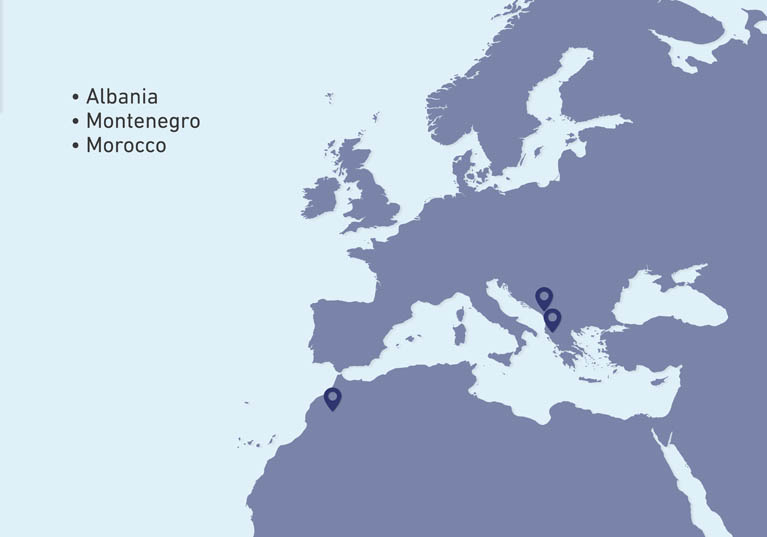
The WoRTH project aims to reduce the incidence of and mortality from breast and cervical cancers in Albania, Montenegro and Morocco, through a comprehensive screening strategy. It will be developed in accordance with national public policies and in close coordination with national health authorities and local healthcare practitioners.

The growing impact of breast and cervical cancers on the 15 countries of the Southern and Eastern shores of the Mediterranean is a major concern. In these countries, incidence and mortality rates of both cancers have been increasing over the past decades. Every year, over 212,000 women are diagnosed with breast cancer, and 19,000 with cervical cancer, while 62,200 and 7,800 respectively succumb to the disease.

With a budget of €4.16 million over 4 years, this project encourages the introduction of a multidimensional and gender-sensitive approach to cervical and breast cancer prevention, focusing on existing policies and delivered services (e.g. primary healthcare facilities, family planning clinics, etc.). The overall aim is to reduce delays to cancer diagnosis and premature deaths, as well as the socio-economic impact of cancer. The project will also encourage in-country and regional cooperation through a cancer-prevention network. This will foster the exchange of information, best practices, and cancer prevention strategies tailored to local realities.

Within the scope of the project, over 45,000 disadvantaged women (aged 25-65) are expected to be tested for cervical and breast cancer and to be educated on the importance of cancer prevention, and more than 300 healthcare professionals and other stakeholders involved in early detection/screening programmes will be trained.

Location
Key figures

Duration:

2016–2020

Beneficiaries:

45K women

Total cost:

€ 4.16M

Countries:

3

Financial contribution

€455,500 – Promoter

€400,000 – Participating countries

€100,000 – The Italian Ministry of Health

€150,000 – Institut National du Cancer, France

Promoter

The Centre for Epidemiology and Prevention of Cancer in Piedmont (CPO) is the lead promotor and has 20 years’ experience in cancer prevention, collaborating with national and international organisations (the World Health Organisation, the International Agency for Research on Cancer, and the European Commission). In May 2014, the CPO was named a WHO Collaborating Centre for Early Detection and Screening of Cancer.

Key partners

Ministry of Health Albania

Ministry of Health Montenegro

Ministry of Health Morocco

Beneficiaries

Women, particularly disadvantaged women living in vulnerable situations, who will be given free access to cancer screening.

National ministries, healthcare professionals and other relevant stakeholders, in particular those working in detection/screening programmes.

Civil society and women’s associations that are committed to women’s health.

Key actions

Analyses of national contexts to assess economic, social and epidemiological conditions and the legal framework for planning and implementing a suitable early cancer detection programme.

Development of national networks of decision makers, healthcare professionals and community organisations active in cervical and breast cancer control.

Implementation of a multidimensional cervical and breast cancer early-detection programme for the benefit of disadvantaged women in two different areas in each country (urban and rural), through the DNA Human Papilloma Virus test and clinical breast examinations.

Raising awareness among women on the risks of cervical and breast cancer.

Training of healthcare professionals and other relevant stakeholders (e.g. decision makers) involved in early detection/screening programmes.

Strengthening Mediterranean networks of cervical and breast cancer screening programmes to promote research and cooperation.

Results

National diagnostics on cervical and breast cancer screening.

45,000 women will be offered a test for cervical (25-65 years old) and breast (40-65 years old) cancer and will be made aware of the risks and the importance of prevention.

At least 15 training sessions for more than 300 beneficiaries including policy makers, healthcare professionals and other relevant actors, as well as 12 tutoring actions and several training activities offered by EU centres dealing with cancer prevention and screening.

National networks of decision makers, health professionals and active community bodies will be created.

Existing Mediterranean networks for the early detection and screening of cervical and breast cancer will be strengthened.

Related news

The UfM advocates for early screenings with the project WoRTH, planning to test 45,000 women for cervical and breast cancer, train over 300 health professionals and a new gender sensitive study
Social & Civil Affairs
Meeting of Women’s Right to Health – WoRTH Project, for early cancer detection and screening
Social & Civil Affairs

Share this:

Printable version

Who we are

  • Member States
  • Meet the team
  • Partners
  • History
  • Transparency and accountability
  • Transparency and access to information
  • Investigating fraud, corruption and misconduct

What we do

  • Economic Development & Employment
  • Higher Education & Research
  • Social & Civil Affairs
  • Water, Environment and Blue Economy
  • Transport & Urban Development
  • Energy & Climate Action
  • Day of the Mediterranean
  • Mediterranean Capitals of Culture and Dialogue

How we work

  • Policy Framework
  • Regional Platforms
  • Projects and Initiatives

Work with us

  • Vacancies
  • Secondments
  • Internships
  • Procurement

Info centre

  • Media corner
  • News
  • Agenda
  • Publications and key documents
  • Stories of Euro-Mediterranean Cooperation
  • Photo gallery
  • Video gallery
Co-financed by the European Union
  • Who we are
    • Member States
    • Meet the team
    • Partners
    • History
    • Transparency and accountability
      • Transparency and access to information
      • Investigating fraud, corruption and misconduct
  • What we do
    • Economic Development and Employment
    • Higher Education & Research
    • Social & Civil Affairs
    • Water, Environment and Blue Economy
    • Transport & Urban Development
    • Energy & Climate Action
  • Initiatives that build bridges
    • Day of the Mediterranean
    • Mediterranean Capitals of Culture and Dialogue
  • How we work
    • Policy Framework
    • UfM Regional Platforms
    • Projects and Initiatives
  • Work with us
    • Vacancies
    • Secondments
    • Internships
    • Procurement
    • Roster of experts
  • Info centre
    • Media center
    • News
    • Agenda
    • Publications and key documents
    • Human Stories of the Mediterranean
  • Contact
  • Social media
    • Facebook
    • Twitter
    • Youtube
    • Linkedin
    • Flickr
  • English
  • Français
  • العربية
  • English
  • Français
  • العربية
Union for the Mediterranean – UfM


We are using cookies to give you the best experience on our website.

You can find out more about which cookies we are using or switch them off in .

Powered by  GDPR Cookie Compliance
Cookies Overview

This website uses cookies so that we can provide you with the best user experience possible. Cookie information is stored in your browser and performs functions such as recognising you when you return to our website and helping our team to understand which sections of the website you find most interesting and useful.

Read more

Strictly Necessary Cookies

Strictly Necessary Cookie should be enabled at all times so that we can save your preferences for cookie settings.

3rd Party Cookies

This website uses Google Analytics to collect anonymous information such as the number of visitors to the site, and the most popular pages.

Keeping this cookie enabled helps us to improve our website.