• English
  • Français
  • العربية
Follow us
Union for the Mediterranean – UfMUnion for the Mediterranean – UfMUnion for the Mediterranean – UfMUnion for the Mediterranean – UfM
  • Who we are
    • The Union for the Mediterranean is an intergovernmental institution bringing together the European Union Member States and 16 countries from the Southern and Eastern shores of the Mediterranean to promote dialogue and cooperation.

      OVERVIEW   

    • Who we are

      • Member States
      • Meet the team
      • Partners
      • History

      Transparency and accountability

      • Transparency and access to information
      • Investigating fraud, corruption and misconduct
    • Key documents

      UfM Institutional Brochure UfM How we work

      More documents   

  • What we do
    • The UfM seeks to enhance regional cooperation, dialogue and the implementation of concrete projects and initiatives with tangible impact on our citizens to address three strategic objectives: human development, stability and integration.

      OVERVIEW   

    • Inclusive development

      • Economic Development and Employment
      • Higher Education & Research
      • Social & Civil Affairs

      Sustainable development

      • Water, Environment and Blue Economy
      • Transport & Urban Development
      • Energy & Climate Action

      Initiatives that build bridges

      • Day of the Mediterranean
      • Mediterranean Capitals of Culture and Dialogue
    • How we work

      • Policy Frameworks
      • Regional Platforms
      • Projects and Initiatives
  • Work with us
    • The UfM Secretariat is the operational platform of the Union for the Mediterranean. The staff of the UfM is made of more than 17 nationalities working in a multicultural environment that fosters cooperation and intercultural communication and exchange.

    • Work with us

      • Vacancies
      • Secondments
      • Internships
      • Procurement
  • Info centre
    • Find our latest press releases, press invitations, visual identity, key institutional documents, photos and other relevant information


      DOWNLOAD THE UfM VISUAL IDENTITY GUIDELINES AND LOGOS (ZIP FILE)   

    • Info centre

      • Media corner
      • News
      • Agenda
      • Publications and key documents
      • Stories of Euro-Mediterranean Cooperation
    • UfM in the Media

      9 May 2026 – Agence Europe (EN) – The fire season that never ends – by Joan Borrell Mayeur
      View article
      9 May 2026 – Agence Europe (FR) – Une saison des feux qui n’en finit pas – par Joan Borrell Mayeur
      View article
      7 May 2026 – Al-Dustour – حرائق غابات المتوسط على وشك أن تبدأ مجدداً… بلا حدود
      View article
  • Contact

On integration in the Euro-Mediterranean region

By the UfM Secretary General, Nasser Kamel. 

Published in the EU Observer, Al Quds Al Arabi, Público, Al Massae, TSA, L’Orient Le Jour, Le Temps, Al Masry Al Youm, Ad-Dustour and Cinco Dias.

Where should the focus of our attention lie as we emerge cautiously from the worst of the pandemic’s impacts? Plans for post-pandemic recovery are gathering pace and the phrase “building back better” is now widely used. To avoid this becoming nothing more than a slogan, we must be clear about the substance behind these words.

The tight grip the virus has held on our movement and on the economy has given us food for thought. The global fight against COVID-19 has highlighted the limitations of the international community’s capacity to coordinate a global response to some of the other crises and challenges facing our world today. Previously championed supply chains were unable to adapt to restrictions. The reliance on distant sources of production made us vulnerable to shortages and ill-equipped to respond accordingly. The circular migration some industries thrive on, all but came to a halt.

The Union for the Mediterranean (UfM) has long vouched for the need to enhance regional cooperation and integration in the Mediterranean, as detailed in the UfM Roadmap for Action, adopted in 2017. That is why the publication of the 1st Progress Report on Euro-Mediterranean Regional Integration is so timely.

Commissioned by the UfM and prepared by the Organisation for Economic Cooperation and Development, the report focuses on five domains of regional integration – trade, finance, infrastructure, the movement of people, and research and higher education – presenting key findings, clear indicators to follow future progress, and policy recommendations for each of these areas. Critically, it is driven by data that allows us to draw some stark conclusions. The good news is that integration has advanced in the region. Dig a little deeper, though, and the truth is that progress has been slow and remains below its potential in terms of capacities and resources.

Uneven integration across and within sub-regions helps explain this in part. The European Union is still responsible for over 95% of the region’s internal merchandise exports and 93% of the external merchandise exports. The majority of financial exchange in the region involves at least one EU member state, and most scientific co-operation in the region is characterised by North-South interactions, though there are South-South exceptions.

In the 1990s and early 2000s, trade agreements within the Euro-Mediterranean region were perhaps too narrow in scope and lacked the conviction that now drives our ambitions for the sustainable development of our communities. They focused mainly on reducing existing tariffs in the trade of manufactured goods, while not covering trade in services. This is a lost opportunity, as trade in services accounts for 25% of global trade flows today.

Two further important challenges to regional integration are the inadequate infrastructure for transport and energy connectivity, as well as the lack of a common vision on human mobility as a driver of innovation and growth in the region. Indeed, The World Bank estimated in 2020 that over the next five to ten years the MENA region will require investment of over 7% of its annual GDP in the maintenance and creation of infrastructure; while concentrated solar power plants in the region could generate 100 times the combined electricity consumption of MENA and Europe together. Though some progress has been made to facilitate human mobility in the region, further cooperation such as softening visa requirements could enable countries to fully leverage the potential of different forms of mobility, such as tourism, student and researcher exchanges.

On top of these priorities, we must not lose sight of the importance of digitalisation, and the opportunities it unlocks for regional cooperation. Digital transformation is changing global production, trade and foreign investment, and offering more ways to collaborate and participate virtually in science and education. It can be used to lower the cost of remittances – an important part of GDP in many Southern and Eastern Mediterranean economies – as well as improve e-commerce. In 2017, studies reported that only 8% of SMEs in the wider MENA region had an online presence and only 1.5% of the region’s retailers were online.

As we recover, we must leverage the opportunity to create new inclusive societies that ensure young people and women can fulfil their potential as agents of development and contributors to the region’s economy as a whole. Regional integration is of common interest to all and to see meaningful change, we must start to show what we really mean by building back better. As always, at the UfM, we believe that ever more committed cooperation is the only way forward.
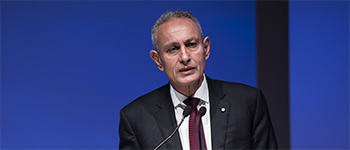
Nasser Kamel

Nasser Kamel is the Secretary General of the Union for the Mediterranean.

Share this:

Latest news

Bridging the digital skills gap and boosting smart e-governance solutions: promoting digital transformation through a UfM Conference in Antalya
21 / 05 / 2026
Call for applications: Research to Business Programme
21 / 05 / 2026
See more

SUBSCRIBE TO OUR NEWSLETTER!


Agenda

11th UfM Regional Platform on Trade, Investment and Industry
03 / 06 / 2026
UfM Senior Officials Meeting (SOM) June 2026
10 / 06 / 2026
See more
Co-financed by the European Union
  • Who we are
    • Member States
    • Meet the team
    • Partners
    • History
    • Transparency and accountability
      • Transparency and access to information
      • Investigating fraud, corruption and misconduct
  • What we do
    • Economic Development and Employment
    • Higher Education & Research
    • Social & Civil Affairs
    • Water, Environment and Blue Economy
    • Transport & Urban Development
    • Energy & Climate Action
  • Initiatives that build bridges
    • Day of the Mediterranean
    • Mediterranean Capitals of Culture and Dialogue
  • How we work
    • Policy Framework
    • UfM Regional Platforms
    • Projects and Initiatives
  • Work with us
    • Vacancies
    • Secondments
    • Internships
    • Procurement
    • Roster of experts
  • Info centre
    • Media center
    • News
    • Agenda
    • Publications and key documents
    • Human Stories of the Mediterranean
  • Contact
  • Social media
    • Facebook
    • Twitter
    • Youtube
    • Linkedin
    • Flickr
  • English
  • Français
  • العربية
  • English
  • Français
  • العربية
Union for the Mediterranean – UfM


We are using cookies to give you the best experience on our website.

You can find out more about which cookies we are using or switch them off in .

Powered by  GDPR Cookie Compliance
Cookies Overview

This website uses cookies so that we can provide you with the best user experience possible. Cookie information is stored in your browser and performs functions such as recognising you when you return to our website and helping our team to understand which sections of the website you find most interesting and useful.

Read more

Strictly Necessary Cookies

Strictly Necessary Cookie should be enabled at all times so that we can save your preferences for cookie settings.

3rd Party Cookies

This website uses Google Analytics to collect anonymous information such as the number of visitors to the site, and the most popular pages.

Keeping this cookie enabled helps us to improve our website.