• English
  • Français
  • العربية
Follow us
Union for the Mediterranean – UfMUnion for the Mediterranean – UfMUnion for the Mediterranean – UfMUnion for the Mediterranean – UfM
  • Who we are
    • The Union for the Mediterranean is an intergovernmental institution bringing together the European Union Member States and 16 countries from the Southern and Eastern shores of the Mediterranean to promote dialogue and cooperation.

      OVERVIEW   

    • Who we are

      • Member States
      • Meet the team
      • Partners
      • History

      Transparency and accountability

      • Transparency and access to information
      • Investigating fraud, corruption and misconduct
    • Key documents

      UfM Institutional Brochure UfM How we work

      More documents   

  • What we do
    • The UfM seeks to enhance regional cooperation, dialogue and the implementation of concrete projects and initiatives with tangible impact on our citizens to address three strategic objectives: human development, stability and integration.

      OVERVIEW   

    • Inclusive development

      • Economic Development and Employment
      • Higher Education & Research
      • Social & Civil Affairs

      Sustainable development

      • Water, Environment and Blue Economy
      • Transport & Urban Development
      • Energy & Climate Action

      Initiatives that build bridges

      • Day of the Mediterranean
      • Mediterranean Capitals of Culture and Dialogue
    • How we work

      • Policy Frameworks
      • Regional Platforms
      • Projects and Initiatives
  • Work with us
    • The UfM Secretariat is the operational platform of the Union for the Mediterranean. The staff of the UfM is made of more than 17 nationalities working in a multicultural environment that fosters cooperation and intercultural communication and exchange.

    • Work with us

      • Vacancies
      • Secondments
      • Internships
      • Procurement
  • Info centre
    • Find our latest press releases, press invitations, visual identity, key institutional documents, photos and other relevant information


      DOWNLOAD THE UfM VISUAL IDENTITY GUIDELINES AND LOGOS (ZIP FILE)   

    • Info centre

      • Media corner
      • News
      • Agenda
      • Publications and key documents
      • Stories of Euro-Mediterranean Cooperation
    • UfM in the Media

      9 May 2026 – Agence Europe (EN) – The fire season that never ends – by Joan Borrell Mayeur
      View article
      9 May 2026 – Agence Europe (FR) – Une saison des feux qui n’en finit pas – par Joan Borrell Mayeur
      View article
      7 May 2026 – Al-Dustour – حرائق غابات المتوسط على وشك أن تبدأ مجدداً… بلا حدود
      View article
  • Contact

Food systems transformation – Processes and pathways in the Mediterranean – A stocktaking exercise

As in many parts of the world, food systems across the Mediterranean are not on track to deliver on food security, nutrition and sustainability outcomes: food systems are the main drivers of environmental degradation, and they are failing to provide decent livelihoods to large parts of the population in a context of increasing disparities and the advent of climate breakdown. These unprecedented challenges are complex and deeply interrelated, affecting the food security, health, nutrition, sustainability, and thus the livelihoods of all people across the Mediterranean. Food systems therefore require solutions that are systemic and dynamic, and which go beyond single disciplinary approaches to actively engage the voices of all food systems stakeholders. However, countries do have common precious heritage, such as the Mediterranean diet, which constitutes a powerful lever for bridging food consumption and production to accelerate food systems transformation in the whole region.

Globally, food systems have been recognized as being a key entry point for achieving the ambitious goals of the 2030 Agenda for Sustainable Development. It is against this background that the United Nations Secretary-General convened the Food Systems Summit (UNFFS) on 23 September 2021 to deliver progress on all 17 Sustainable Development Goals through a food systems approach, leveraging the interconnections within food systems to address global challenges such as hunger, climate change, poverty and inequality. The Summit and its preparatory process have set the stage for food systems transformation across the globe, which was also reflected in the Mediterranean region. In this context, a number of Food Systems Summit Dialogues (FSSDs) were organized across the Mediterranean, allowing a broad and diverse range of stakeholders to explore the challenges faced in food systems, reflect on the Summit’s objectives, and learn from the perspective of other participants in order to make change happen.

Tackling food systems transformation in the Mediterranean region requires considering sustainable food systems as a whole, rather than their separate parts, and going beyond disciplinary approaches and silos. Policy-makers have to take into consideration a web of interconnected and interdependent components within a decision-making environment concerning food systems that is very fragmented, and where there is a wide range of voices from different interest groups and agendas, with diverse institutional and agro-ecological constraints in countries and territories on all shores of the Mediterranean.

Within this setting, the Food and Agriculture Organization of the United Nations, the International Center for Advanced Mediterranean Agronomic Studies, and the Union for the Mediterranean have joined forces to enhance regional dialogue and cooperation on food systems transformation in the Mediterranean through a multi-stakeholder initiative, the Sustainable Food Systems in the Mediterranean (SFS-MED) Platform. This initiative aims to foster the sense of community needed to engage countries and stakeholders across the Mediterranean, including post-Summit efforts, offering a forum for dialogue and multi-stakeholder exchange, and promoting flagship projects, investments and regional cooperation on data sharing, science diplomacy and innovation.

As part of this effort, this publication takes stock of common challenges, priorities and opportunities specific to the Mediterranean context, as reflected in the great number of FSSDs that took place in the region, as well as national pathways, and the statements delivered by Member States during the Pre-Summit, the UNFSS and other related events. The stocktaking exercise concludes by suggesting potential areas of collaboration between regional stakeholders and proposing possible next steps to move towards the implementation of pathways to transform agri-food systems. The recently developed SFS-MED Platform is also set to play a key role in assisting countries in this process.

It is crucial that the momentum generated between 2020 and 2021 by the Food Systems Summit does not come to a halt. This publication is part of the follow-up process and aims to help countries and stakeholders to maximize their efforts towards food systems transformation in the Mediterranean region, ultimately accelerating progress on the delivery of the 2030 Agenda for Sustainable Development, leaving no one behind.

Copyright: FAO, CIHEAM and UfM, 2021

January 2022
 

PDF  

…Other publications you may like

Water-Energy-Food-Ecosystems (WEFE) Nexus Strategy in the Mediterranean Source to Sea Continuum
Strategic Framework for Digital Transformation of the Water Sector
UfM Recommendations on Water Finance
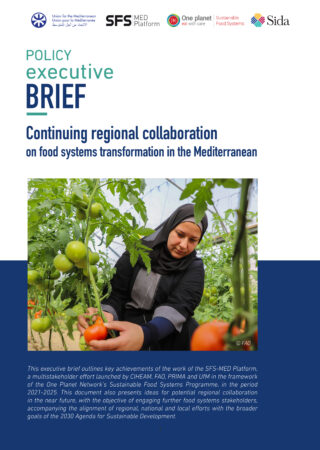
Policy Brief executive – Continuing regional collaboration on food systems transformation in the Mediterranean

Who we are

  • Member States
  • Meet the team
  • Partners
  • History
  • Transparency and accountability
  • Transparency and access to information
  • Investigating fraud, corruption and misconduct

What we do

  • Economic Development & Employment
  • Higher Education & Research
  • Social & Civil Affairs
  • Water, Environment and Blue Economy
  • Transport & Urban Development
  • Energy & Climate Action
  • Day of the Mediterranean
  • Mediterranean Capitals of Culture and Dialogue

How we work

  • Policy Framework
  • Regional Platforms
  • Projects and Initiatives

Work with us

  • Vacancies
  • Secondments
  • Internships
  • Procurement

Info centre

  • Media corner
  • News
  • Agenda
  • Publications and key documents
  • Stories of Euro-Mediterranean Cooperation
  • Photo gallery
  • Video gallery
Co-financed by the European Union
  • Who we are
    • Member States
    • Meet the team
    • Partners
    • History
    • Transparency and accountability
      • Transparency and access to information
      • Investigating fraud, corruption and misconduct
  • What we do
    • Economic Development and Employment
    • Higher Education & Research
    • Social & Civil Affairs
    • Water, Environment and Blue Economy
    • Transport & Urban Development
    • Energy & Climate Action
  • Initiatives that build bridges
    • Day of the Mediterranean
    • Mediterranean Capitals of Culture and Dialogue
  • How we work
    • Policy Framework
    • UfM Regional Platforms
    • Projects and Initiatives
  • Work with us
    • Vacancies
    • Secondments
    • Internships
    • Procurement
    • Roster of experts
  • Info centre
    • Media center
    • News
    • Agenda
    • Publications and key documents
    • Human Stories of the Mediterranean
  • Contact
  • Social media
    • Facebook
    • Twitter
    • Youtube
    • Linkedin
    • Flickr
  • English
  • Français
  • العربية
  • English
  • Français
  • العربية
Union for the Mediterranean – UfM


We are using cookies to give you the best experience on our website.

You can find out more about which cookies we are using or switch them off in .

Powered by  GDPR Cookie Compliance
Cookies Overview

This website uses cookies so that we can provide you with the best user experience possible. Cookie information is stored in your browser and performs functions such as recognising you when you return to our website and helping our team to understand which sections of the website you find most interesting and useful.

Read more

Strictly Necessary Cookies

Strictly Necessary Cookie should be enabled at all times so that we can save your preferences for cookie settings.

3rd Party Cookies

This website uses Google Analytics to collect anonymous information such as the number of visitors to the site, and the most popular pages.

Keeping this cookie enabled helps us to improve our website.