
Winners of the UfM Student Competition 2025 Exploring Mediterranean Urban Solutions to Climate Change and Resilience
Barcelona, February 2026. We are pleased to announce the winners of the “UfM Student Competition on Urban Design 2025”, launched under the UfM Network of Schools of Architecture and Urban Design, to contribute in the international recognition of the youth working on concrete projects in environmental and climate action through urban design.
After reviewing 48 proposals from 13 UfM countries, and 32 different universities, the jury announced the winners of the “UfM Student Competition on Urban Design 2023” First, Second and Third Prizes, as well as the two winning Mentions.
The Jury praised the high quality of the project entries, which made the selection process both challenging and exciting. The Jury looks forward to evaluating the lessons learned from this edition of the award and build on them to make the next iterations even better.
Results of the UfM Student Competition 2025 Exploring Mediterranean Urban Solutions to Climate Change and Resilience
1st Prize (5000 € awarded by the UfM)
Title – SUNKEN
Project Team – Martina Cutillo, Elena Pagliuso, Valentina Santoro, Rebeca Temperanza
University – Università IUAV di Venezia
Country – Italy
2nd Prize (3000 € awarded by the UfM)
Title – V-LIVE. REGENERATING VJOSA: A LIVING CORRIDOR FOR EUROPE’S LAST WILD RIVER
Project Team – Erva Sala
University – POLIS University
Country – Albania
3rd Prize (2000 €)
Title – METAMORFOSIS BESOS
Project Team – Álvaro Rosell Serrano
University – Universitat Politècnica de Catalunya (UPC)
Country – Spain
Mention (500 € awarded by the UfM)
Title – GROWING IN THE CITY
Project Team – Juliet Charbonnier, Amélie Andreani
University – ENSA Marseille
Country – France
Mention (500 € awarded by the UfM)
Title – KM0. MERGE NATURE, COUNTRYSIDE AND CITY
Project Team – Vincent de Gasperí, Ariadna Garriga Ballarín
University – Universitat Politècnica de Catalunya (UPC)
Country – Spain
Mention (500 € awarded by the UfM)
Title – CO-EXISTANCE: FUTURE PROSPECTIVE FOR THE ENERGY LANDSCAPE OF THE TAGLIAMENTO
Project Team – Camilla Bacchin, Giorgia Pompermaier, Fabio Toninato
University – Università IUAV di Venezia
Country – Italy
Mention (500 € awarded by the UfM)
Title – LIVING STREAMS
Project Team – Nora Mulet Jordan, Natasha Menorca Hidalgo, Marc Vendrell Puig
University – Universitat Politècnica de Catalunya (UPC)
Country – Spain
Mention (500 € awarded by the UfM)
Title – INHABITED TRANSITION: COEXISTING WITH URBAN RENEWAL WORKS IN THE ‘THREE WINDOWS’ HOUSING OF MARSEILLE
Project Team – Eva-Luz Sanchez
University – ENSA Marseille
Country – France
1st Prize
SUNKEN
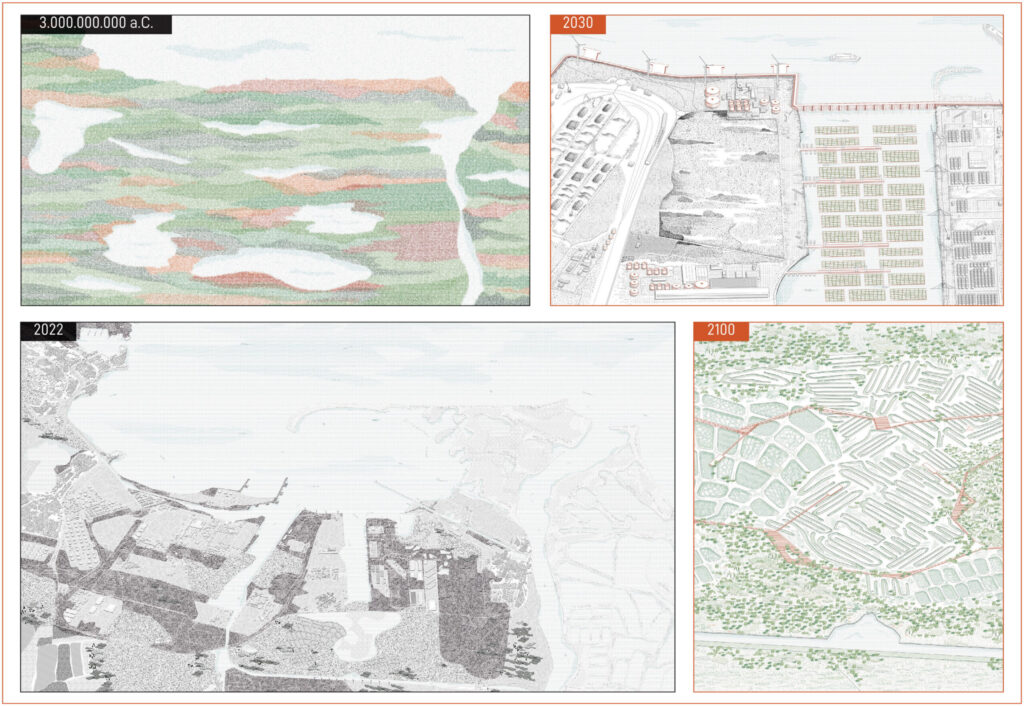
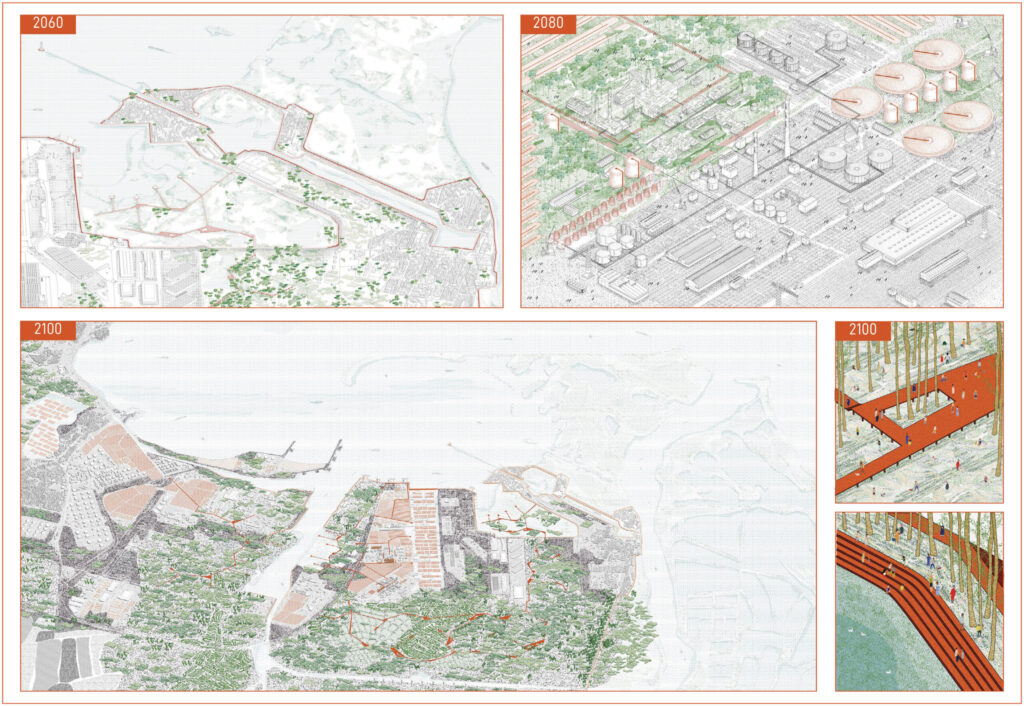
The project is located in southern France, in the industrial zone of Fos-sur-Mer, overlooking the Mediterranean; it responds to current and future challenges. In the Anthropocene, humanity has altered major systems, decisively influencing global ecology and pushing the planet beyond its natural limits. The consequences are already visible today and will intensify in future scenarios: coastal cities may be partially submerged and urban centres near industrial poles will be abandoned due to severe pollution. Through a network of territorial interventions, the project aims at spatial transformation and protection. A series of actions unfolds chronologically by priority until 2100, including industrial reconversion, biomass production in tanks and photobioreactors for energy transition, construction of dams and dikes against sea level rise, and creation of natural soil phyto-purification systems.
The territory, fragmented in 2022 with a clear distinction between urban, industrial, and natural areas, becomes by 2100 a cohesive system where different contexts merge into an articulated network. Each area relates organically to the others, generating a complexity that revolutionizes our imaginary future. This new world emerges from nature reclaiming its spaces and a production system founded on renewed environmental awareness, transforming what was once divided into an integrated landscape, where human infrastructure and natural processes coexist in dynamic equilibrium.
2nd Prize
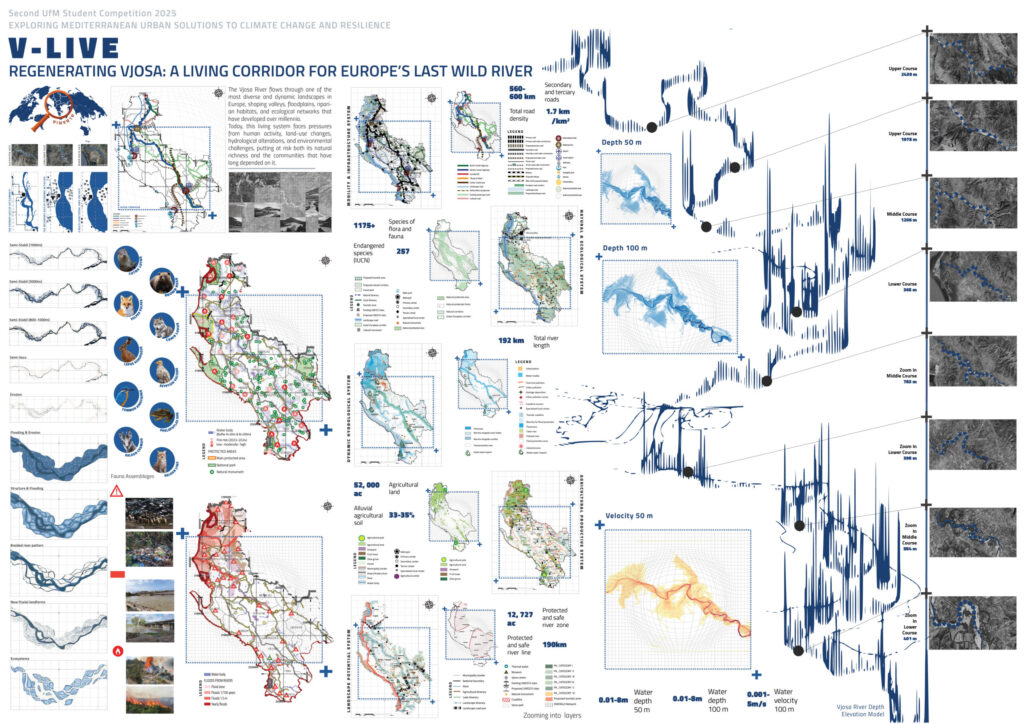
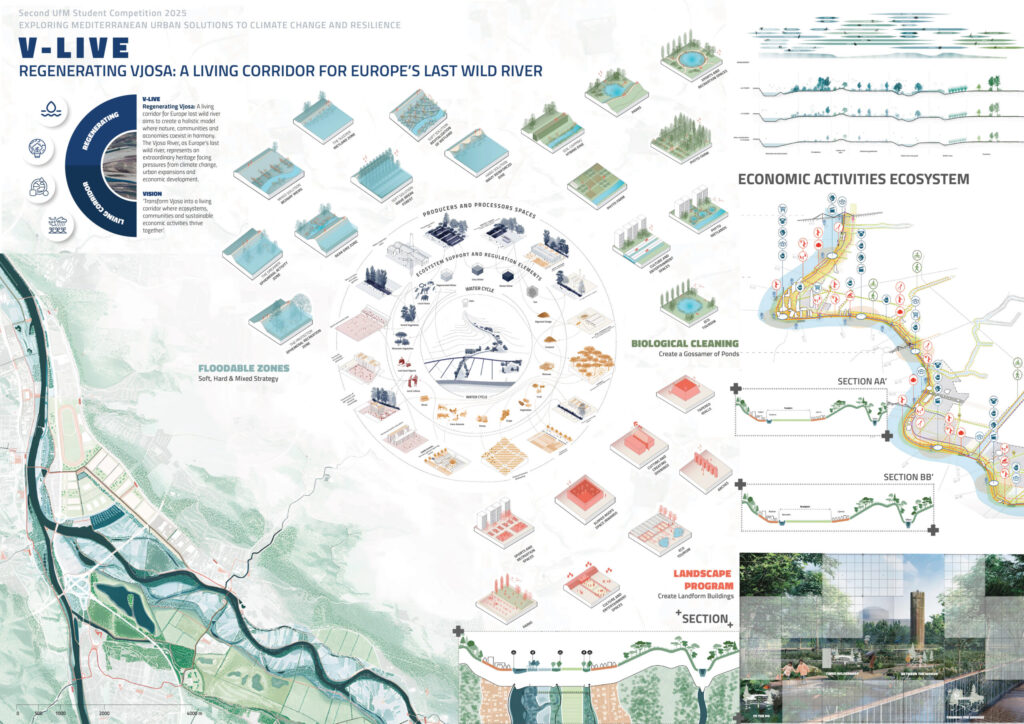
V-LIVE. REGENERATING VJOSA: A LIVING CORRIDOR FOR EUROPE’S LAST WILD RIVER
Across the Vjosa Valley, nature, culture, and community life intersect in ways that are both fragile and deeply compelling. Europe’s last wild river moves freely through a landscape shaped by seasonal floods, agricultural rhythms and long-standing local traditions. This project builds on that complexity, offering a vision where the river’s natural intelligence becomes the foundation for long-term resilience and sustainable development. The approach focuses on reinforcing ecological processes rather than replacing them. Restored wetlands, biological cleaning ponds, and adaptive floodplains allow water to move, filter, and breathe naturally while protecting nearby settlements and strengthening biodiversity.
These elements form a coherent environmental backbone that supports the valley without constraining its character. Alongside this, the initiative introduces new community-oriented opportunities: eco-tourism routes, small-scale production spaces, and educational nodes that connect people directly to the river’s seasonal cycles. Each intervention is shaped with care for the Mediterranean morphology of the valley, ensuring that innovation respects place-based identity. Together, these layers create a framework that is both pragmatic and aspirational one that positions the Vjosa as a living corridor where environmental integrity and human futures evolve in balance.
3rd Prize
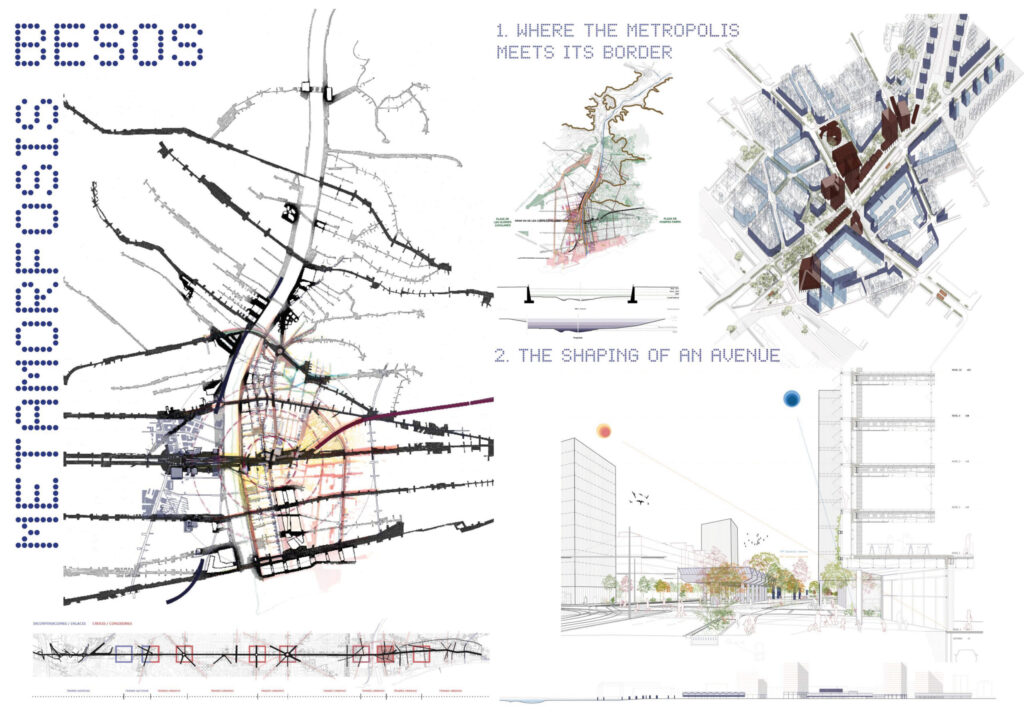
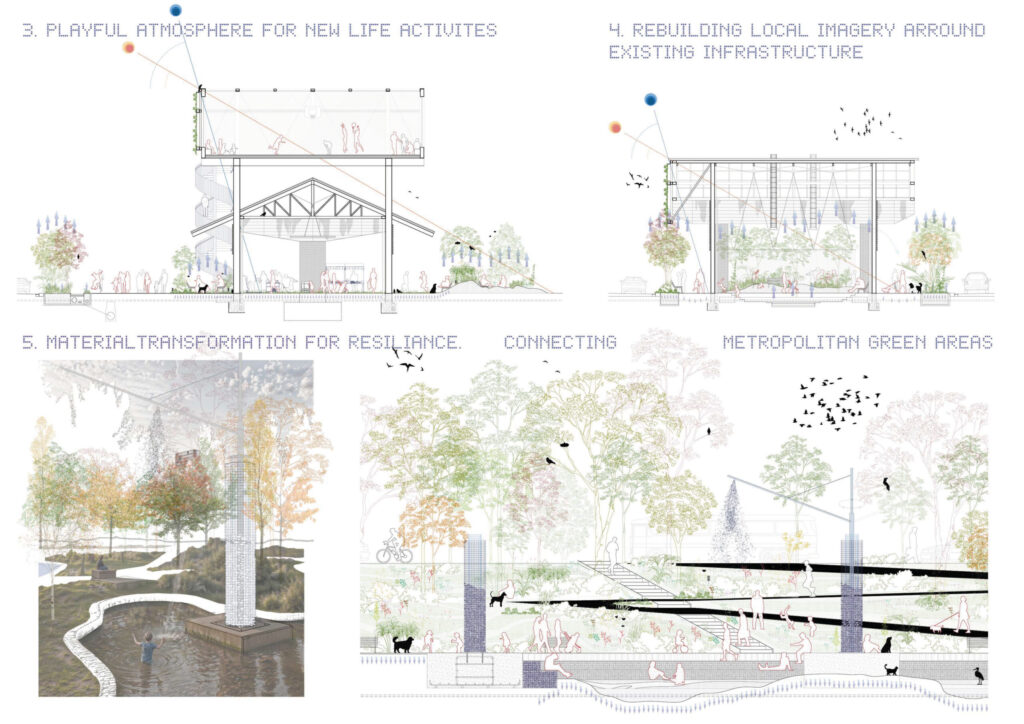
METAMORFOSIS BESOS
The Besòs emerges today as a laboratory where the memories of Barcelona’s industrial expansion intersect with contemporary urgencies of climate resilience, offering innovative solutions that enhance urban quality in the Mediterranean context. If in the nineteenth century the demolition of medieval walls and the installation of industrial estates enabled the city’s growth, this same territory – where resides of modern infrastructures still operate as scars – now allows the metropolis to be rethought as an organism in perpetual mutation and in dialogue with Mediterranean cultural and morphological specificities. The proposal subverts the imaginary of a degraded periphery to place the river at the centre of a new metropolitan narrative. Dismantling the infrastructural logic that confines it not only opens physical space but releases a transformative potential. The river becomes an active subject capable of shaping centralities, producing hybrid landscapes, and articulating new relations between bodies, technique, and territory, contributing to the SDGs throwg cultural, social, economic, and environmental sustainability. In this framework, mutation ceases to be a threat and becomes the project’s guiding principle: former barriers turn into green corridors, interstitial areas become spaces of exchange, and obsolete infrastructures are the support for new urban vitalities.
1st MENTION
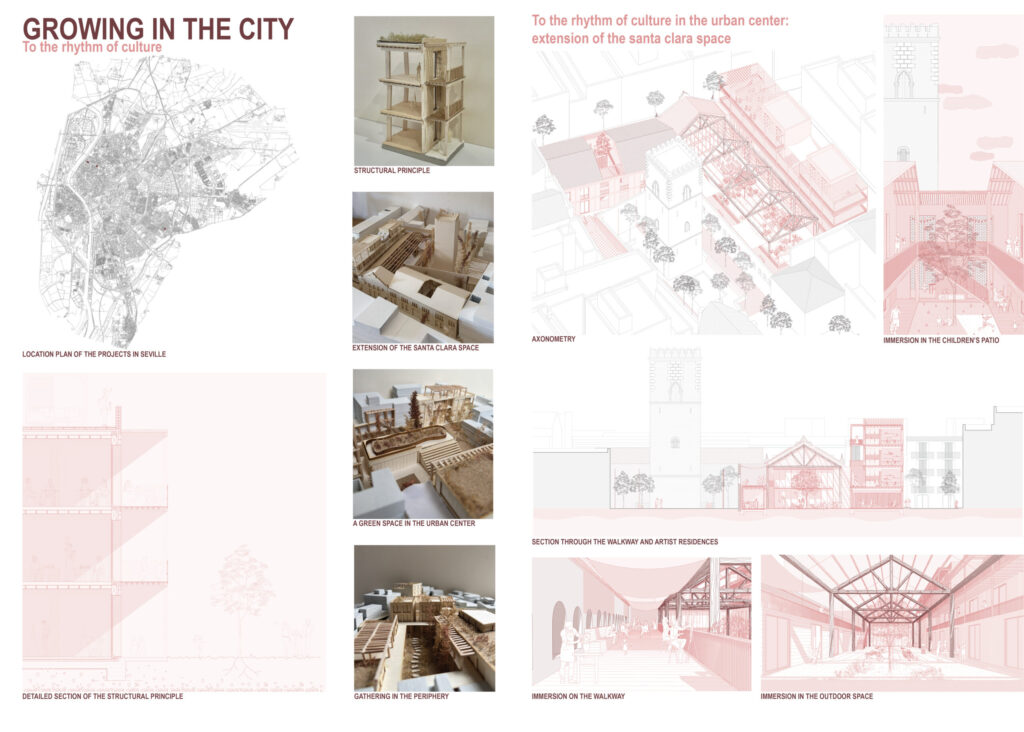
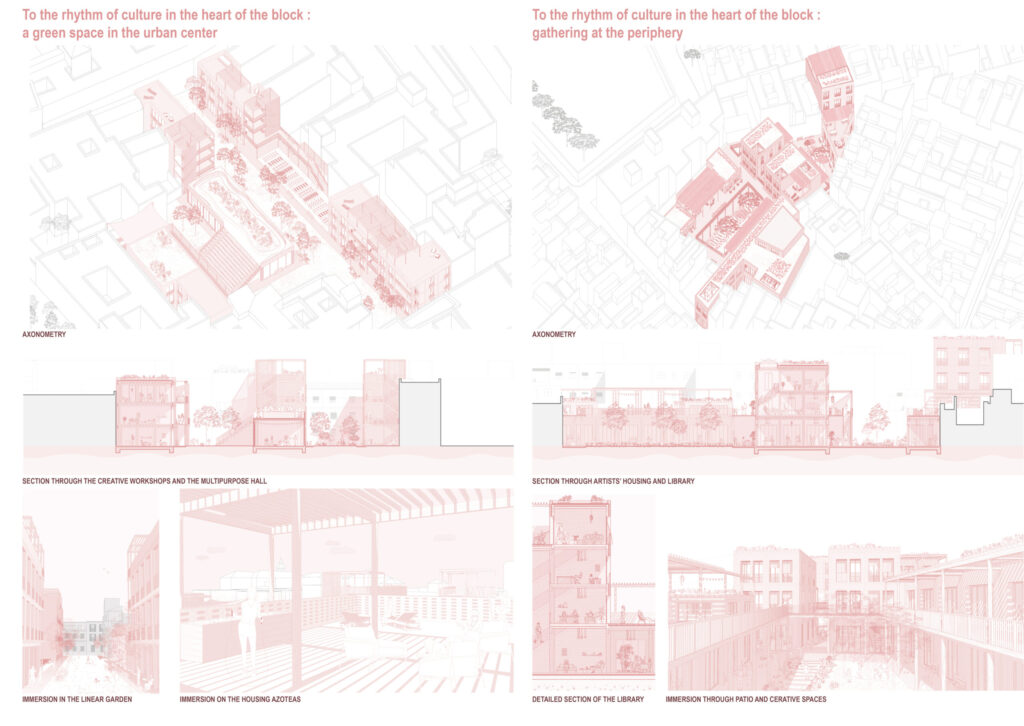
GROWING IN THE CITY”
This final-year project is rooted in Seville, a Mediterranean city marked by climate warming, strong tourism pressure, a process of gentrification, and a progressive loss of local cultural ownership by its inhabitants. In response to these issues, the project proposes rethinking the place of culture in the city, not as a tourist product, but as a vector of social connection, transmission, and territorial anchoring. The project aims to create open, accessible spaces designed for Sevillians, in order to rebuild a living cultural fabric in the heart of the city. It develops across several neglected interstitial spaces, each facing different pressures and challenges, following a model that adapts to the morphologies and issues of the neighborhoods. It relies on programmatic, material, and architectural coherence, integrating local specificities to adapt to the climate. Drawing on the forms and craftsmanship of Andalusian architecture such as patios, zaguanes, azoteas, and traditional materials, the project proposes a porous, climate-responsive architecture connected to its context and uses. It addresses contemporary challenges such as climate change adaptation, the fight against the museumification of historic centers, and tourism. It also responds to the need to rebuild connections between inhabitants, culture, and territory by creating spaces for intergenerational and interdisciplinary exchange.
2nd MENTION
KM0. MERGE NATURE, COUNTRYSIDE AND CITY
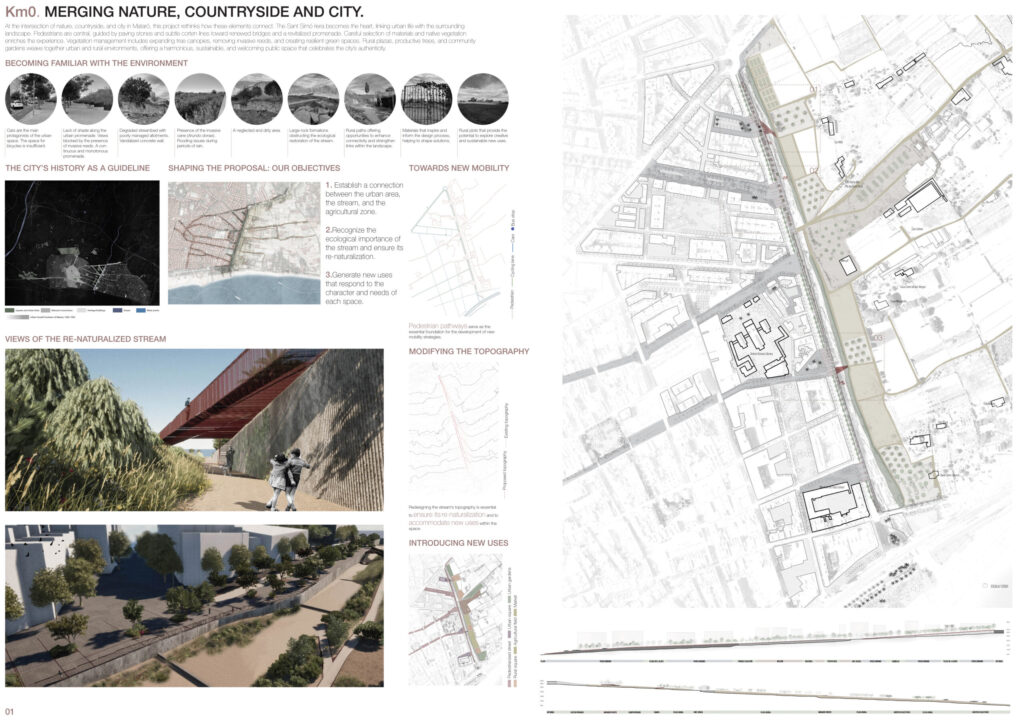
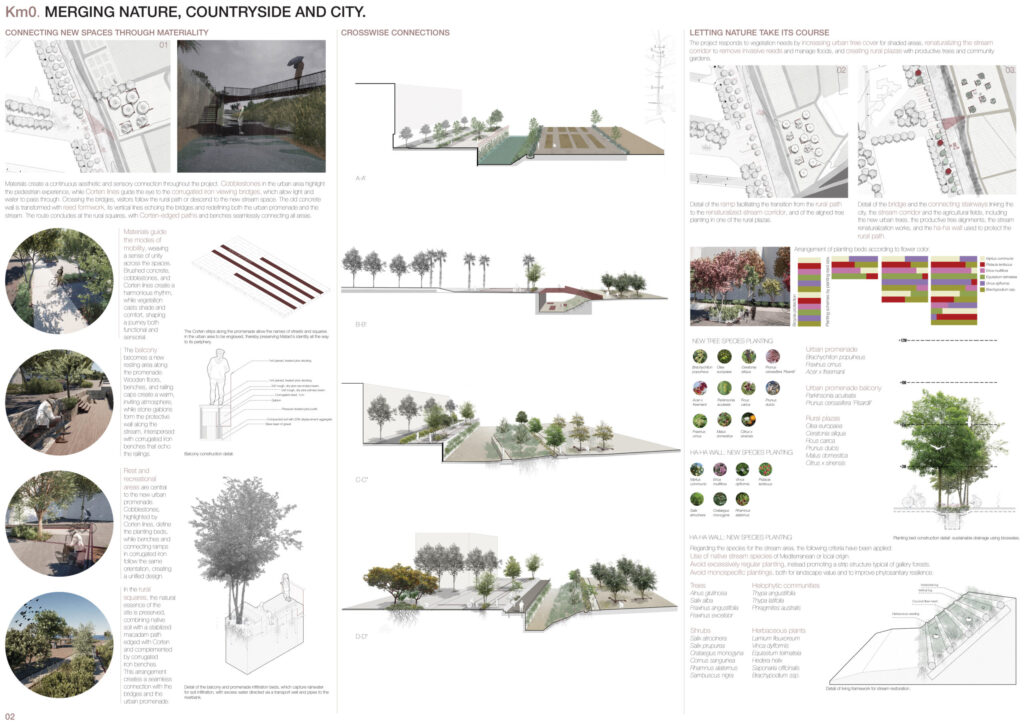
Where nature, countryside, and the city of Mataró converge, this project reawakens their dialogue, celebrating the authenticity of each. The Sant Simó stream forms the heart of the design, a living spine connecting the urban fabric to the richness of the surrounding landscapes, inviting pedestrians to explore the space as central participants. The urban area is transformed through subtle interventions: cobblestones trace the pedestrian path, corten lines mark transitions, and corrugated iron bridges span the renewed promenade, guiding movement while structuring the visual narrative. Vegetation enlivens the space. Expanded tree canopies provide shade, invasive reeds are removed, and native species are planted to foster resilience and sustainability. The renaturalized stream becomes a versatile, multi-sensory landscape, while rural squares, productive tree alignments, and shared cultivation areas weave the urban and rural into harmony. Every material, plant, and detail is chosen to enrich the visitor’s experience, transforming the site into more than a passage: a space where city, nature, and countryside coexist in balance. This project embodies ecological, social, and aesthetic values, offering a living landscape that engages, inspires, and reconnects people with their environment.
3rd MENTION
CO-EXISTANCE: FUTURE PROSPECTIVE FOR THE ENERGY LANDSCAPE OF THE TAGLIAMENTO
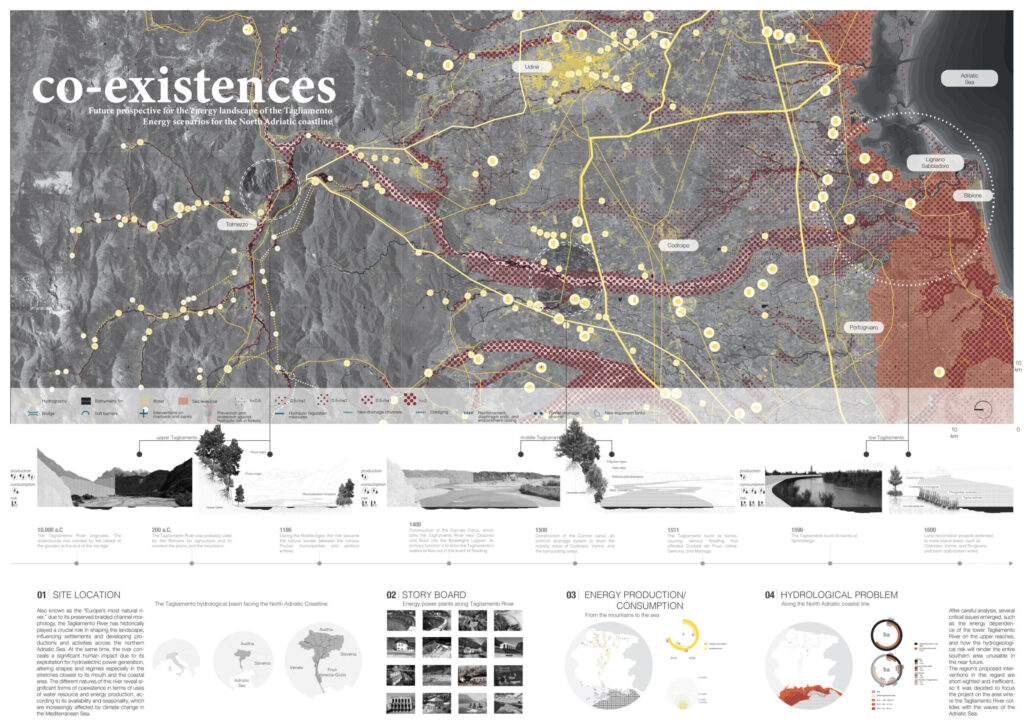
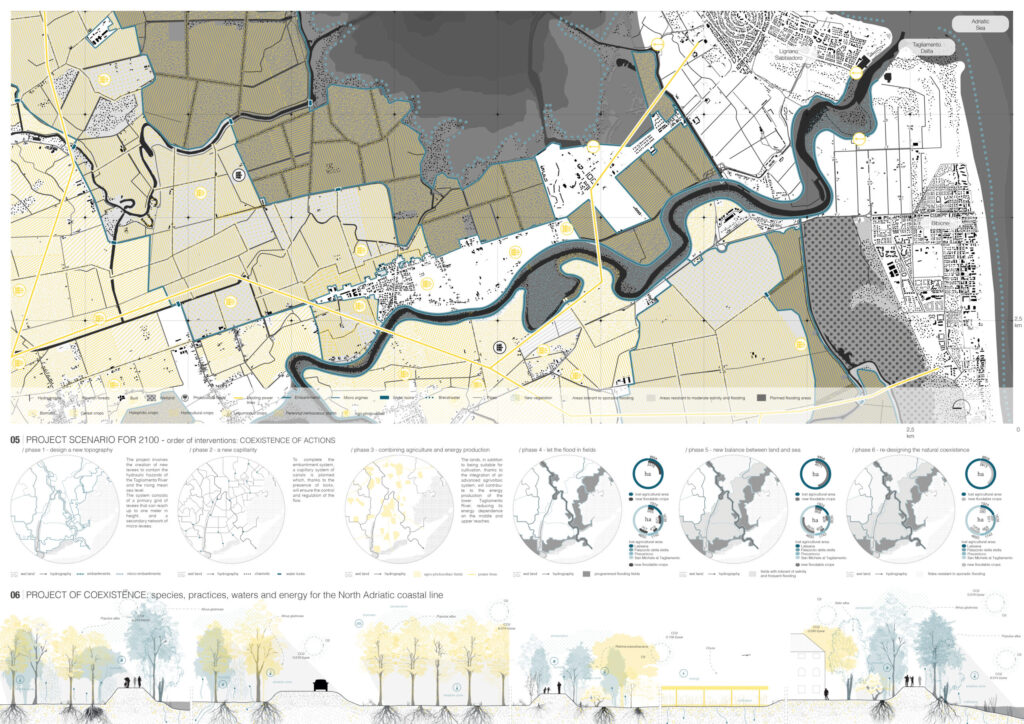
Coexistence toward a Northen Adriatic Scenario Also known as the “Europe’s most natural river,” due to its preserved braided channel morphology, the Tagliamento River has historically played a crucial role in shaping the landscape, influencing settlements and developing productions and activities across the northern Adriatic Sea. The river conceals a significant human impact due to its exploitation for hydroelectric power generation, altering shapes and regimes especially in the stretches closest to its mouth and the coastal area. The different natures of this river reveal significant formes of coexistence in terms of uses of water resource and energy production, according to its availability and seasonality, which are increasingly affected by climate change. How could the ecological features of this river be combined to the energy production in the perspective of a broad sea level rise scenario? The territorial de-sign thesis explores different degrees of Coexistences using data and case studies to analyze and describe the various spatial issues that still coexist and how they may or not continue to coexist, in a scenario where anthropogenic pressures linked to future energy production perspectives are rooted in a context of growing energy demand and profound uncertainty closely linked to the Med-iterranean Sea.
4th MENTION
LIVING STREAMS
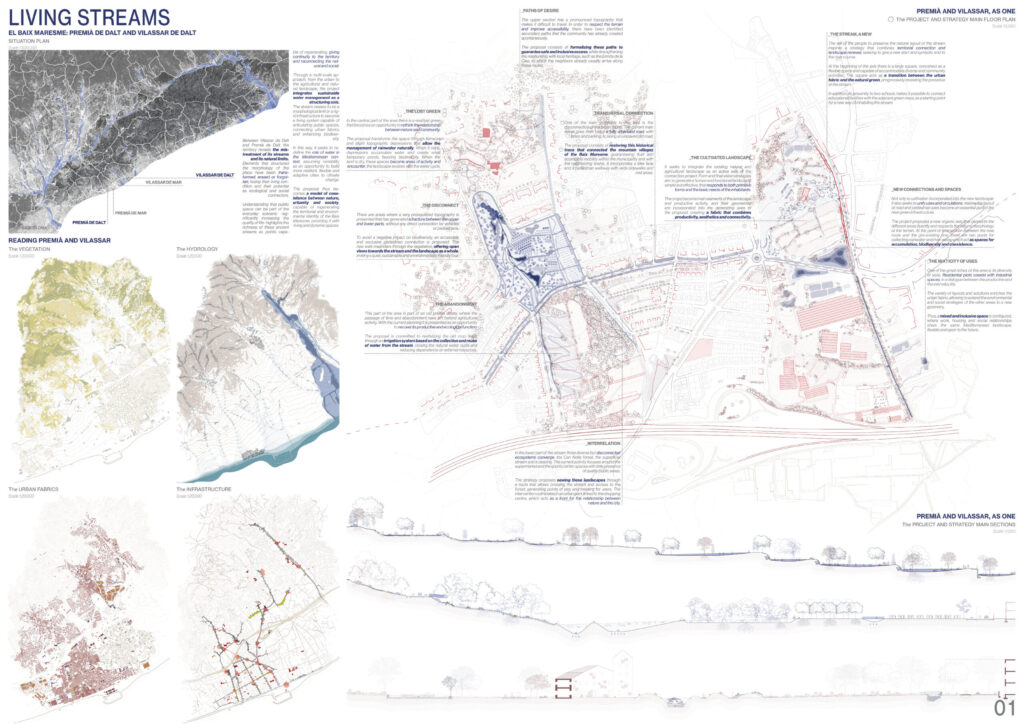
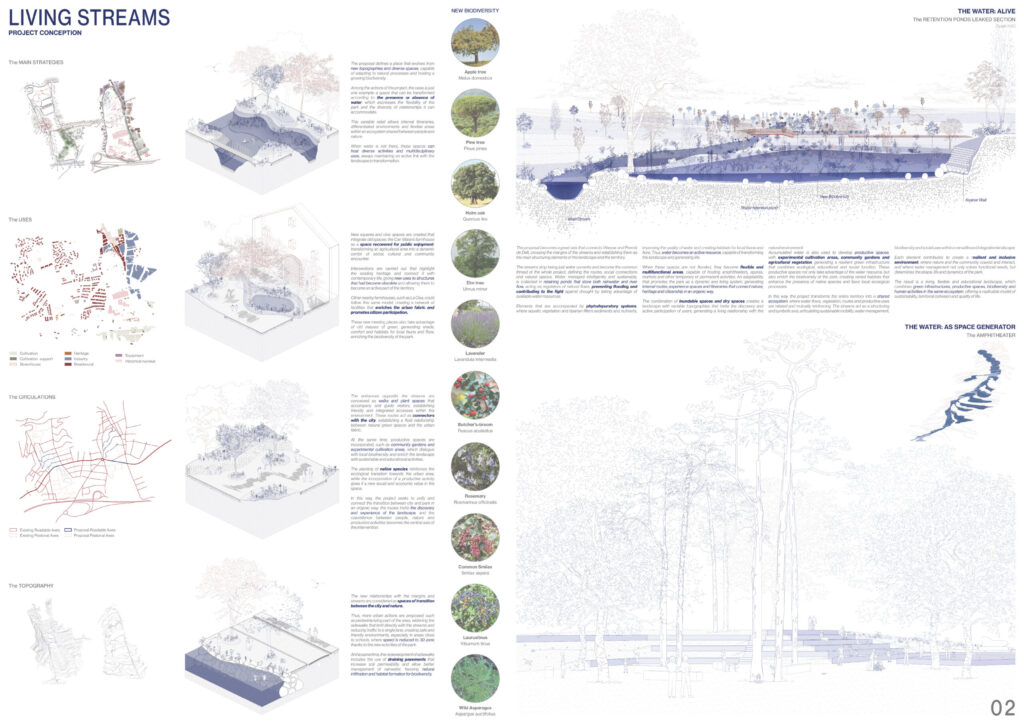
Between Vilassar de Dalt and Premià de Dalt, the territory reveals the mistreatment of its streams and its natural limits. Elements that structured the morphology of the place have been transformed, erased or forgotten, losing their living condition and their potential as ecological and social connectors. Understanding that public space can be part of the everyday scenario-significantly increasing the quality of life- highlights the richness of these ancient streams as points capable of regenerating, giving continuity to the territory and reconnecting the natural and social. Through a multi-scale approach, from the urban to the agricultural and natural landscape, the project integrates sustainable water management as a structuring axis. The stream ceases to be a morphological limit or a rigid infrastructure to become a living system capable of articulating public spaces, connecting urban fabrics and enhancing biodiversity. In this way, it seeks to redefine the role of water in the Mediterranean context, assuming variability as an opportunity to build more resilient, flexible and adaptive cities to climate change. The proposal thus becomes a model of coexistence between nature, urbanity and society, capable of regenerating the territorial and environmental identity of the Maresme, providing it with living and dynamic spaces.
5th MENTION
INHABITED TRANSITION: COEXISTING WITH URBAN RENEWAL WORKS IN THE ‘THREE WINDOWS’ HOUSING OF MARSEILLE
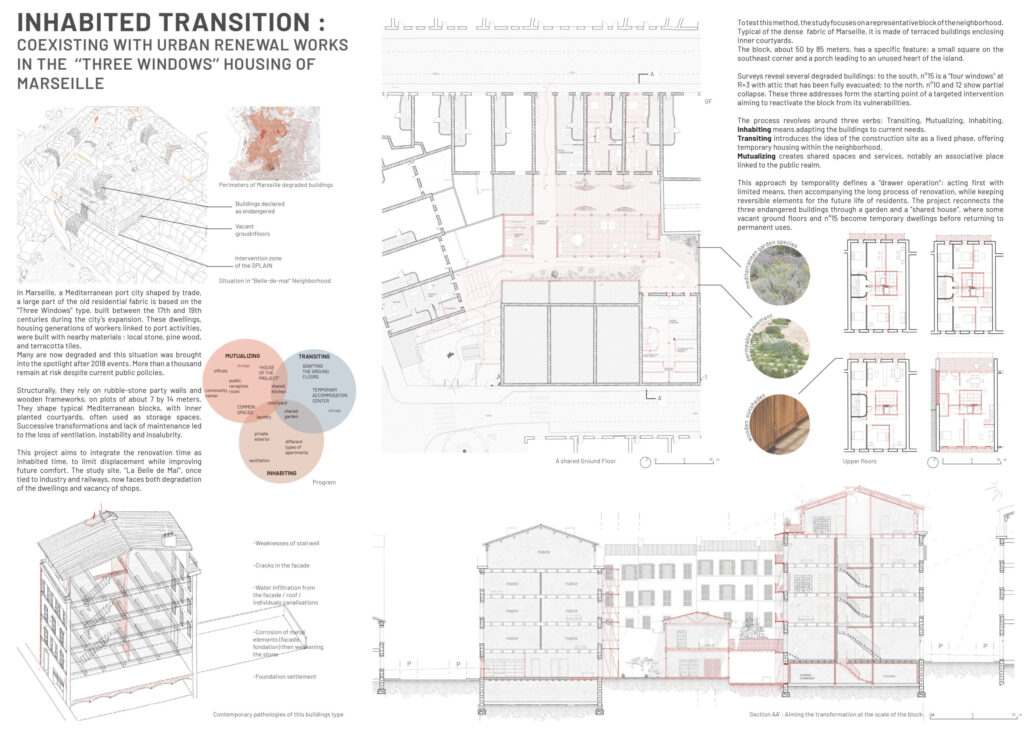
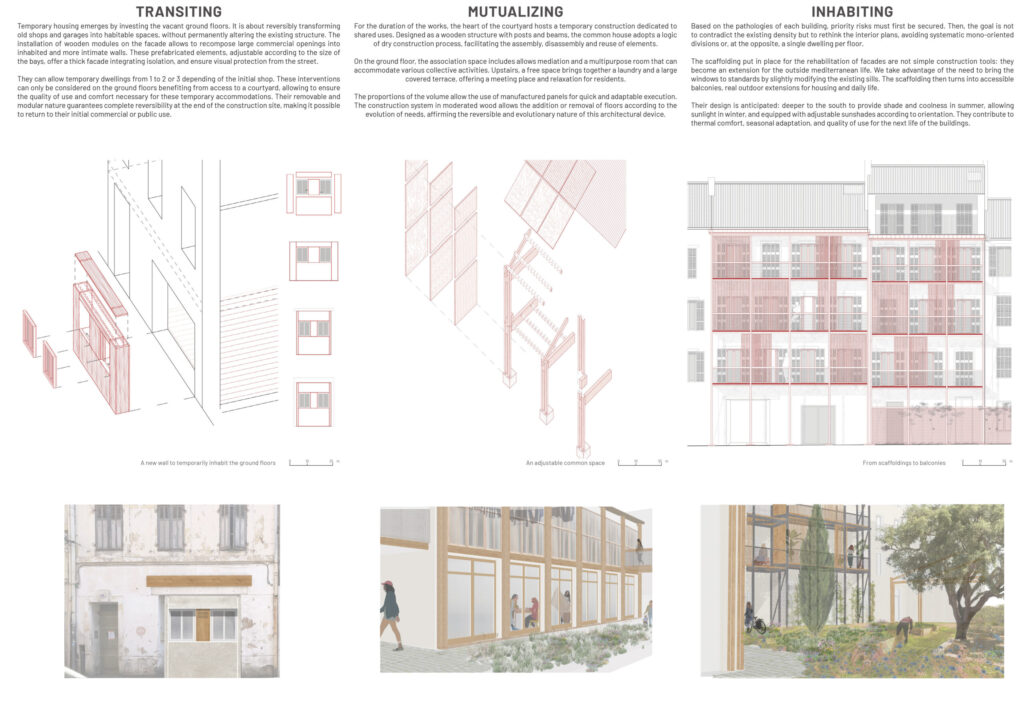
This project questions the renovation of old Marseille buildings while rethinking about the lives rooted within them. After the 2018 collapse on rue d’Aubagne, the emergency to address the “Trois Fenêtres Marseillais” type became evident. The district of La Belle de Mai, marked by social and architectural vulnerability, is the study area. The approach revolves around three verbs: Inhabiting (adapting and strengthening historic dwellings; crossing, flexible, comfortable), Transiting (providing on-site temporary housing to limit displacement during construction), and Mutualizing (reopening vacant ground floors and reactivating the mediterranean ambient in the heart of the block through shared courtyards). This “drawer operation” enables phased rehabilitation: temporary relocation, reintegration, and a renewed renovation cycle. Architectural and technical choices favour sobriety and reversibility: demountable wooden modules on ground floors, porous and vegetated inner courts, structural consolidation, through-going housing, scaffold reuse, and dry construction. The project responds to social, environmental, and resource challenges specific to Marseille: soil de-permeabilization, heat-island mitigation, and climate-adapted building performance. Transforming constraints and vacancy into opportunities, it reconnects architecture, everyday Mediterranean life, and local morphologies, allowing renovation to remain an inhabited, living process.
The Union for the Mediterranean (UfM) is an intergovernmental organisation, which brings together with 43 members, including all countries of the European Union and 16 non-EU countries around the Mediterranean. The UfM provides a forum to enhance regional cooperation and dialogue, as well as the implementation of concrete projects and initiatives with tangible impact on the citizens of its Member States.

With the cooperation of

With the experience of

Share this

