Leveraging multilateral cooperation to promote regional integration dynamics
- The high-level dialogue that brought together the UfM, the United Nations Development Programme (UNDP), the Organisation for Economic Co-operation and Development (OECD) and representatives from the European Union aimed at aligning development and investment agendas, identifying opportunities for partnership, and translating policy recommendations into action.
- The UfM region remains to be one of the most economically fragmented regions in the world with trade and investment flows profoundly skewed, interconnectivity potential yet to be unlocked, and mobility of people curtailed by several obstacles.
Brussels, 11 February 2026 – Successive disruptions over the last few years have demonstrated the extent to which the low levels of economic integration have made the UfM region more vulnerable to the shockwaves of multiple global crises. Following the adoption of the Pact for the Mediterranean which seeks a paradigm shift towards deeper integration based on co-ownership, co-creation and joint responsibility, the moment is opportune to explore synergies with the UfM Progress Report on Regional Integration which analysis the state-of-play of economic integration in the Euro-Mediterranean region, as well as the UNDP Maghreb Strategy 2025-2030 which focuses on one of the least integrated sub-regions within the UfM.
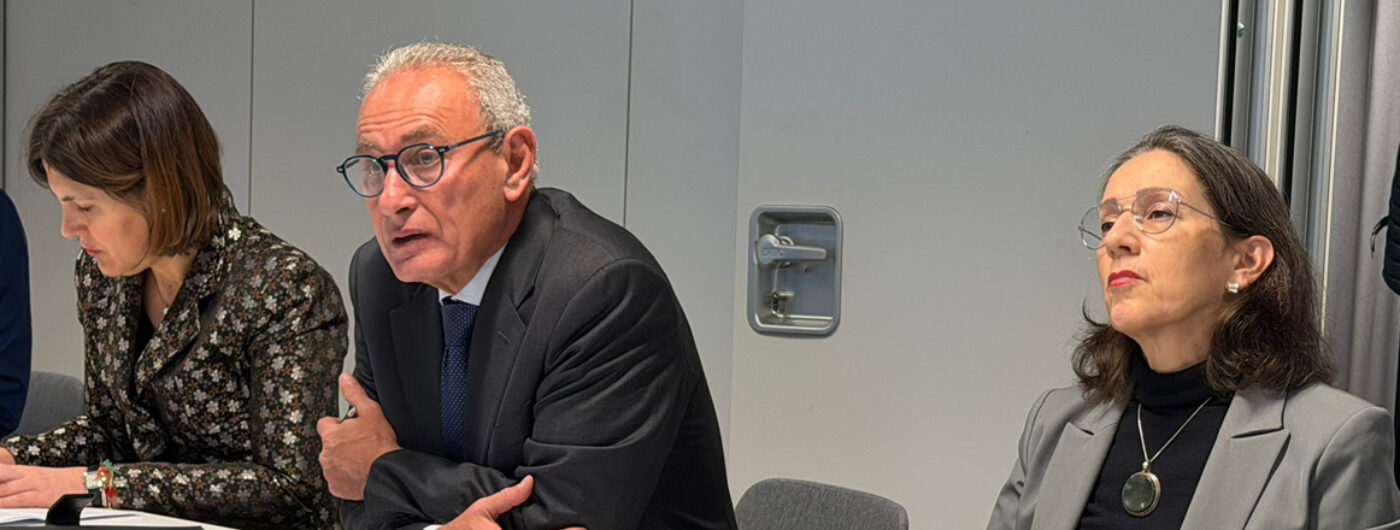
In this spirit, a high-level roundtable discussion was held at the UNDP premises in Brussels with the idea of creating strategic coherence between the three documents; promoting inclusive integration with a focus on women, youth, as well as green and digital transitions; and translating policy frameworks into action through solid partnerships and mobilization of investments.
During his welcoming remarks, UfM Secretary General Nasser Kamel stated that “integration has become a metanarrative of potential for our region, but this integration is fragile. This is exactly why we need to take hold of the reigns of that change into our hands, harness it, make it favourable and conducive to the economic integration that would make our region more resilient, more competitive, and better positioned to untap its full potential”. This was followed by presentations of the Pact for the three documents and an open discussion on key thematics that ranged from the twin transition to agile partnership models for co-delivering value on the WEFE nexus, the CBAM Convention, and mobility, among other priorities.
The UfM will be disseminating the findings and the policy recommendations of its Progress Report on Regional Integration during the current and the coming years within the UfM, the Gulf and Africa, seeking meaningful complementarities and sub-regional solutions that can be scaled and replicated.