
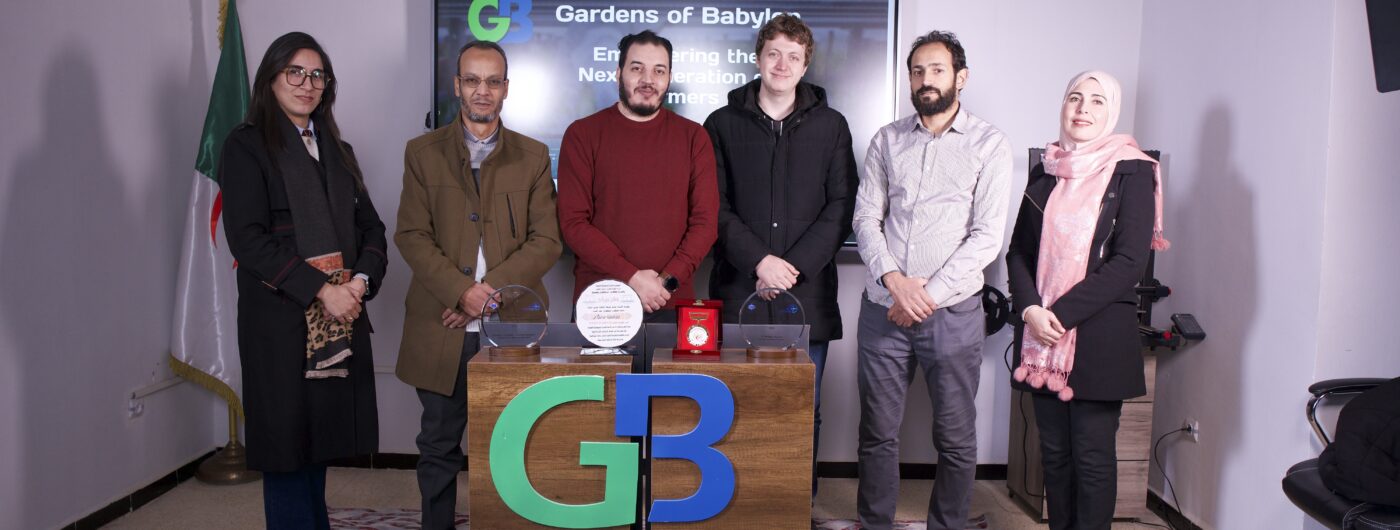
Farming in an age of drought: an Algerian innovation simplifying technology and reshaping production
20 March 2026. In the plains outside Mascara, a city in north-western Algeria once known for its fertile land, Mokhtar Bouazza stood watching his family’s fields slowly die. Land that had sustained generations dried up as rainfall declined and groundwater reserves receded.
Bouazza, 31, is living through the effects of climate and environmental change in a landscape growing increasingly arid. Yet he chose to respond, drawing on technical expertise shaped by generations of agricultural knowledge.
His project, Gardens of Babylon, is a smart technological system that uses software and sensors to manage vertical and closed farming environments. It relies on automated irrigation and climate control to improve both productivity and water efficiency. The approach is based on maximising output by increasing the number of harvest cycles each year, while significantly reducing water consumption compared to conventional agriculture. The name itself is inspired by the Hanging Gardens of Babylon, one of the wonders of the ancient world, reflecting an ambition to develop more sustainable agricultural solutions.
Bringing technology closer to farmers
Bouazza explains that the real innovation does not lie in vertical farming itself, which has existed for years, but in making it accessible. This type of agriculture has long remained complex, costly, and largely confined to advanced farms or well-resourced institutions, limiting its reach among ordinary farmers.
The core challenge in agriculture, he argues, is not simply access to equipment, but the ability to make the right decisions. In traditional models, farmers and agronomists rely on field observation and experience, often without having all relevant data available at the same time. Decision-making is therefore constrained by the complexity of variables such as seed type, soil condition, daily climate variation, water quality, and plant growth stages.
His system addresses this gap by analysing these variables in an integrated way using artificial intelligence, and recommending the most appropriate agricultural decisions at each stage. This ensures that crops receive exactly the water and conditions they need, without waste. The result is more precise decision-making, reduced water use, and improved yields. Despite the technological complexity behind it, the system is designed with a simple interface, making it accessible to farmers.
Mounting environmental pressures
Bouazza’s project comes at a time when data from the Food and Agriculture Organization of the United Nations (FAO) shows that agriculture is the largest consumer of water in Algeria, in a context of severe water stress and significant reliance on groundwater.
These challenges are part of a broader regional pattern. The Mediterranean basin has warmed by around 1.5°C above pre-industrial levels, faster than the global average. Summer rainfall in parts of the region is projected to decline by up to 30%, while around 180 million people already live under conditions of water scarcity. Without effective adaptation measures, agricultural yields could fall sharply across parts of North Africa.
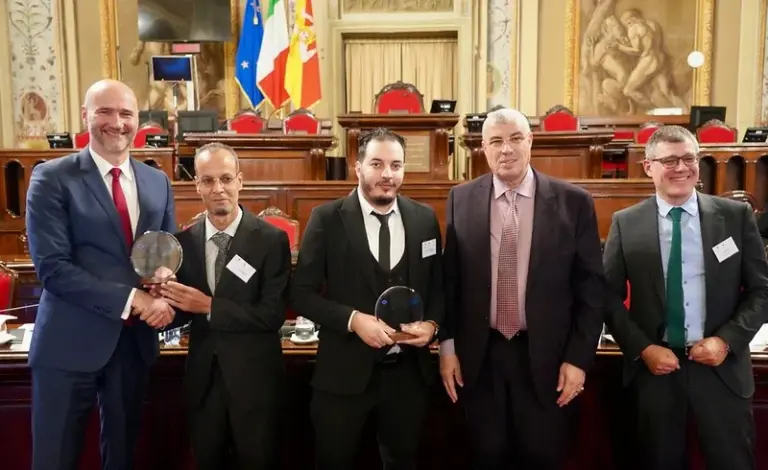
Mokhtar Bouazza, the 31-year-old founder of a vertical farm called Gardens of Babylon, and Beanoumeur Bakhti of the business incubation team at Mascara University in Algeria were presented with the ARLEM Award: Young local entrepreneurship in the Mediterranean on 7 November 2025 by the co-chairs of the Euro-Mediterranean Regional and Local Assembly (ARLEM), Palermo, Italy.
Institutional support
This ambition has been supported at multiple levels. The project received the 2025 ARLEM Award for Young Local Entrepreneurship in the Mediterranean, organised by the Euro-Mediterranean Regional and Local Assembly in cooperation with the Union for the Mediterranean.
Its development has also benefited from support beyond individual effort. At the national level in Algeria, it has been backed by the Ministry of Knowledge Economy, Start-ups and Micro-enterprises, as well as the Ministry of Agriculture through the National Chamber of Agriculture, which facilitated direct engagement with farmers. Locally, support has come from the business incubator at the University of Mascara and the Wilaya People’s Assembly, while internationally the project has been accompanied by the German Agency for International Cooperation (GIZ).
Bouazza insists that the project’s true capital is human. A team of 12 specialists, including a laboratory director, an agronomist, an IT engineer and an irrigation expert, runs the operation. More than 100 farmers and entrepreneurs have already been trained through its programmes, with a particular focus on youth employment and women-led initiatives in a region where both remain significantly underserved.
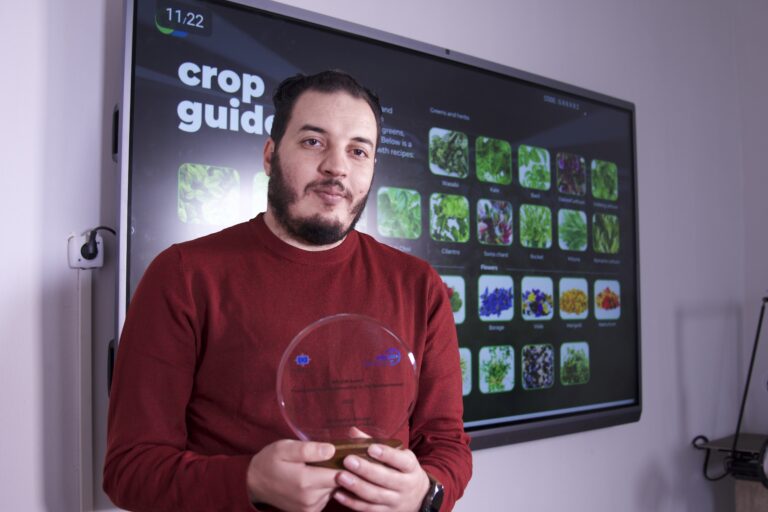
Mokhtar Bouazza holding the 2025 ARLEM crystal award

