Women, Peace and Security and Climate Change in the Arab Region: advancing policy coherence from the regional to the national level
Cairo, Egypt, 23–24 September 2026 – How can governments and stakeholders better address the interconnected challenges of gender inequality, climate change and conflict?
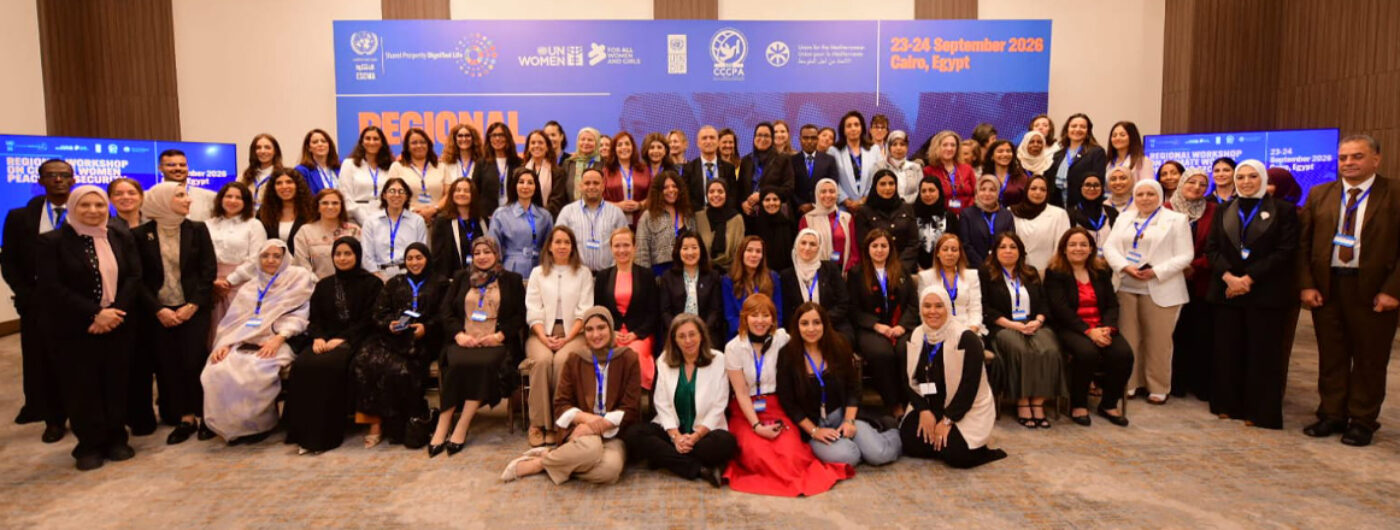
This question was at the centre of a regional workshop on “Women, Peace and Security and Climate Change in the Arab Region: Operationalizing Policy Coherence for the Gender–Climate–Conflict Nexus”, held in Cairo on 23–24 September.
Convened by the Union for the Mediterranean, the United Nations Economic and Social Commission for Western Asia (ESCWA), in partnership with UN Women, the United Nations Development Programme (UNDP), and the Cairo International Center for Conflict Resolution, Peacekeeping and Peacebuilding (CCCPA), the workshop brought together more around 100 representatives of national women’s machineries, ministries of environment, and civil society from more than Arab 20 countries as well as regional and international organisations.
The workshop addressed the need to better connect policy processes that are often developed and implemented separately, including Women, Peace and Security National Action Plans (WPS NAPs), Nationally Determined Contributions (NDCs), National Adaptation Plans (NAPs) and Disaster Risk Reduction (DRR) strategies.
 In her opening remarks, UfM Deputy Secretary General for Human Development, Petra Kežman, called for a shift from recognition to implementation of the nexus. Stressing that the region already has the evidence, policy frameworks and commitments needed to act, she argued that “what is still missing, too often, is coherence.” She emphasized the importance of connecting existing frameworks, strengthening cooperation across institutions and sectors, and translating political commitments into concrete action that delivers tangible results for communities across the region.
Discussions throughout the two-day programme focused on four interconnected pathways for strengthening policy coherence:
1. Governance, coordination and financing
Participants explored mechanisms to strengthen coordination across institutions and policy processes and discussed how financing approaches can support integrated responses to the gender–climate–conflict nexus.
2. Institutional and technical capacity
The workshop examined the capacities required by national stakeholders, including national women’s machineries and line ministries, to engage meaningfully in climate governance, NDC processes and DRR planning.
3. Data, knowledge and evidence
Participants discussed the importance of strengthening gender-responsive data and evidence to better understand the intersections between climate, women, peace and security, and to support analysis, planning, monitoring and reporting.
These areas reflect the four pathways of the UNDP Guidance Note on Operationalizing the Gender–Climate–Conflict Nexus, which informed the workshop and provides a practical framework for strengthening coherence across the WPS Agenda, climate policies and DRR strategies. Participants discussed practical approaches to strengthen coherence between Women, Peace and Security (WPS) National Action Plans, climate policies, disaster risk reduction frameworks and sustainable development strategies. The Guidance Note introduces a human security-based approach and identifies four key pathways for action: governance and coordination, institutional capacities, data and evidence systems, and financing.
Strengthening the UfM Climate–WPS regional platform
The workshop highlighted the role of the UfM Network on Climate, Women, Peace and Security (WPS) as a regional platform for knowledge exchange, coordination and action.
Launched by the UfM in Amman in November 2025, the Network seeks to contribute to a more coordinated and action-oriented regional approach to the intersections between climate change, peace and security and gender equality. Its first knowledge output, the IEMED led MedWE Policy Study on Women, Peace and Security and the Climate Nexus, contributes to mapping the state of knowledge, data and policy in the region and identifying gaps, good practices and actionable recommendations.
The evidence base need to be built and structured
The UfM Network’s four Thematic Working Groups, the MedWE3 study, and the Knowledge Hub together will support in knowledge sharing and development.
All the components mentioned in these two days (Governance & coordination, Institutional capacity , Data & evidence) should be covered by a common demand-driven Regional Action Plan to be promoted as flagships initiatives of upcoming UfM 6th Ministerial Conference on Strengthening the Role of Women in Society in 2027.