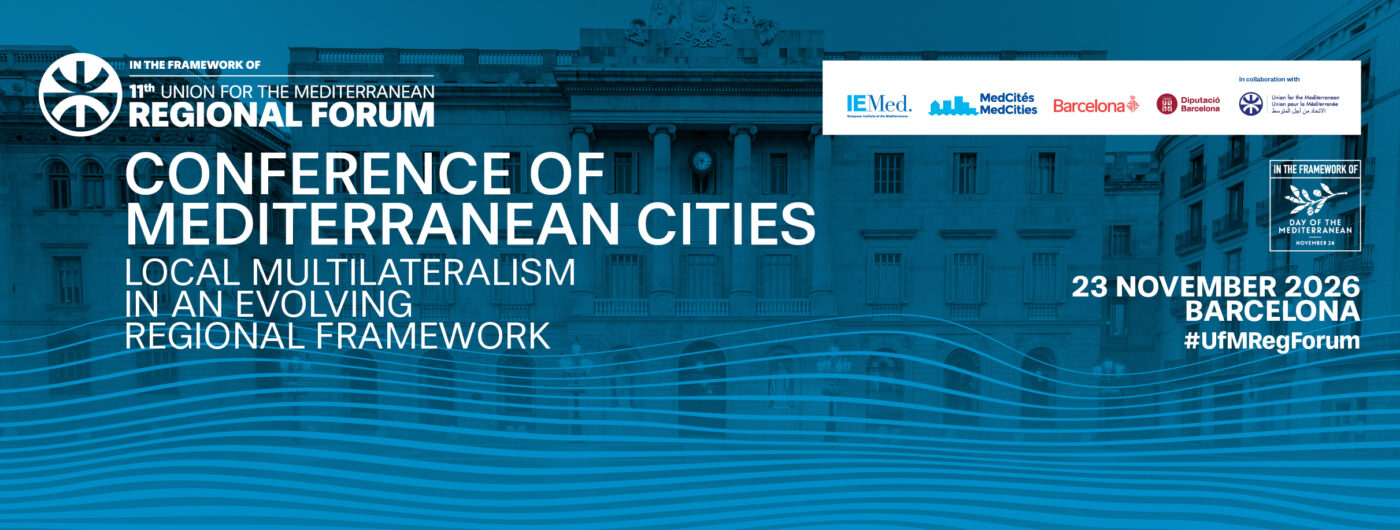
Conference of Mediterranean Cities: Local multilateralism in an evolving regional framework
On 23 November 2026, the Palau de Pedralbes in Barcelona hosts the Conference of Mediterranean Cities, held ahead of the 11th UfM Regional Forum. IEMed and MedCities are organising it, with support from Barcelona City Council and Barcelona Provincial Council. This year’s theme is “Local multilateralism in an evolving regional framework”, and the question is how cities can strengthen their influence over Euro-Mediterranean and European governance.
Cities have become established players in international cooperation, all the more so as global relations fragment and many national governments pull decisions back to the centre. The Pact for the Future, adopted by the UN General Assembly in 2024, explicitly recognises local and regional governments, and city networks are increasingly present in global forums. This is what “local multilateralism” means: cities and regions acting as political players that can shape international decisions, as well as putting global agendas into practice. 2026 is a key year for this debate, with the World Urban Forum, the UCLG World Congress and the midterm review of the New Urban Agenda all shaping the future of urban governance.
In the Euro-Mediterranean region the debate is even more urgent. Open wars, humanitarian crises and the growing impact of climate change are hitting the region hard, and cities are often the first places affected by violence, forced displacement and extreme weather. They are also where people manage to keep living together, where basic services are kept going and where reconstruction and peace processes start to take shape.
Last year’s Barcelona+30 conference confirmed that cities are essential to Euro-Mediterranean cooperation, but it also made the obstacles clear. Regional policies often lack a local perspective. Local authorities are expected to turn political commitments into concrete policies, often without a seat at the table where decisions are made, and their access to European and international funding remains limited and scattered. The issue today is less about finding spaces for dialogue and more about using them to gain real political influence. That is why this year’s conference has a smaller, more strategic format. It brings together 10 to 15 mayors of key Mediterranean cities with European and Euro-Mediterranean institutions and city networks, and showcases resilience cases that other cities can adapt and scale up.
The next few years bring real opportunities, from the Pact for the Mediterranean and the next EU Multiannual Financial Framework to the implementation of the new UfM strategic vision. The conference aims to build on the dialogue among mayors that Barcelona+30 started and to agree on concrete ways to strengthen cities’ institutional and financial weight. It also hopes to lay the ground for a political alliance of Mediterranean cities committed to more inclusive regional governance that takes local realities into account. Its conclusions will be gathered in a Joint Declaration and will feed into the UfM side event on Mediterranean resilience the following day.