
UfM welcomes new Deputy Secretaries General in a renewed commitment to inclusive leadership
- Ahead of International Women’s Day, five new Deputy Secretaries General (DSGs) have been appointed by the Union for the Mediterranean (UfM), bringing the leadership team to six DSGs, four of whom are women.
- The new team, announced ahead of the International Women’s Day, reflects the UfM’s commitment to inclusive and merit-based leadership at the highest institutional level.
- The appointments follow the adoption of the UfM’s new Strategic Vision and institutional reform, strengthening the UfM as a central platform for dialogue, cooperation and partnership among the 43 members states of the Euro-Mediterranean region.
- Under the new governance structure, DSGs assume strengthened executive mandates in leading political dialogue and strategic action across three pillars: connecting people, connecting countries and connecting economies.
Barcelona, 5 March 2026. Three days ahead of International Women’s Day, the Union for the Mediterranean announces a renewal of its leadership, with women holding four of the six Deputy Secretaries General (DSGs) positions. The appointment of five new DSGs, alongside the continuation of Meltem Büyükkarakaş as DSG for Economic Development and Employment, reflects the organisation’s ongoing commitment to the values it promotes across its 43 Member States and reinforces the alignment between the UfM’s internal governance and its regional commitments
“Increasing the representation of women in leadership positions within public institutions across the Mediterranean is both a responsibility and an opportunity. At the UfM, we seek to lead by example by ensuring that women’s presence in leadership translates into real influence in decision-making. Inclusive leadership strengthens our institutions and enhances our collective ability to respond to the region’s challenges. I am confident that this new team will contribute decisively to advancing our new Strategic Vision,” said UfM Secretary General Nasser Kamel.
The appointments follow the adoption of the UfM’s new Strategic Vision and institutional reform, endorsed last November at the 10th UfM Regional Forum in Barcelona. Under the new governance structure, Deputy Secretaries General are full members of UfM senior management with a strengthened role in leading political dialogue, advancing strategic priorities and supporting the implementation of ministerial mandates ensuring that political commitments are translated into coordinated action and measurable impact across the region. The new Strategic Vision is structured around three interconnected pillars: connecting people, connecting economies, and connecting countries.
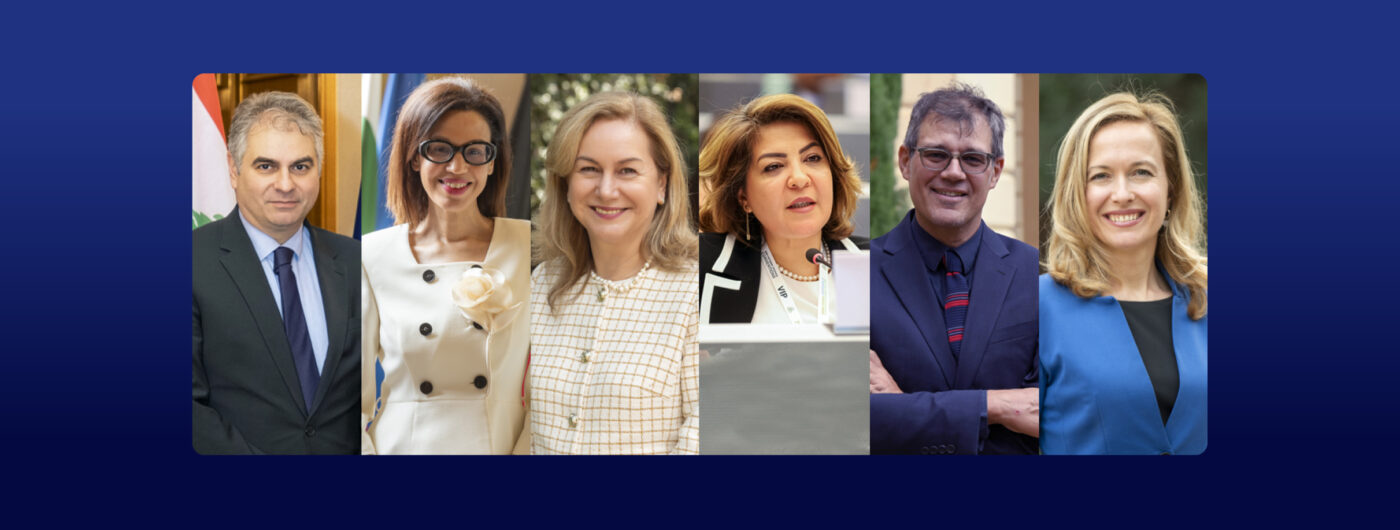
The six-member Deputy Secretaries General team brings together a wide range of expertise and geographic representation from across the Euro-Mediterranean region. Mariam Diallo (France) takes office as Senior Deputy Secretary-General, bringing extensive diplomatic experience in international development and institutional reform. Petra Kežman (Slovenia) joins as Deputy Secretary General for Human Development, with a portfolio covering higher education, research, women and youth empowerment, and social inclusion. Nisreen Tamimi (Palestine) assumes the role of Deput Secretary General for Sustainable Development, overseeing environment, sustainable urban development and transport, blue and green economy. Joan Borrell Mayeur (Spain) serves as Deputy Secretary General for Stability and Resilience, leading work on civil protection, energy and water resilience, climate action and policy dialogue. Fadi Hajali (Lebanon) will take up the position of Deputy Secretary General for Administration, with responsibility for organisational efficiency and institutional governance. Completing the team, Meltem Büyükkarakaş (Türkiye) continues in her current role as Deputy Secretary General for Economic Development and Employment, providing institutional continuity as the organisation advances the implementation of its new agenda.
Over the years, the UfM has placed the principle of gender equality at the centre of its regional agenda, building on five Ministerial Conferences on the Role of Women in Society and the outcomes of the 5th Ministerial Declaration (Madrid, 2022). By aligning its internal leadership structure with this political framework, the UfM strengthens the credibility of its external action and demonstrates consistency between commitment and governance. In 2026, the UfM continues to advance programmes addressing women’s participation in agri-food systems, the energy transition, the economy, digital inclusion, and the climate, peace and security nexus.
Quotes by the new DSGs
“The Mediterranean is at an inflection point. The pressures are real – climate, instability, inequality – but so is the political will to act together. My responsibility and priority are clear, to turn the institutional reform endorsed by our Member States intro strong political leadership, sharper coordination and measurable impact for our Member States” said Mariam Diallo, Senior Deputy Secretary General.
“Human development is what regional cooperation is ultimately about. It is the shared responsibility of the Euro-Mediterranean community to create the conditions in which Mediterranean citizens can pursue their aspirations and contribute fully to their societies. My objective is to strengthen policy dialogue between governments and stakeholders, and to reinforce the links between knowledge, inclusion and opportunity so that our cooperation delivers tangible benefits for people across the region”, said Petra Kežman, DSG for Human Development.
“The Mediterranean cannot afford to treat sustainable development priorities as separate issues. They require integrated policies that connect the environment, the blue economy, sustainable urban development and transport- considering climate change- to achieve a balance between economic growth, environmental protection, and social equity for present and future generations. My role is to help Member States translate shared ambitions into concrete regional cooperation and build the cross-border solutions the region urgently needs. And that work starts now”, said Nisreen Tamimi, DSG for Sustainable Development.
“Stability in the Mediterranean is not an abstract ambition. It is built through preparedness, cooperation and the capacity to manage shared risks. Water, energy and climate pressures are already reshaping the region and resilience requires joint actions. My priority is to strengthen regional cooperation on civil protection, crisis preparedness and climate water and energy resilience, so that Member States can anticipate shocks and delivery practical solutions together, said Joan Borrell Mayeur, DSG for Stability and Resilience.
“An organisation’s credibility rests on its capacity to deliver concrete results. My commitment is to consolidate and enhance the governance, efficiency and transparency mechanisms that enable the UfM Secretariat to fully support the priorities of our Member States”, said Fadi Hajali, DSG for Administration.
“Economic development and employment are not abstract goals: they are the daily reality of millions of people across the Mediterranean who are seeking decent livelihoods, fair opportunities and a stake in the region’s future. What is needed is deeper integration and sustained collaboration. Building on the work already under way, my priority is to strengthen the links between trade, investment, digital transformation, entrepreneurship and employment so that the UfM’s new Strategic Vision delivers tangible economic benefits for people across all 43 Member States,” said Meltem Büyükkarakaş, DSG for Economic Development and Employment.
Photo of Nisreen Tamimi by IISD/ENB | Mike Muzurakis