• English
  • Français
  • العربية
Follow us
Union for the Mediterranean – UfMUnion for the Mediterranean – UfMUnion for the Mediterranean – UfMUnion for the Mediterranean – UfM
  • Who we are
    • The Union for the Mediterranean is an intergovernmental institution bringing together the European Union Member States and 16 countries from the Southern and Eastern shores of the Mediterranean to promote dialogue and cooperation.

      OVERVIEW   

    • Who we are

      • Member States
      • Meet the team
      • Partners
      • History

      Transparency and accountability

      • Transparency and access to information
      • Investigating fraud, corruption and misconduct
    • Key documents

      UfM Institutional Brochure UfM How we work

      More documents   

  • What we do
    • The UfM seeks to enhance regional cooperation, dialogue and the implementation of concrete projects and initiatives with tangible impact on our citizens to address three strategic objectives: human development, stability and integration.

      OVERVIEW   

    • Inclusive development

      • Economic Development and Employment
      • Higher Education & Research
      • Social & Civil Affairs

      Sustainable development

      • Water, Environment and Blue Economy
      • Transport & Urban Development
      • Energy & Climate Action

      Initiatives that build bridges

      • Day of the Mediterranean
      • Mediterranean Capitals of Culture and Dialogue
    • How we work

      • Policy Frameworks
      • Regional Platforms
      • Projects and Initiatives
  • Work with us
    • The UfM Secretariat is the operational platform of the Union for the Mediterranean. The staff of the UfM is made of more than 17 nationalities working in a multicultural environment that fosters cooperation and intercultural communication and exchange.

    • Work with us

      • Vacancies
      • Secondments
      • Internships
      • Procurement
  • Info centre
    • Find our latest press releases, press invitations, visual identity, key institutional documents, photos and other relevant information


      DOWNLOAD THE UfM VISUAL IDENTITY GUIDELINES AND LOGOS (ZIP FILE)   

    • Info centre

      • Media corner
      • News
      • Agenda
      • Publications and key documents
      • Stories of Euro-Mediterranean Cooperation
    • UfM in the Media

      9 May 2026 – Agence Europe (EN) – The fire season that never ends – by Joan Borrell Mayeur
      View article
      9 May 2026 – Agence Europe (FR) – Une saison des feux qui n’en finit pas – par Joan Borrell Mayeur
      View article
      7 May 2026 – Al-Dustour – حرائق غابات المتوسط على وشك أن تبدأ مجدداً… بلا حدود
      View article
  • Contact

The private sector as a driving force for regional integration

Economic Development and Employment

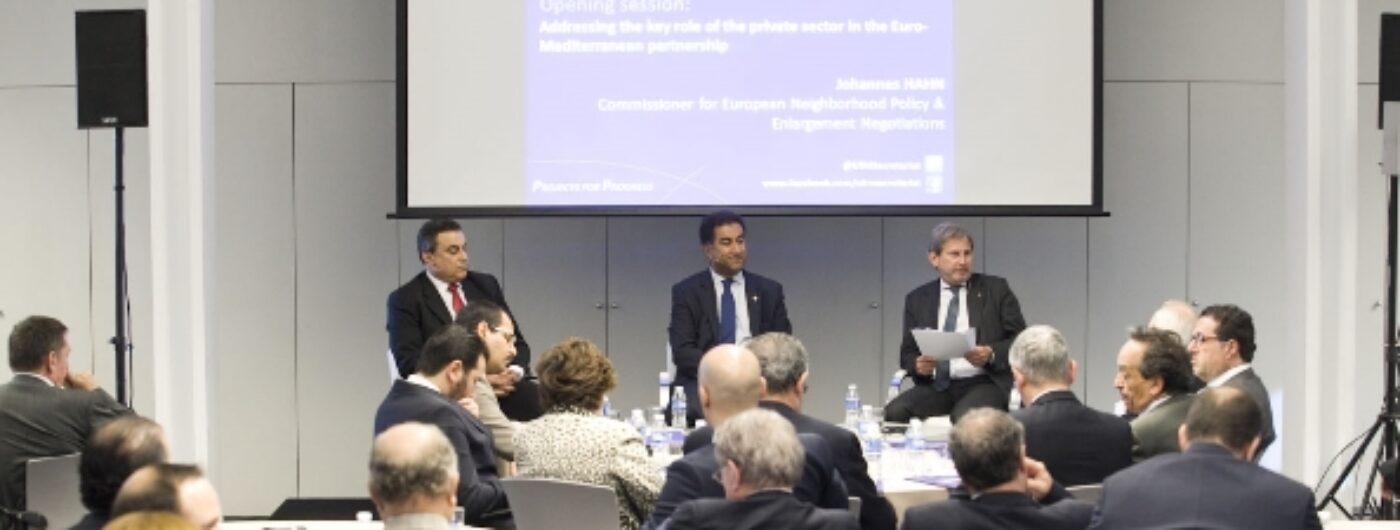
Barcelona, 14 April 2015 – The Union for the Mediterranean organised together with the European Commission a two-day High-level Meeting on the role of the private sector in strengthening the Euro-Mediterranean Partnership.

The meeting, which gathered more than 100 representatives from the private sector, international and regional organisations and International Financial Institutions (IFIs), took place immediately after the informal Ministerial Conference held yesterday at Palau de Pedralbes, headquarters of the UfM, to discuss the future of the European Neighborhood Policy (ENP). The revision of the ENP provides an opportunity to emphasize the need for strengthening the role of the private sector and improving the business environment across the region.

Discussions aimed at fostering dialogue between stakeholders from the private sector and main financial institutions on key strategic issues for the future of the region:  inclusive growth and job creation, Public-Private Partnerships (PPP) and informal economy. According to a survey by the European Investment Bank: in 2013, major financial institutions have committed more than 1.5 billion euros for the private sector in the region and  the estimation of infrastructure investment needs for 2020 for southern Mediterranean countries are of the order of € 23 billion per year, or a total of $ 160 billion over 7 years; in addition, data from the World Bank show that the informal economy could represent over 65% of employment in Southern Mediterranean countries.

At the opening speech at the Caixa Forum in Barcelona, Secretary General Sijilmassi said to participants that this meeting “will allow continuing the regional dynamic and to associate more closely private sector with UfM activities and also to identify how UfM can support private sector ideas and initiates”.

Commissioner Hahn stated: “A flourishing economy across the Mediterranean is key to reach our shared objectives of stability and prosperity and for that the private sector must be at the core of any successful process”. He also highlighted the important role played by the Union for the Mediterranean in promoting private sector-led growth and employment in the Southern Partners.

Former Prime Minister from Tunisia stressed that “private sector needs to open the door to young unemployed people. We cannot tackle unemployment without the private sector”.

This meeting is part of an ongoing process in the framework of the UfM strategy for the private sector development, launched at the end of last year, and that has initiated the first regional dynamic with the private sector. As first steps of this strategy, the Secretariat organized last year two working meetings to engage private sector players in addressing the region’s challenges through consultations and discussions with international financial institutions (IFIs), private companies, international and regional organisations as well as civil society representatives. The three key strategic issues discussed during today’s meeting were raised by the participants on those occasions.

Today’s meeting also served to identify other priority issues for the development of the private sector in the region: access to finance, labour rights and social responsibility, which could be addressed in future meetings in the framework of this strategy. The UfM foresees as well the organization this year of two other High-level private sector meetings on food security (5/6 May 2015) and energy (second semester).

Private sector development is key to seizing existing business opportunities and fostering regional integration in the Mediterranean by raising the current levels of intra-regional trade, only 5% of total external trade, low compared to 65% among EU countries, 22% of ASEAN countries and 19% of MERCOSUR countries.

FURTHER INFORMATION

  • UfM Secretariat to boost private sector’s role on inclusive growth in Euro-Mediterranean countries
  • Focus on private sector development: UfM and EU hold seminar gathering EU Heads of cooperation and private sector representatives

PHOTO GALLERY

Meeting’s pictures

VIDEO GALLERY

Statement by EU Commissioner Hahn
 

Share this:

Latest news

Spanish Foreign Minister Joins Senior Officials to Bid Farewell to UfM Secretary General Nasser Kamel
10 / 06 / 2026
Advancing Euro-Mediterranean Research and Innovation: UfM hosts Extraordinary Platform Meeting and Scalability Roundtable
08 / 06 / 2026
See more

SUBSCRIBE TO OUR NEWSLETTER!


Agenda

UfM Study Visit on International Trade and Investment Policy
16 / 06 / 2026
3rd Mediterranean Green Week
30 / 06 / 2026
See more

Who we are

  • Member States
  • Meet the team
  • Partners
  • History
  • Transparency and accountability
  • Transparency and access to information
  • Investigating fraud, corruption and misconduct

What we do

  • Economic Development & Employment
  • Higher Education & Research
  • Social & Civil Affairs
  • Water, Environment and Blue Economy
  • Transport & Urban Development
  • Energy & Climate Action
  • Day of the Mediterranean
  • Mediterranean Capitals of Culture and Dialogue

How we work

  • Policy Framework
  • Regional Platforms
  • Projects and Initiatives

Work with us

  • Vacancies
  • Secondments
  • Internships
  • Procurement

Info centre

  • Media corner
  • News
  • Agenda
  • Publications and key documents
  • Stories of Euro-Mediterranean Cooperation
  • Photo gallery
  • Video gallery
Co-financed by the European Union
  • Who we are
    • Member States
    • Meet the team
    • Partners
    • History
    • Transparency and accountability
      • Transparency and access to information
      • Investigating fraud, corruption and misconduct
  • What we do
    • Economic Development and Employment
    • Higher Education & Research
    • Social & Civil Affairs
    • Water, Environment and Blue Economy
    • Transport & Urban Development
    • Energy & Climate Action
  • Initiatives that build bridges
    • Day of the Mediterranean
    • Mediterranean Capitals of Culture and Dialogue
  • How we work
    • Policy Framework
    • UfM Regional Platforms
    • Projects and Initiatives
  • Work with us
    • Vacancies
    • Secondments
    • Internships
    • Procurement
    • Roster of experts
  • Info centre
    • Media center
    • News
    • Agenda
    • Publications and key documents
    • Human Stories of the Mediterranean
  • Contact
  • Social media
    • Facebook
    • Twitter
    • Youtube
    • Linkedin
    • Flickr
  • English
  • Français
  • العربية
  • English
  • Français
  • العربية
Union for the Mediterranean – UfM


We are using cookies to give you the best experience on our website.

You can find out more about which cookies we are using or switch them off in .

Powered by  GDPR Cookie Compliance
Cookies Overview

This website uses cookies so that we can provide you with the best user experience possible. Cookie information is stored in your browser and performs functions such as recognising you when you return to our website and helping our team to understand which sections of the website you find most interesting and useful.

Read more

Strictly Necessary Cookies

Strictly Necessary Cookie should be enabled at all times so that we can save your preferences for cookie settings.

3rd Party Cookies

This website uses Google Analytics to collect anonymous information such as the number of visitors to the site, and the most popular pages.

Keeping this cookie enabled helps us to improve our website.