
UfM Ministers launch Rome Initiative to facilitate water management, investment planning and sustainable projects
- The Rome Initiative on Water will facilitate the implementation of sustainable water systems in the Mediterranean region by improving the mobilisation of investments and technical assistance.
- The 2nd UfM Ministerial Meeting on Water provided the organisation’s 43 Member States with strategic guidance to achieve the water-related UN Sustainable Development Goals. The 2nd UfM Ministerial Declaration on Water – endorsed today – calls for greater cross-border cooperation.
- The Mediterranean faces mounting water challenges driven by climate change, environmental degradation and demographic pressures. Water stress is already a reality in all Southern and Eastern Mediterranean countries, while 70% of Southern Europe’s population lives in areas with water stress in the summer. More than 180 million people in the region are classified as water poor.
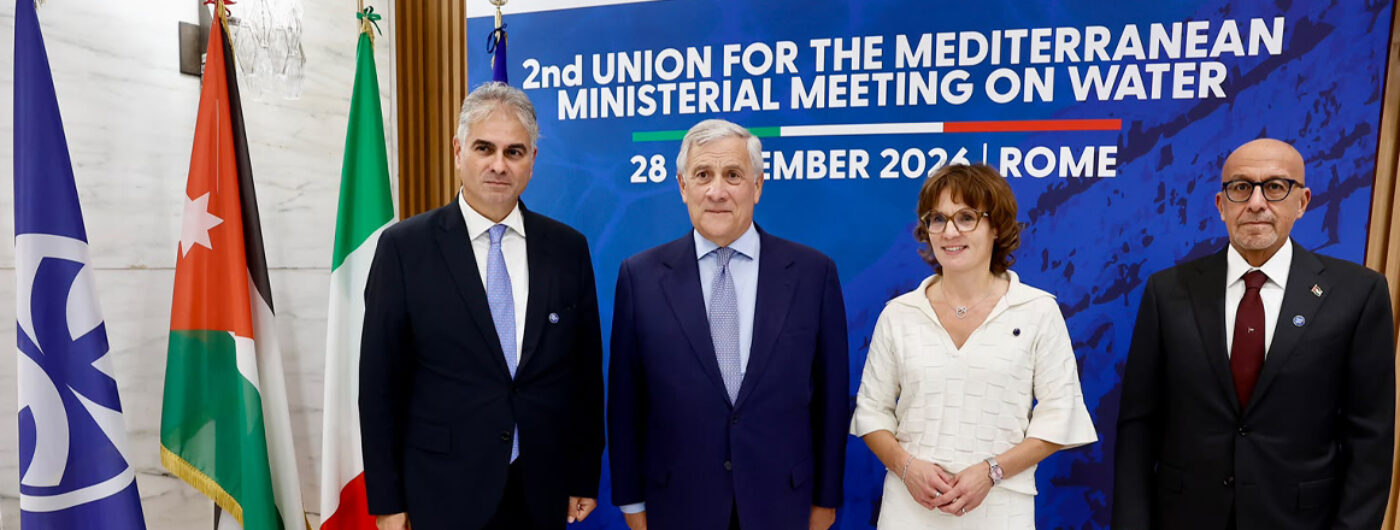
28 September 2026, Rome. The 2nd UfM Ministerial Meeting on Water witnessed the launch of the Rome Initiative, a scheme designed to facilitate the design, financing and management of sustainable water systems in the Mediterranean while contributing to the development of technical capacities. Co-chaired by EU Commissioner for Environment, Water Resilience and a competitive Circular Economy Jessika Roswall and Jordanian Minister of Water and Irrigation Raed Abu Saoud and hosted by Italian Minister of Foreign Affairs and International Cooperation Antonio Tajani in the presence of UfM Secretary General ad Interim Fadi Hajali, attendees also reaffirmed their commitment to enhanced cooperation on sustainable water management with the endorsement of the 2nd UfM Ministerial Declaration on Water in the Mediterranean.
 Significantly, the Rome Initiative on Water – point 21 of said Ministerial Declaration – will help accelerate the implementation of much-needed sustainable water actions by mobilising investments and facilitating cross-border partnerships for capacity development, knowledge exchange, and project preparation. While there has been progress in access to water supply, sanitation and hygiene in the region, the financial sustainability of these systems has not yet been achieved in many countries. The Rome Initiative will therefore establish a framework similar to that of the UfM’s landmark Blue Mediterranean Partnership that will allow it to connect, coordinate and enhance existing efforts, increasing their impact and visibility.
“Italy lies at the heart of the Mediterranean geographically, historically and culturally, and promotes dialogue and cooperation across the region,” stated Italian Minister of Foreign Affairs and International Cooperation Antonio Tajani. “Water is strategic to our common future: managing it sustainably helps build a more resilient, stable and prosperous Mediterranean. Italy is turning this commitment into action through water security projects and regional dialogue, including the 2nd Union for the Mediterranean Ministerial Meeting on Water, hosted in Rome. A new Italian initiative will also help Mediterranean countries design and finance water security projects, making water a stronger driver of cooperation among States. Held ahead of the Euro-Mediterranean Water Forum, the meeting brought delegations and stakeholders together to review progress and set future priorities: water governance, the water-energy-food-ecosystems nexus, finance and investment, digitalisation, and water and climate.”
“The Mediterranean region is one of the regions in the world most vulnerable to water scarcity and the impacts of climate change. By setting out the priorities for national action and regional cooperation on sustainable water management, climate adaptation and mitigation, financing and infrastructure, I’m convinced that today’s meeting will significantly contribute to enhanced water resilience in the region,” said EU Commissioner Jessika Roswall.
“Today’s adoption of the Second Union for the Mediterranean Ministerial Declaration on Water sends a clear message: water security is a shared Mediterranean responsibility that requires urgent and coordinated collective action. Under the protracted geopolitical crises, the region must focus on cooperation rather than conflicts. Water resources must not be weaponized as a political tool or hijacked by one single country. The Declaration sets a common direction for addressing water scarcity, climate change, droughts, floods, pollution and unequal access to safe water and sanitation. It also strengthens regional cooperation on water governance, sustainable finance, digital transformation, the Water-Energy-Food-Ecosystems Nexus and non-conventional water resources,” said Raed Abu Saoud, Minister of Water and Irrigation of Jordan. “Jordan welcomes the launch of the Rome Initiative as a practical mechanism to strengthen national capacities and help countries develop sustainable, finance-ready water projects. As UfM Co-President, Jordan remains committed to turning this Declaration into measurable action and to carrying a strong Mediterranean message to the 2026 United Nations Water Conference. Our shared objective is clear: stronger water resilience, deeper regional solidarity and reliable water services for all our people.”
“Achieving the water-related Sustainable Development Goals is a major challenge in the Mediterranean, a climate change hotspot that must simultaneously contend with socioeconomic and demographic pressures and geopolitical unrest,” said UfM Secretary General ad Interim Fadi Hajali. “As the UfM Ministerial Declaration on Water in the Mediterranean highlights, regional cooperation towards sustainable and integrated water management must be strengthened if we wish to meet these goals in the near future. The Rome Initiative on Water brings us one step closer to this ambition by turning political commitments into tangible results.”
Taking place ahead of the Euro-Mediterranean Water Forum, the 2nd UfM Ministerial Meeting on Water also allowed delegations and stakeholders from across the region to come together to review progress and discuss priorities for regional cooperation in the coming years. Representatives agreed to focus efforts on water governance, the water-energy-food-ecosystems nexus, water finance and investment, digitalisation, and water and climate while also endorsing three strategic documents on guiding regional action in the sector.