Cairo hosts UfM Economic Forum to boost investment and regional trade opportunities
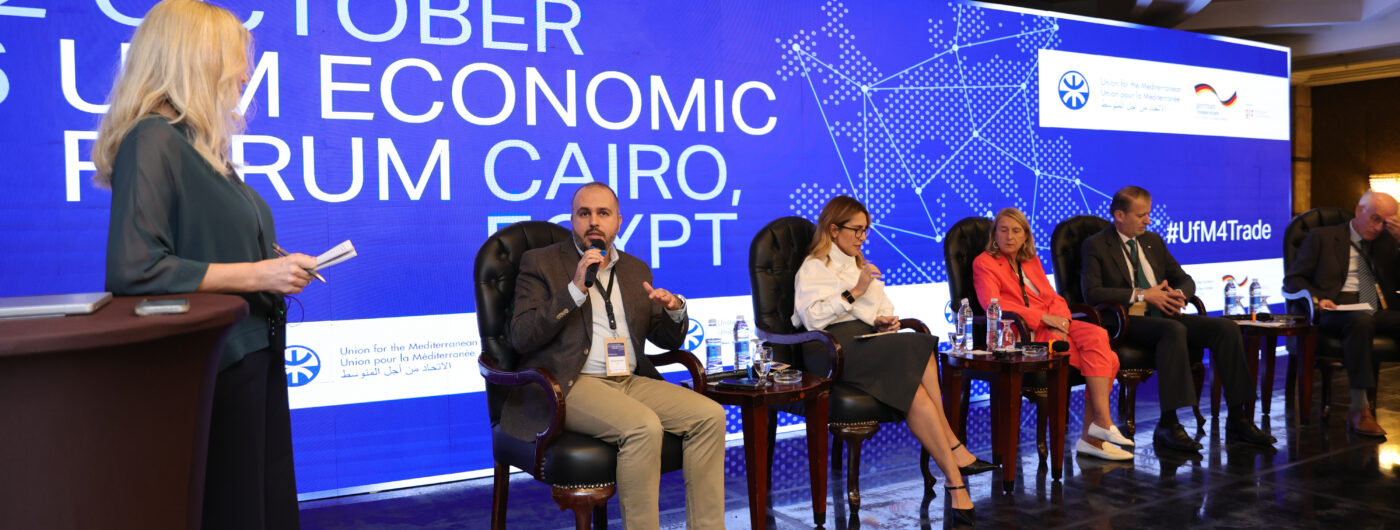
Cairo, 20 October 2026. The UfM Economic Forum, held in cooperation with the European Union and with the support of the German Agency for International Cooperation (GIZ) opened today in Cairo. The forum brings together government representatives, private sector leaders and development partners to discuss investment facilitation, regional trade promotion and the role of businesses in supporting sustainable growth and job creation. This comes as UfM Secretary General ad interim Fadi Hajali met with Egypt’s Minister of Foreign Affairs, Badr Abdelatty, to discuss current developments in the Mediterranean and preparations for the UfM 11th Regional Forum next month in Barcelona.
The opening session featured Angelina Eichhorst, Ambassador of the European Union to Egypt; Jürgen Schulz, Ambassador of the Federal Republic of Germany to Egypt; Mariam Diallo, UfM Senior Deputy Secretary General, and. Ahmed Ghoneim, Chief Executive Officer of the Grand Egyptian Museum. The session was also overseen by Meltem Büyükkarakaş, UfM Deputy Secretary General for Economic Development and Employment.
The forum’s discussions, together with the accompanying workshops and their recommendations, will be consolidated into policy briefs to inform regional dialogue on economic development, which the UfM conducts under the mandate of its Member States, and contribute to identifying ways to implement the EU Pact for the Mediterranean. The event also provides a business-to-business (B2B) networking platform, enabling participants to arrange meetings and develop partnerships during and after the event.
 “The Economic Forum reaffirms our commitment to strengthening regional economic integration, facilitating trade and investment, and building stronger partnerships between all shores of the Mediterranean,” said Mariam Diallo, UfM Senior Deputy Secretary General. “We aim to empower the private sector to turn shared challenges into opportunities for growth and employment. Investment is not just about capital flows or launching projects. It is also about investing in people, fostering innovation and building more prosperous and stable societies across the Mediterranean,” she added.
Ambassador Meltem Büyükkarakaş, UfM Deputy Secretary General for Economic Development and Employment, stated: “We value Egypt’s hosting of this forum and look forward to its role in strengthening economic cooperation across the Euro-Mediterranean region. From Cairo, we aim to advance regional dialogue towards practical partnerships that create greater opportunities for businesses in Egypt and across the Mediterranean to invest, produce and export. Simplifying procedures and expanding access to finance and markets, in cooperation with the private sector, are essential to translating these opportunities into sustainable growth and jobs that benefit the people of the region.“
Angelina Eichhorst, Ambassador of the European Union to Egypt, highlighted the importance of deeper economic integration across the Mediterranean: “The Mediterranean should not simply be a space between markets. It should increasingly become a more integrated economic area, one that connects businesses, investment, value chains and people across its shores. This ambition is at the heart of the Pact for the Mediterranean. The EU accounts for nearly half (42.1%) of the region’s total exports and is by far its top trading partner. However, we think there is a lot of unrealised potential.”
The German ambassador to Egypt, Jürgen Schulz, stated: “Trust drives investment. Together, we can turn reform into investment and jobs. Germany is proud to be part of Team Europe.”
Through its high-level sessions, the UfM Economic Forum also addressed ways to strengthen investment, sustainable economic integration and growth across the Euro-Mediterranean region. Discussions focused on improving the business environment and enhancing economic competitiveness through regulatory reforms, streamlined procedures, and trade and investment facilitation. They also highlighted promising opportunities in regional value chains, the digital economy, and the information and communication technology sector.
Attendees emphasised the central role of the private sector in driving economic growth, creating jobs and strengthening public-private partnerships, while underscoring the importance of regional cooperation and coordinated efforts to attract sustainable investment and achieve more inclusive economic growth across the region.
The event programme also included workshops and capacity-building sessions. These comprised a regional workshop on digital trade and e-commerce, focusing on facilitating cross-border transactions, and another on the revised Regional Convention on pan-Euro-Mediterranean preferential rules of origin and its implementation aimed at supporting regional trade and supply chains.