UfM-organised Mediterranean Pavilion brings regional climate solutions to COP31 in Antalya
- The Mediterranean Pavilion brings together a coalition of institutions, scientists, civil society and the private sector to advance regional climate action from November 10 to 20 at the first-ever UN climate conference on the shores of the Mediterranean.
- In a region warming significantly faster than the global average, the pavilion presents a united Mediterranean contribution to the UN climate process, ensuring its unique challenges and solutions are heard. Practical responses to extreme heat, water scarcity, biodiversity loss and the energy transition will be advanced.
- Activity highlights include the launch of almost 50 green transition projects worth over €120 million, new climate resilience partnerships and new scientific data on the impact of environmental change on migration in the Mediterranean region.
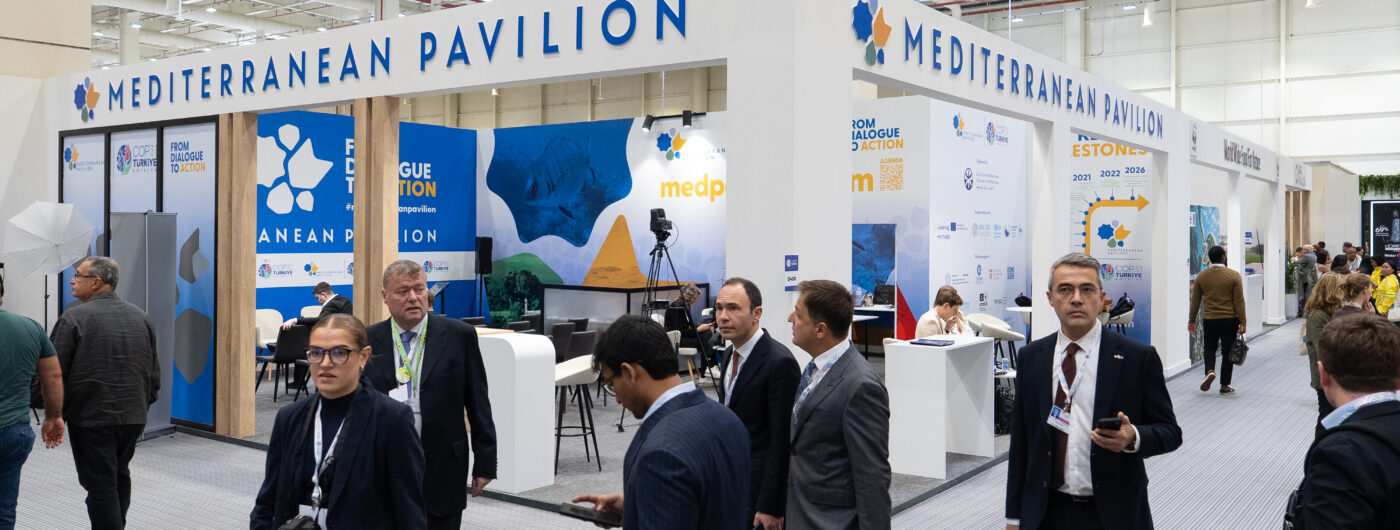
10 November 2026, COP31 Antalya. The Union for the Mediterranean is once again hosting a Mediterranean Pavilion at this year’s COP, ensuring the region’s climate priorities and solutions are present at the international climate conference. Organised in partnership with Interreg NEXT MED, the Anna Lindh Foundation and the United Nations Environment Programme’s Mediterranean Action Plan (UNEP/MAP)’s Climate Change Regional Activity Centre in Istanbul, it will be located in the conference’s Blue Zone from 10 to 20 November. The Mediterranean Pavilion provides regional stakeholders with a shared space to connect climate commitments with practical action and build on the cooperation established in its first edition at COP27 in 2022.
This year’s conference in the UfM Member State of Türkiye carries particular strategic and symbolic weight for the region. One of the world’s most vulnerable regions to climate change, average temperatures in the Mediterranean are already 1.5°C above pre-industrial levels. The region’s more than 500 million inhabitants face increasingly severe heatwaves, droughts, wildfires and floods in addition to rising sea levels and desertification. Without stronger cooperation on climate action, these cross-border pressures risk further undermining ecosystems, livelihoods, infrastructures and economic stability across the Mediterranean.
The pavilion’s programme of activities explores how this cooperation can deliver tangible results: financing adaptation, expanding renewable energy, protecting ecosystems and supporting more sustainable ways of producing and consuming in our region. It also connects experiences from across the Mediterranean with those of other parts of the world facing similar climate risks.
“For the first time, the world’s most important climate conference is taking place on Mediterranean shores. This is an opportunity we cannot afford to miss. Our region is a climate change hotspot, and its challenges transcend national borders,” said UfM Deputy Secretary General for Stability and Resilience Joan Borrell. “The Mediterranean Pavilion sends a clear message: despite our differences, we share the same climate risks and have much to gain by working together. Our ambition is to turn this common vulnerability into a driving force for cooperation and concrete climate action.”
The Mediterranean Pavilion’s activity highlights include:
- Extreme heat: action & policy from subnational governments, 10 November (11:30-12:30 GMT+3). The Mediterranean Climate Action Partnership will bring together regional governments to share adaptation measures and discuss priorities for its next phase of cooperation, connecting Mediterranean regions with counterparts including California and the Western Cape.
- New partnerships to strengthen energy cooperation in the Mediterranean, 10 November (13:00-14:00 GMT+3). The TeraMed Initiative will explore renewable energy deployment, investment and regional electricity integration. The session will include the signing of a new TeraMed–UfM Partnership Agreement.
- Launch of new investments in the green transition, 11 November (13:00-14:00 GMT+3). Interreg NEXT MED will launch 49 projects worth over €120 million, bringing together more than 300 organisations from 15 countries. The projects address water management, clean energy, biodiversity, health and the circular economy.
- Enabling 1.5°C Lifestyles through Circular Economy, 13 November (13:00-14:00 GMT+3). MedWaves and the Hot or Cool Institute will examine how public policy, business innovation and the circular economy can reduce material and energy demand while supporting people’s wellbeing.
- Press conference on human mobility in a warming Mediterranean, 16 November (10:30-11:00 GMT+3 in Press Conference Room 1 Mevlana, Area D2-D3). The UfM and the Mediterranean Experts on Climate and Environmental Change (MedECC) will present the main outcomes of the Mediterranean Pavilion and the findings MedECC’s latest report on the complex links between environmental pressures, conflict and human migration in the Mediterranean. Information is available under embargo upon request.
- Financing the protection of marine and coastal ecosystems, 17 November. WWF Mediterranean will launch the Mediterranean Blue Natural Capital Accelerator Facility, exploring how investment can support ecosystem restoration, including seagrass meadows, and strengthen the resilience of coastal communities.
In addition to the UfM’s organising partners, the pavilion is supported by Italy’s Ministry of Foreign Affairs and International Cooperation; Croatia’s Ministry of Environmental Protection and Green Transition; the International Centre for Advanced Mediterranean Agronomic Studies (CIHEAM); the Rome Initiative on Water; MedWaves; UNESCO’s Intergovernmental Hydrological Programme; the Mediterranean Climate Action Partnership; the Mediterranean Alliance of Think Tanks on Climate Change; the TeraMed Initiative; WWF Mediterranean; the Euro-Mediterranean Economists Association; and the Mediterranean Experts on Climate and Environmental Change (MedECC).