
• English
  • Français
  • العربية
Follow us
Union for the Mediterranean – UfMUnion for the Mediterranean – UfMUnion for the Mediterranean – UfMUnion for the Mediterranean – UfM
  • Who we are
    • The Union for the Mediterranean is an intergovernmental institution bringing together the European Union Member States and 16 countries from the Southern and Eastern shores of the Mediterranean to promote dialogue and cooperation.

      OVERVIEW   

    • Who we are

      • Member States
      • Meet the team
      • Partners
      • History

      Transparency and accountability

      • Transparency and access to information
      • Investigating fraud, corruption and misconduct
    • Key documents

      UfM Institutional Brochure UfM How we work

      More documents   

  • What we do
    • The UfM seeks to enhance regional cooperation, dialogue and the implementation of concrete projects and initiatives with tangible impact on our citizens to address three strategic objectives: human development, stability and integration.

      OVERVIEW   

    • Inclusive development

      • Economic Development and Employment
      • Higher Education & Research
      • Social & Civil Affairs

      Sustainable development

      • Water, Environment and Blue Economy
      • Transport & Urban Development
      • Energy & Climate Action

      Initiatives that build bridges

      • Day of the Mediterranean
      • Mediterranean Capitals of Culture and Dialogue
    • How we work

      • Policy Frameworks
      • Regional Platforms
      • Projects and Initiatives
  • Work with us
    • The UfM Secretariat is the operational platform of the Union for the Mediterranean. The staff of the UfM is made of more than 17 nationalities working in a multicultural environment that fosters cooperation and intercultural communication and exchange.

    • Work with us

      • Vacancies
      • Secondments
      • Internships
      • Procurement
  • Info centre
    • Find our latest press releases, press invitations, visual identity, key institutional documents, photos and other relevant information


      DOWNLOAD THE UfM VISUAL IDENTITY GUIDELINES AND LOGOS (ZIP FILE)   

    • Info centre

      • Media corner
      • News
      • Agenda
      • Publications and key documents
      • Stories of Euro-Mediterranean Cooperation
    • UfM in the Media

      9 May 2026 – Agence Europe (EN) – The fire season that never ends – by Joan Borrell Mayeur
      View article
      9 May 2026 – Agence Europe (FR) – Une saison des feux qui n’en finit pas – par Joan Borrell Mayeur
      View article
      7 May 2026 – Al-Dustour – حرائق غابات المتوسط على وشك أن تبدأ مجدداً… بلا حدود
      View article
  • Contact

Agri-food systems facing climate change in the MENA region: gender equality for better resilience

Social & Civil Affairs

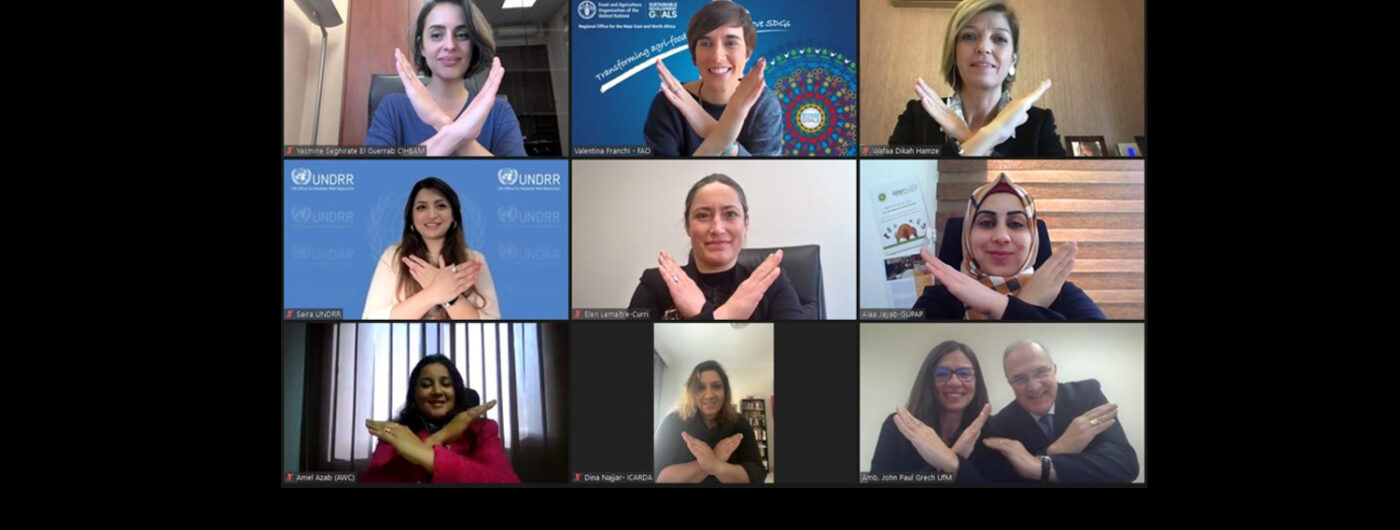
The UfM, in partnership with the Regional Office for the Near East and North Africa of FAO and the International Center for advanced Mediterranean agronomic studies (CIHEAM), organized the online event “Agri-food systems facing climate change in the MENA region: gender equality for better resilience”.

7 March 2022. In the context of the 2022 International Women’s Day, recognizing this year the contribution of women and girls to build a more sustainable future, the UfM organised, in partnership with the Regional Office for the Near East and North Africa of FAO and the CIHEAM , the online event on “Agri-food systems facing climate change in the MENA region: gender equality for better resilience” to identify challenges faced by women as change drivers for a more resilient agri-food systems facing climate change. Moreover, possible solutions were put forward in terms of policies, strategies and governance at regional and country levels.

The opening remarks by Abdulhakim Elwaer, Assistant Director General and Regional Representative, FAO Regional Office for the Near East and North Africa highlighted the important role that women play in agri-food systems in the face of climate change and water scarcity in the region, despite the persisting inequalities that constraint their potential and empowerment. He also pointed out to the need to strengthen collaborations across the region to consolidate and accelerate efforts.

However, because of persistent bias and discrimination, women have less opportunity to thrive and have limited access to technology, financial instruments and actual land ownership. In this regard, Elen Le maître-Curri, director of Plan Bleu,  recalled that the effects of climate change aggravate an already complicated situation for the agri-food systems of the MENA region, marked by limited natural resources, food insecurity, or even rural areas that are losing part of their population, especially the youngest and most active. A set of challenges that affect women differently than men.

In the round table a constructive exchange took place, bringing together experiences from across the region, thanks to the contribution of institutions and organizations, such as ICARDA, UNDDRR, Arab Water Council and GUPAP among others.

The discussion focused its attention on the need to foster rights and fair policies in order to support the most fragile groups, namely women, girls and children. Women – especially in rural communities – provide for their families and contribute to the resilience of their communities while being paid less than men and are often those affected by discriminating policies and harmful social norms which exclude them from the relevant decision-making processes. When it comes to the migrations caused by climate change, women are the most vulnerable and it is therefore important to include political measures to promote women’s priorities linked to climate change events.

Social bias has been identified as very visible in the region: power dynamics at the community level prevent women from excelling in knowledge and experience. It is therefore important to raise awareness to fight discriminatory social norms, and to do so the involvement of men is an essential tool as well as the creation of women networks to exchange best practices.

In his closing remarks the Deputy Secretary General of the UfM, John Paul Grech, highlighted “Women leadership is a key factor to be ensured when outlining climate resilient policies. It is key that women actively participate in the discussions and decisions over climate change mitigation and adaptation, as they possess unique skills and knowledge to help respond to climate change effectively and sustainably”.

This joint event by the UfM, in partnership with the Regional Office for Near East and North Africa of FAO and the International Center for advanced Mediterranean agronomic studies (CIHEAM) stems from their commitment to promoting gender equality and women’s empowerment in agri-food systems, and to creating a conducive environment for women and girls to lead and thrive.
Share this:

Latest news

Time to act on climate change in the Mediterranean is now, UfM warns ahead of World Environment Day
03 / 06 / 2026
Bridging the digital skills gap and boosting smart e-governance solutions: promoting digital transformation through a UfM Conference in Antalya
21 / 05 / 2026
See more

SUBSCRIBE TO OUR NEWSLETTER!


Agenda

UfM Senior Officials Meeting (SOM) June 2026
10 / 06 / 2026
Women Leading Change – Training for Universities and their Municipalities
11 / 06 / 2026
See more

Who we are

  • Member States
  • Meet the team
  • Partners
  • History
  • Transparency and accountability
  • Transparency and access to information
  • Investigating fraud, corruption and misconduct

What we do

  • Economic Development & Employment
  • Higher Education & Research
  • Social & Civil Affairs
  • Water, Environment and Blue Economy
  • Transport & Urban Development
  • Energy & Climate Action
  • Day of the Mediterranean
  • Mediterranean Capitals of Culture and Dialogue

How we work

  • Policy Framework
  • Regional Platforms
  • Projects and Initiatives

Work with us

  • Vacancies
  • Secondments
  • Internships
  • Procurement

Info centre

  • Media corner
  • News
  • Agenda
  • Publications and key documents
  • Stories of Euro-Mediterranean Cooperation
  • Photo gallery
  • Video gallery
Co-financed by the European Union
  • Who we are
    • Member States
    • Meet the team
    • Partners
    • History
    • Transparency and accountability
      • Transparency and access to information
      • Investigating fraud, corruption and misconduct
  • What we do
    • Economic Development and Employment
    • Higher Education & Research
    • Social & Civil Affairs
    • Water, Environment and Blue Economy
    • Transport & Urban Development
    • Energy & Climate Action
  • Initiatives that build bridges
    • Day of the Mediterranean
    • Mediterranean Capitals of Culture and Dialogue
  • How we work
    • Policy Framework
    • UfM Regional Platforms
    • Projects and Initiatives
  • Work with us
    • Vacancies
    • Secondments
    • Internships
    • Procurement
    • Roster of experts
  • Info centre
    • Media center
    • News
    • Agenda
    • Publications and key documents
    • Human Stories of the Mediterranean
  • Contact
  • Social media
    • Facebook
    • Twitter
    • Youtube
    • Linkedin
    • Flickr
  • English
  • Français
  • العربية
  • English
  • Français
  • العربية
Union for the Mediterranean – UfM


We are using cookies to give you the best experience on our website.

You can find out more about which cookies we are using or switch them off in .

Powered by  GDPR Cookie Compliance
Cookies Overview

This website uses cookies so that we can provide you with the best user experience possible. Cookie information is stored in your browser and performs functions such as recognising you when you return to our website and helping our team to understand which sections of the website you find most interesting and useful.

Read more

Strictly Necessary Cookies

Strictly Necessary Cookie should be enabled at all times so that we can save your preferences for cookie settings.

3rd Party Cookies

This website uses Google Analytics to collect anonymous information such as the number of visitors to the site, and the most popular pages.

Keeping this cookie enabled helps us to improve our website.