
PLASTIC BUSTERS
Context and objectives
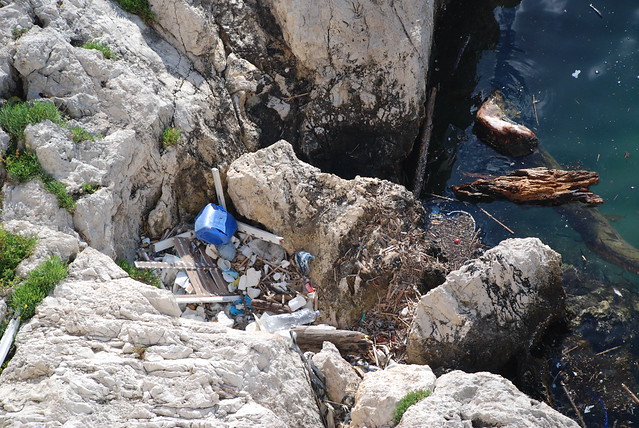
Marine litter remains one of the most pressing threats to the Mediterranean, affecting marine wildlife, coastal ecosystems, beach quality, fisheries and the livelihoods of coastal communities. Since 2013, the Plastic Busters Initiative has worked to tackle this challenge through a coordinated Mediterranean approach: monitoring, assessment, prevention, mitigation, governance support, capacity-building and awareness-raising.
Originally recognised as a sustainable development solution and later granted the UfM label in 2016, the Initiative has evolved into a shared framework for like-minded projects addressing marine litter and wider environmental pressures across the region.
Today, this framework continues through projects such as MIRAMAR and MedProAct, bringing science, innovation and transnational cooperation together to protect and restore Mediterranean ecosystems.
The goal is clear: move from fragmented efforts to shared solutions for a cleaner, healthier and more resilient Mediterranean Sea.
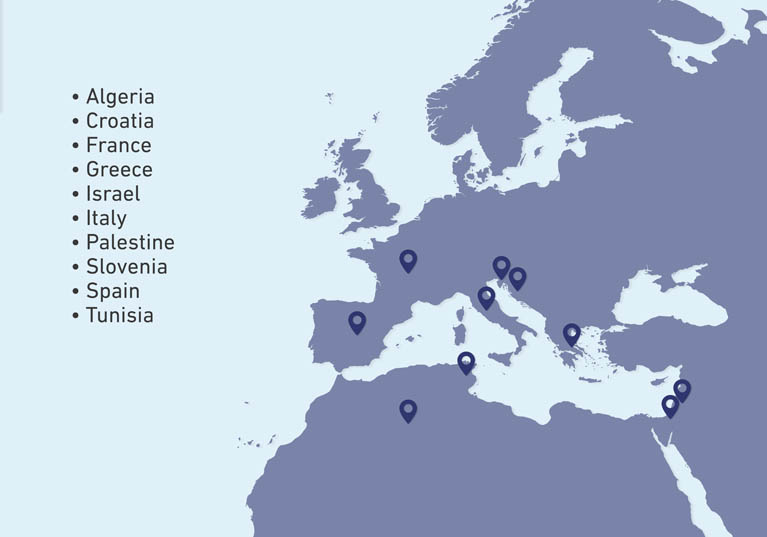
Location
Key figures
Duration:
Since 2016
Countries:
10
Financial contribution
Contribution from promoters: € 3.6M
Promoter
This project is promoted by the University of Siena, which has wide experience in collecting data on micro-plastics in the Mediterranean Sea and in the eco-toxicological effects of plastic derivates on bio-indicator organisms.
Key partners
UN Environment Programme /Mediterranean Action Plan (UNEP/MAP)
Mediterranean Information Office for Environment Culture & Sustainable Development (MIO-ECSDE)
Institut Français de Recherche pour l’Exploitation de la Mer (IFREMER)
Balearic Islands Coastal Observing & Forecasting System (SOCIB)
Italian National Institute for Environmental Protection & Research (ISPRA)
University of Sousse
IWRS
Consiglio Nazional delle Ricerche (CNR)
Hellenic Centre for Marine Research (HCMR)
ECNC Land & Sea Group
ISOTECH
Consorzio Mediterraneo
University of Bologna
FispMed

Beneficiaries
Regional authorities, municipalities & local authorities, including port authorities.
Coastal and marine industry (commercial fishing, coastal tourism).
Waste management sector (waste collection and transportation, sewage treatment) and industrial sector (including the plastics industry).
Environmental NGOs.
Educators, students and wider public.
Key actions
Addressing information gaps regarding marine litter, complementing existing assessments carried out in the region, as well as further developing and implementing harmonised monitoring methods based on the UNEP/MAP monitoring guidance and other projects where appropriate.
Developing and coordinating demonstration projects showcasing actions to prevent, reduce and remove marine litter in the Mediterranean Sea, following steps set out in the UNEP/MAP Regional Plan on Marine Litter Management in the Mediterranean.
Assess the status of the implementation of the above mentioned Regional Plan on Marine Litter at national, sub-regional and regional level
Results
A comprehensive assessment of the status (amounts, composition, impacts) of marine litter, including a geographic information system database.
A hotspot analysis of areas with marine litter accumulation in the Mediterranean.
A set of comprehensive recommendations based on scientific findings to facilitate effective policymaking at regional, national and local levels with regards to the prevention, reduction and removal of marine litter in the Mediterranean Sea.
Involvement and participation of 50-60 regional marine litter experts in the development and application of standarised monitoring methods.
At least 10 demonstration projects showcasing specific actions to prevent, reduce and remove marine litter in the Mediterranean Sea.
A comprehensive assessment of the status of implementation of the Regional Plan and a package of measures to fully tackle marine litter.
Awareness campaigns in at least 15 Mediterranean countries to promote the shared responsibility of all stakeholders in tackling marine litter.