
The Mediterranean, a sea with no water
By the UfM Secretary General ad interim, Fadi Hajali.
Published in Syria TV, Annahar, Al Rai, La Marseillaise, La Dépêche du Midi, EFE Verde, Repubblica, Le Soir, Youm7, Kathimerini, Assabah Morocco, Assabah Tunisia (print), Mediapart, TSA, La Libre, Al Ahdat Maghribya (print).
There is no getting around the fact that millions of people worldwide face severe water shortages, all too frequently turning a basic necessity into a luxury item. As tempting as it may be to view this as a distant problem affecting the nameless others, here in the Mediterranean we could all do with taking a good look at our own corner of the globe.
That the Mediterranean is a global warming hotspot, one that is warming 20% faster than the global average, is a well-established fact. Coupled with economic and demographic pressures, the entire region’s water resources and services are under considerable strain. Significantly, all Southern and Eastern Mediterranean countries have less than 500m3 to 1000m3 of water available per inhabitant annually – a reality that meets the official definition of ‘water scarcity’. The picture isn’t all that much rosier in the north: 30% of Southern Europe’s population lives in areas with permanent water stress, while a staggering 70% do in the summer. Across the basin, some 180 million people are water poor and another 60 million experience severe water stress. Water, or the lack thereof, is a decidedly Mediterranean crisis.
Now that the basic facts have been established – that the availability of water is critically low across the countries bordering our shared sea – it is time we decided how to move forward from here. Are siloed national approaches the answer? Or should we tackle this regional problem face on, recognising it for what it is? When business-as-usual amounts to passive resignation at best and obstinate cynicism at worst, I implore you to join me in choosing to confront this together.
This week in Rome representatives from the Union for the Mediterranean’s 43 Member States endorsed the 2nd UfM Ministerial Declaration on Water in the Mediterranean. Stressing the need for greater cross-border cooperation on sustainable water management, it acknowledges the multifaceted consequences of the current situation: harmful impacts on human health and ecosystems, stunted socioeconomic development or an increase in the frequency and intensity of natural disasters.
Far from an empty political statement, this declaration sets in motion the launch of the Rome Initiative on Water to mobilise investments and technical capacity for the sustainable water systems our Mediterranean so desperately needs. Although there has been some progress in recent years, financial sustainability has all too often proven to be a barrier to environmental sustainability. By creating a framework that connects, coordinates and enhances existing efforts, the Rome Initiative on Water bridges the funding and expertise gaps hindering the modernisation and improved management of utility plants. A drop in the – if you will allow me – sea, perhaps, but perhaps also a blueprint for other vital sustainability initiatives that can be replicated to build a more integrated and resilient Mediterranean.
If one thing should be apparent by now, it’s that our Mediterranean’s water woes cannot be addressed in isolation. Our water systems are intimately interwoven – in no world can one country become entirely secure when their immediate neighbours face scarcity. Water has the potential to shape not only the integrity of our ecosystems and the health of our people, but the very heart of our region’s socioeconomic and political stability. We have the necessary knowledge and tools to address this issue. Do we, therefore, choose to become a region of cooperation and resilience, or one of escalating vulnerabilities?
28 September 2026
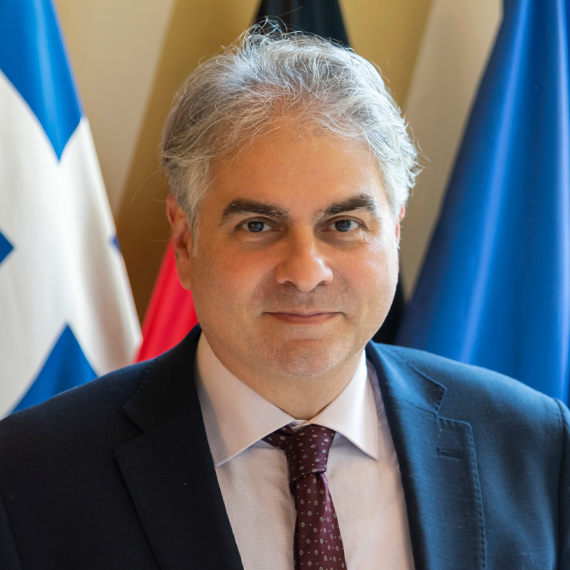
Fadi Hajali
Secretary General ad interim of the Union for the Mediterranean.

