
UfM and MEDPorts launch first comparative study on governance models of Mediterranean ports
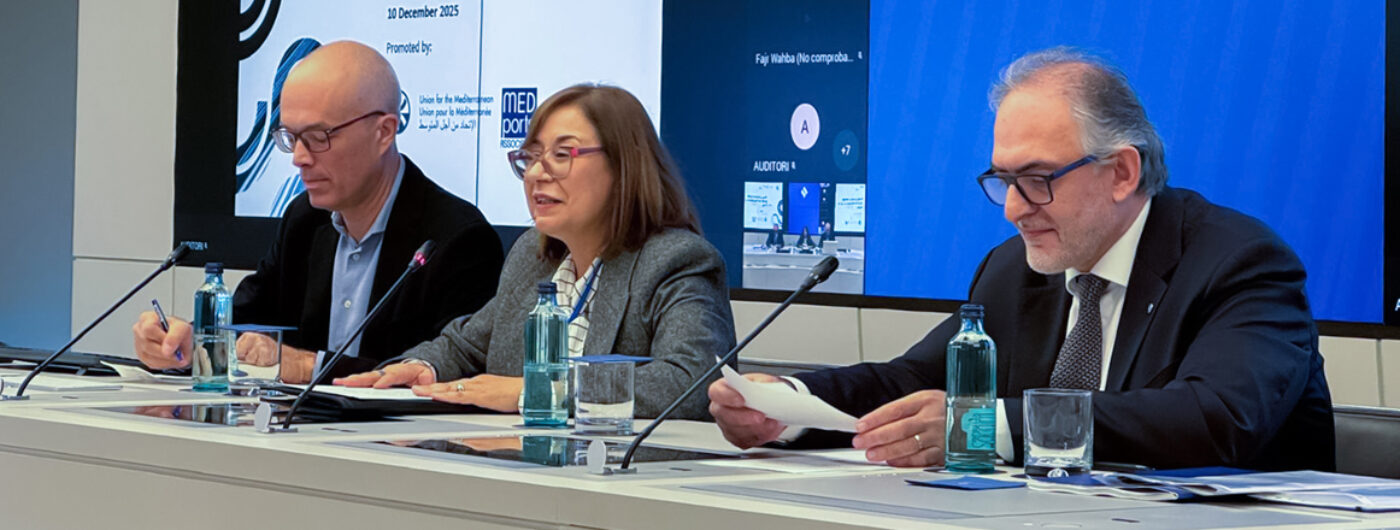
Barcelona, 10 December 2025. The Union for the Mediterranean (UfM) and the MEDPorts Association today launched the Study on Governance Models of Mediterranean Ports at the Port of Barcelona, presenting the first comprehensive comparative overview of how ports across 16 Mediterranean countries are governed and organised.
The study compiles and systematises data on port ownership structures, regulatory frameworks and operational responsibilities. It maps governance structures in Albania, Algeria, Croatia, Egypt, France, Greece, Jordan, Italy, Lebanon, Libya, Malta, Mauritania, Morocco, Slovenia, Spain and Tunisia, providing an evidence base to support regional cooperation, policy alignment and knowledge sharing.
The study, developed by the UfM in collaboration with MEDPorts, with analytical work carried out by CENIT-CETMO, responds to a clear and longstanding regional need arising from the diversity of governance and organisational models in the Mediterranean, including differences in ownership, regulation, autonomy and service provision. Until now, this diversity had not been analysed in a structured, comparative way. By filling this gap and bringing together a substantial body of previously unsystematised data, the work places the Mediterranean on a par with other maritime regions that have already benefited from wide-ranging comparative analysis of port governance.

“Port governance in the Mediterranean is not only a technical matter—it is strategic, economic, environmental, and geopolitical,” said UfM Acting Deputy Secretary General for Transport and Urban Development Dhouha Najjar at the launch. “The study we are launching today fills this gap. It is a major achievement—one that will serve policymakers, port authorities, operators, investors, and regional organisations for years to come.”
Key findings presented today confirm that public administration remains central to port governance in most Mediterranean countries, where national ministries or specialised public entities define strategic objectives, investment frameworks and regulatory structures. In twelve of the sixteen countries analysed, some form of landlord port model predominates, combining public oversight with private operational responsibilities, though the balance between the two varies significantly. Port managing bodies continue to prioritise traditional functions such as cargo operations, vessel services, logistics integration and port–industry interfaces, while roles related to digital transformation, decarbonisation and energy transition are emerging but remain uneven across the region. Private operators are deeply involved in operations but are less present in long-term strategic planning except where concession frameworks or governance structures encourage deeper engagement.
The study is fully aligned with the UfM Ministerial mandate on transport connectivity and with the UfM Regional Transport Action Plan for the Mediterranean, endorsed by UfM Transport Ministers. It constitutes one of the first major building blocks of the permanent knowledge centre on transport systems envisaged under Action 25, which calls for the systematic collection and analysis of data to monitor the functioning of transport systems in the region.
By providing a shared evidence base on governance models across MEDPorts members—more than 30 ports from all shores of the Mediterranean representing over 70% of freight traffic and 90% of passenger traffic in the basin—the study will support the work of the UfM Regional Platform on Transport Connectivity and its Working Group on Maritime Transport. It will help inform future cooperation on port governance and maritime transport, contributing to more efficient, sustainable and resilient Mediterranean port systems.
Study on Governance Models of Mediterranean Ports – Final Report