
Diversity is what Mediterranean peoples are made of
By the UfM Secretary General, Nasser Kamel.
Published on the occasion of the World Day for Cultural Diversity for Dialogue and Development. Published in L’Orient-Le Jour.
The Mediterranean has never been defined by isolation. Throughout the centuries, its societies have been forged through exchange, movement, and the constant encounter between cultures, languages, and beliefs. Civilisations around this sea evolved through a continuous process of interaction that transcends borders.
The foundations of our shared heritage are rooted in this long history of movement and encounter. Across centuries, the Mediterranean served not only as a corridor for trade and knowledge, but as a space where identities themselves were continuously shaped through contact with others. Languages absorbed new vocabularies, cuisines blended ingredients and techniques from distant shores, and artistic expressions evolved through constant reinterpretation. Ports, markets, and universities became meeting points where various communities exchanged knowledge, customs, ideas, and worldviews. Political systems, commercial practices, literature, music, and everyday social habits all emerged from this layered process of interaction. Mediterranean societies did not develop in parallel isolation; they were forged through coexistence, negotiation, adaptation, and mutual influence. This continuous circulation of people and culture transformed diversity from a simple fact of geography into one of the region’s defining civilisational strengths.
This legacy demonstrates that the region’s most significant periods of advancement have consistently coincided with its greatest openness to diversity. Today, this historical interdependence serves as a reminder that our collective resilience depends on our ability to maintain these channels of cooperation and cross-pollination, ensuring that the Mediterranean remains a space of shared opportunity.
However, we cannot ignore the gravity of the current moment, nor the deep sense of pain and exhaustion felt by many across our shores. Conflicts across the region continue to exact a devastating human toll. The catastrophic humanitarian conditions and regional instability reveal the heartbreaking consequences of collapsed dialogue and the disregard for international law. These crises do not exist in isolation; they reverberate far beyond the immediate conflict zones, deepening polarisation, fuelling extremism, and fraying the social cohesion that binds us together as a human family.
At the same time, xenophobia and divisive rhetoric are rising globally. Hate speech, often amplified by disinformation, erodes the trust required for any lasting peace. At a moment when multilateralism is under strain and interdependence is sometimes viewed as a vulnerability, the Mediterranean reminds us of a simple, unavoidable reality: geography leaves no room for isolation.
In such a climate, we must recognise that dialogue is not a soft alternative to political action. It is a political act in itself and the very foundation upon which any sustainable peace must be built.
This is why the Union for the Mediterranean together with the Anna Lindh Foundation launched the Mediterranean Capitals of Culture and Dialogue. The initiative is not simply a cultural label or a celebration of heritage; it is a long-term investment in rebuilding trust across a fragmented region. By connecting cities such as Matera and Tetouan this year, and Cordoba and Saida in 2027, the programme creates sustained spaces for cooperation between artists, educators, civil society organisations, universities, and local communities from different shores of the Mediterranean. At a time when political divisions often dominate regional relations, cities can still preserve channels of dialogue that remain open, practical, and human. The Capitals demonstrate that culture is not peripheral to peacebuilding; it is one of the few spaces where empathy, shared memory, and mutual recognition can still be actively cultivated. Through exchanges, co-creations, and people-to-people engagement, these cities become living examples of how diversity can be transformed into cooperation rather than conflict.
Cultural co-production and these sustained partnerships achieve what policy papers alone cannot: they make the “other” recognisable again. They remind us that behind every political boundary is a person with shared aspirations for dignity, security, and a future for their children.
The strength of our region has never come from sameness. It has come from the difficult and unfinished work of living together. The sea between us is a mirror that reflects what we choose to build together or what we allow to drift apart. In a time of conflict and mistrust, investing in our shared culture is not a luxury. It is an act of defiance against hatred and a long-term investment in the regional cohesion we so desperately need.
21 May 2026
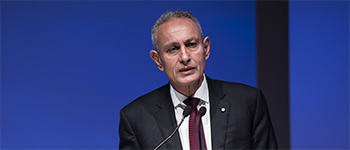
Nasser Kamel
Nasser Kamel is the Secretary General of the Union for the Mediterranean.

