• English
  • Français
  • العربية
Follow us
Union for the Mediterranean – UfMUnion for the Mediterranean – UfMUnion for the Mediterranean – UfMUnion for the Mediterranean – UfM
  • Who we are
    • The Union for the Mediterranean is an intergovernmental institution bringing together the European Union Member States and 16 countries from the Southern and Eastern shores of the Mediterranean to promote dialogue and cooperation.

      OVERVIEW   

    • Who we are

      • Member States
      • Meet the team
      • Partners
      • History

      Transparency and accountability

      • Transparency and access to information
      • Investigating fraud, corruption and misconduct
    • Key documents

      UfM Institutional Brochure UfM How we work

      More documents   

  • What we do
    • The UfM seeks to enhance regional cooperation, dialogue and the implementation of concrete projects and initiatives with tangible impact on our citizens to address three strategic objectives: human development, stability and integration.

      OVERVIEW   

    • Inclusive development

      • Economic Development and Employment
      • Higher Education & Research
      • Social & Civil Affairs

      Sustainable development

      • Water, Environment and Blue Economy
      • Transport & Urban Development
      • Energy & Climate Action

      Initiatives that build bridges

      • Day of the Mediterranean
      • Mediterranean Capitals of Culture and Dialogue
    • How we work

      • Policy Frameworks
      • Regional Platforms
      • Projects and Initiatives
  • Work with us
    • The UfM Secretariat is the operational platform of the Union for the Mediterranean. The staff of the UfM is made of more than 17 nationalities working in a multicultural environment that fosters cooperation and intercultural communication and exchange.

    • Work with us

      • Vacancies
      • Secondments
      • Internships
      • Procurement
  • Info centre
    • Find our latest press releases, press invitations, visual identity, key institutional documents, photos and other relevant information


      DOWNLOAD THE UfM VISUAL IDENTITY GUIDELINES AND LOGOS (ZIP FILE)   

    • Info centre

      • Media corner
      • News
      • Agenda
      • Publications and key documents
      • Stories of Euro-Mediterranean Cooperation
    • UfM in the Media

      9 May 2026 – Agence Europe (EN) – The fire season that never ends – by Joan Borrell Mayeur
      View article
      9 May 2026 – Agence Europe (FR) – Une saison des feux qui n’en finit pas – par Joan Borrell Mayeur
      View article
      7 May 2026 – Al-Dustour – حرائق غابات المتوسط على وشك أن تبدأ مجدداً… بلا حدود
      View article
  • Contact

Gender-Responsive procurement boosts resilience of transport networks at ITF 2025 Summit

Transport & Urban Development

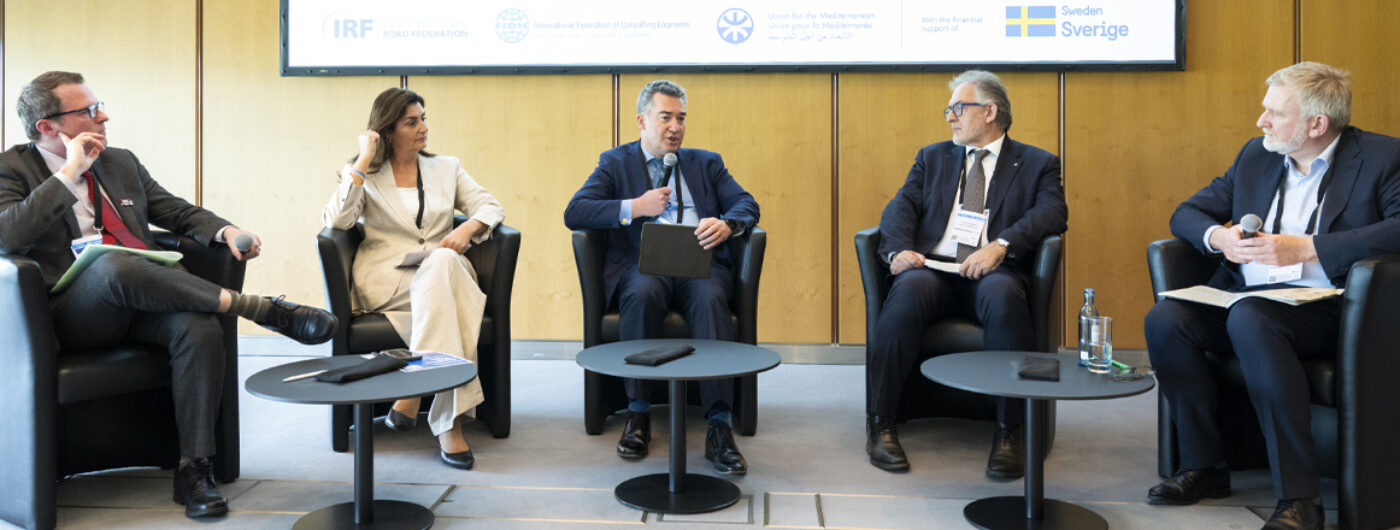
21 May 2025, Leipzig, Germany – The Union for the Mediterranean (UfM), in collaboration with the International Road Federation (IRF) and the International Federation of Consulting Engineers (FIDIC), and with the financial support of Sweden (Sida), organised the Official Side Event titled “Effective Qualifications-Based and Gender-Responsive Procurement as a Tool to Enhance the Resilience of Transport Systems” on 21 May 2025 during the ITF 2025 Summit held in Leipzig, Germany.

Transport systems in many LMICs remain under development, making the current decade crucial for avoiding inefficient investments and costly retrofitting in the future. Natural hazards cause an estimated USD 15 billion in direct damage to global transport systems annually, with LMICs bearing about USD 8 billion — the highest costs relative to their GDP. Despite the transport sector receiving around 29% of global climate finance, it faces the largest investment gap of any sector.

Against this background, the session explored the challenges and innovative procurement strategies and solutions for building resilient transport systems in low- and middle-income countries (LMICs) and emerging economies. It underscored the crucial role of effective procurement in shaping the resilience of transport infrastructure in the face of diverse global challenges, while optimising resources, promoting gender equality, and a more equitable and sustainable future.

The session featured key speakers, including Dhouha Najjar, UfM Acting Deputy Secretary General for Transport and Urban Development, and Gonzalo Alcaraz, IRF Acting Director General. The panel discussion brought together experts from across the field, including Francesc Carbonell, UfM Head of Sector for Transport, Susanna Zammataro, CEO of FIDIC, Nicolas Peltier, Global Director for Transport at the World Bank, and Reinaldo Fioravanti, Group Head of Infrastructure & Transportation at the Inter-American Development Bank (IDB). The session was moderated by Mike Evans, Director of Global Roads and Streets at ARUP and Board Member of IRF.

As highlighted by UfM Acting Deputy Secretary General Najjar during her Opening Address, “the Mediterranean region, at the crossroads of three continents, faces critical challenges. By focusing on resilience, climate adaptation, and social inclusion of transport systems, we can turn these challenges into opportunities for sustainable development. The next decade is crucial for building transport infrastructure that can withstand future shocks, particularly in vulnerable low- and middle-income countries. It is important to recognise the central role of the procurement process in shaping resilient transport infrastructure, while addressing broader social and environmental goals.”

As noted by Francesc Carbonell, UfM Head of Sector for Transport during the panel discussion, “public procurement is a significant policy instrument, accounting for 29% of government expenditures and approximately 12% of gross domestic product (GDP) in the OECD area. Public procurement policies and processes can therefore be a powerful tool to pursue strategic objectives and drive demand for greater gender equality. Even if infrastructure projects do not explicitly consider a gender angle, public procurement can help mainstream gender equality and gender considerations throughout the delivery and execution of transport infrastructure projects.”

The discussion touched upon qualifications-based procurement which prioritizes high-quality materials, experienced contractors, sustainable practices, and risk management. By adopting such methods, transport authorities were able to ensure that infrastructure projects were not only structurally resilient but also contributed to a diverse, inclusive workforce. This approach, it was argued, would lead to better long-term outcomes in terms of both project success and societal resilience.

Building on the ongoing partnership between the UfM Secretariat and the IRF, the event emphasized a shared commitment to inclusive, sustainable transport systems. The side event also complemented the broader goals of the ITF 2025 Summit, which brought together transport ministers, international organizations, and industry leaders to discuss global strategies for adapting to and recovering from disruptions.
Share this:

Latest news

Spanish Foreign Minister Joins Senior Officials to Bid Farewell to UfM Secretary General Nasser Kamel
10 / 06 / 2026
Advancing Euro-Mediterranean Research and Innovation: UfM hosts Extraordinary Platform Meeting and Scalability Roundtable
08 / 06 / 2026
See more

SUBSCRIBE TO OUR NEWSLETTER!


Agenda

UfM Study Visit on International Trade and Investment Policy
16 / 06 / 2026
3rd Mediterranean Green Week
30 / 06 / 2026
See more

Who we are

  • Member States
  • Meet the team
  • Partners
  • History
  • Transparency and accountability
  • Transparency and access to information
  • Investigating fraud, corruption and misconduct

What we do

  • Economic Development & Employment
  • Higher Education & Research
  • Social & Civil Affairs
  • Water, Environment and Blue Economy
  • Transport & Urban Development
  • Energy & Climate Action
  • Day of the Mediterranean
  • Mediterranean Capitals of Culture and Dialogue

How we work

  • Policy Framework
  • Regional Platforms
  • Projects and Initiatives

Work with us

  • Vacancies
  • Secondments
  • Internships
  • Procurement

Info centre

  • Media corner
  • News
  • Agenda
  • Publications and key documents
  • Stories of Euro-Mediterranean Cooperation
  • Photo gallery
  • Video gallery
Co-financed by the European Union
  • Who we are
    • Member States
    • Meet the team
    • Partners
    • History
    • Transparency and accountability
      • Transparency and access to information
      • Investigating fraud, corruption and misconduct
  • What we do
    • Economic Development and Employment
    • Higher Education & Research
    • Social & Civil Affairs
    • Water, Environment and Blue Economy
    • Transport & Urban Development
    • Energy & Climate Action
  • Initiatives that build bridges
    • Day of the Mediterranean
    • Mediterranean Capitals of Culture and Dialogue
  • How we work
    • Policy Framework
    • UfM Regional Platforms
    • Projects and Initiatives
  • Work with us
    • Vacancies
    • Secondments
    • Internships
    • Procurement
    • Roster of experts
  • Info centre
    • Media center
    • News
    • Agenda
    • Publications and key documents
    • Human Stories of the Mediterranean
  • Contact
  • Social media
    • Facebook
    • Twitter
    • Youtube
    • Linkedin
    • Flickr
  • English
  • Français
  • العربية
  • English
  • Français
  • العربية
Union for the Mediterranean – UfM


We are using cookies to give you the best experience on our website.

You can find out more about which cookies we are using or switch them off in .

Powered by  GDPR Cookie Compliance
Cookies Overview

This website uses cookies so that we can provide you with the best user experience possible. Cookie information is stored in your browser and performs functions such as recognising you when you return to our website and helping our team to understand which sections of the website you find most interesting and useful.

Read more

Strictly Necessary Cookies

Strictly Necessary Cookie should be enabled at all times so that we can save your preferences for cookie settings.

3rd Party Cookies

This website uses Google Analytics to collect anonymous information such as the number of visitors to the site, and the most popular pages.

Keeping this cookie enabled helps us to improve our website.