• English
  • Français
  • العربية
Follow us
Union for the Mediterranean – UfMUnion for the Mediterranean – UfMUnion for the Mediterranean – UfMUnion for the Mediterranean – UfM
  • Who we are
    • The Union for the Mediterranean is an intergovernmental institution bringing together the European Union Member States and 16 countries from the Southern and Eastern shores of the Mediterranean to promote dialogue and cooperation.

      OVERVIEW   

    • Who we are

      • Member States
      • Meet the team
      • Partners
      • History

      Transparency and accountability

      • Transparency and access to information
      • Investigating fraud, corruption and misconduct
    • Key documents

      UfM Institutional Brochure UfM How we work

      More documents   

  • What we do
    • The UfM seeks to enhance regional cooperation, dialogue and the implementation of concrete projects and initiatives with tangible impact on our citizens to address three strategic objectives: human development, stability and integration.

      OVERVIEW   

    • Inclusive development

      • Economic Development and Employment
      • Higher Education & Research
      • Social & Civil Affairs

      Sustainable development

      • Water, Environment and Blue Economy
      • Transport & Urban Development
      • Energy & Climate Action

      Initiatives that build bridges

      • Day of the Mediterranean
      • Mediterranean Capitals of Culture and Dialogue
    • How we work

      • Policy Frameworks
      • Regional Platforms
      • Projects and Initiatives
  • Work with us
    • The UfM Secretariat is the operational platform of the Union for the Mediterranean. The staff of the UfM is made of more than 17 nationalities working in a multicultural environment that fosters cooperation and intercultural communication and exchange.

    • Work with us

      • Vacancies
      • Secondments
      • Internships
      • Procurement
  • Info centre
    • Find our latest press releases, press invitations, visual identity, key institutional documents, photos and other relevant information


      DOWNLOAD THE UfM VISUAL IDENTITY GUIDELINES AND LOGOS (ZIP FILE)   

    • Info centre

      • Media corner
      • News
      • Agenda
      • Publications and key documents
      • Stories of Euro-Mediterranean Cooperation
    • UfM in the Media

      9 May 2026 – Agence Europe (EN) – The fire season that never ends – by Joan Borrell Mayeur
      View article
      9 May 2026 – Agence Europe (FR) – Une saison des feux qui n’en finit pas – par Joan Borrell Mayeur
      View article
      7 May 2026 – Al-Dustour – حرائق غابات المتوسط على وشك أن تبدأ مجدداً… بلا حدود
      View article
  • Contact

Leading the future: Shifting the focus to women’s leadership in academia

Higher Education & Research

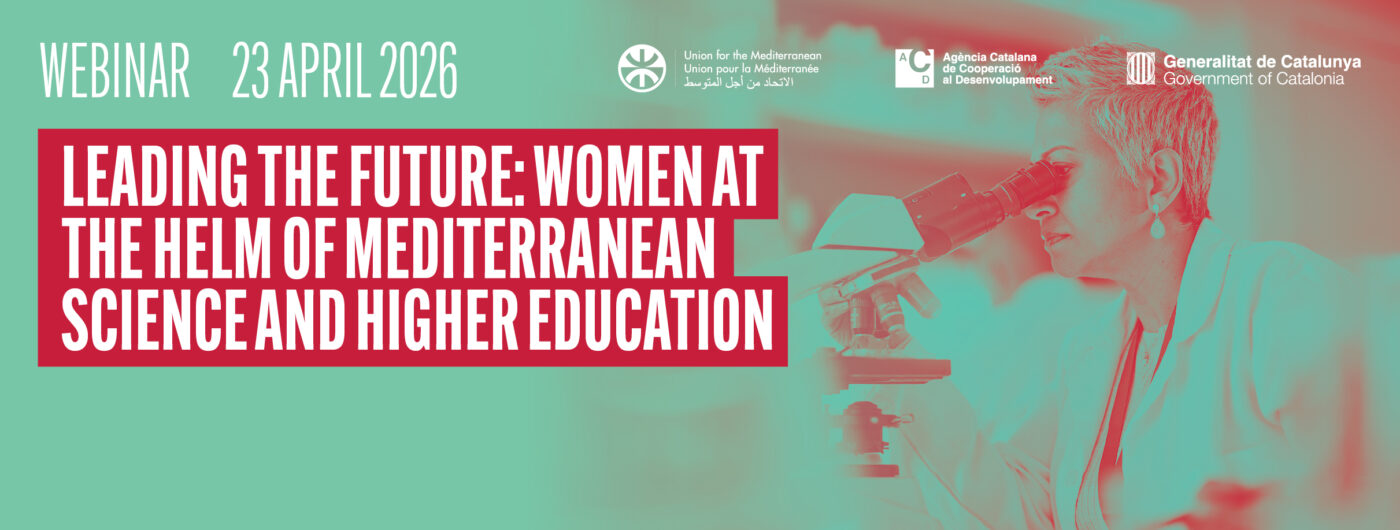
Barcelona, 23 April 2026 – Despite women making up over 50% of graduates in UfM Member States, a persistent glass ceiling keeps them critically underrepresented in top academic roles, with limited number of university heads at regional level. Highlighting structural barriers, advancements and solutions, the Union for the Mediterranean (UfM) and the Catalan Development Cooperation Agency (ACCD) hosted the high-level webinar, “Leading the Future: Women at the Helm of Mediterranean Science and Higher Education.”

Opening the event, UfM Deputy Secretary General Petra Kežman stressed that closing the leadership gap in higher education is not only a matter of equality, but a strategic imperative for the future of the Mediterranean region. “When women are excluded from leadership, the whole region loses,” she stated, adding that “women’s leadership is a driver of excellence, innovation, peace and development.” She reaffirmed the UfM’s commitment to making gender-sensitive leadership a cross-cutting priority, including through the new Women Leading Change initiative and upcoming policy dialogues.

Echoing the need for actionable solutions, Andrea Costafreda, Director General for Development Cooperation, Government of Catalonia highlighted their commitment to concrete capacity-building to empower tomorrow’s leaders.

Delivering the keynote address, Maria Cristina Russo from the European Commission emphasized that gender equality is a prerequisite for excellent science and good governance. She noted that the EU’s commitment is translated into regional action through the UfM Research and Innovation Platform and sitting at the heart of the Pact for the Mediterranean. Women must increasingly shape research agendas rather than just contribute to them.

The first session, “Women in Academic Leadership,” focused on driving tangible institutional reform to overcome entrenched biases, highlighting how deeply institutional culture and leadership practices shape progress toward gender equality in higher education. Benefiting from insights from the We4Lead project (Aix-Marseille University), speakers presented gender equality as a strategic process that requires sustained capacity building and concrete mechanisms to enable a truly transformative approach. They emphasized that while strong top-down commitment is crucial, Gender Equality Plans only succeed when supported by collective bottom-up engagement, dedicated gender-sensitive budgeting, and robust data to track women’s substantive decision-making power rather than mere descriptive representation.

Translating these insights into action, the session culminated in the presentation of the newly launched UfM project, Women Leading Change. Supported by the ACCD and implemented across ten universities in Morocco, Lebanon, and Syria, the initiative aims to strengthen institutional capacity to design and sustain truly inclusive leadership models for the future.

The second session, focusing on scientific leadership, highlighted that closing the gender gap in research and innovation is no longer solely a matter of fairness, but a critical driver of regional competitiveness. Prof. Rajaâ Cherkaoui El Moursli, awarded the UNESCO-L’Oreal Prize for Women in Science, shared her personal journey and presented data illustrating that while women are heavily present in laboratories, they remain largely invisible in management. The problem is not a lack of qualified women, but a system hampered by structural and mental barriers.

Bringing together leading scientists, policymakers, and institutional leaders, the ensuing panel discussion emphasized the urgent need to move women from the implementation stage into strategic decision-making. Panelists, including representatives from SESAME, the UK FCDO, the European Commission, and PRIMA, advocated for supporting women holistically through tools such as mentoring, sponsorship, policy levers, and positive incentives such as awards. One key strategy that emerged for altering power dynamics was ensuring women are included early in strategic decision-making and scientific advisory committees.

Ultimately, the discussion underscored that true transformation cannot rely on good will alone; it requires mandatory structural levers, contextualized policies, and a collective commitment to empowering the next generation of women leaders across the Euro-Mediterranean region.

Results will be integrated in the UfM Women Leading Change project and reported to the UfM Regional Platform on Research and Innovation.
Share this:

Latest news

UfM new leadership team meets Commissioner Šuica to advance Pact for the Mediterranean cooperation
05 / 06 / 2026
11th Meeting of the UfM Regional Platform on Trade, Investment and Industry: The 2026 UfM Economic Forum will echo regional trade and investment priorities
04 / 06 / 2026
See more

SUBSCRIBE TO OUR NEWSLETTER!


Agenda

UfM Senior Officials Meeting (SOM) June 2026
10 / 06 / 2026
Women Leading Change – Training for Universities and their Municipalities
11 / 06 / 2026
See more

Who we are

  • Member States
  • Meet the team
  • Partners
  • History
  • Transparency and accountability
  • Transparency and access to information
  • Investigating fraud, corruption and misconduct

What we do

  • Economic Development & Employment
  • Higher Education & Research
  • Social & Civil Affairs
  • Water, Environment and Blue Economy
  • Transport & Urban Development
  • Energy & Climate Action
  • Day of the Mediterranean
  • Mediterranean Capitals of Culture and Dialogue

How we work

  • Policy Framework
  • Regional Platforms
  • Projects and Initiatives

Work with us

  • Vacancies
  • Secondments
  • Internships
  • Procurement

Info centre

  • Media corner
  • News
  • Agenda
  • Publications and key documents
  • Stories of Euro-Mediterranean Cooperation
  • Photo gallery
  • Video gallery
Co-financed by the European Union
  • Who we are
    • Member States
    • Meet the team
    • Partners
    • History
    • Transparency and accountability
      • Transparency and access to information
      • Investigating fraud, corruption and misconduct
  • What we do
    • Economic Development and Employment
    • Higher Education & Research
    • Social & Civil Affairs
    • Water, Environment and Blue Economy
    • Transport & Urban Development
    • Energy & Climate Action
  • Initiatives that build bridges
    • Day of the Mediterranean
    • Mediterranean Capitals of Culture and Dialogue
  • How we work
    • Policy Framework
    • UfM Regional Platforms
    • Projects and Initiatives
  • Work with us
    • Vacancies
    • Secondments
    • Internships
    • Procurement
    • Roster of experts
  • Info centre
    • Media center
    • News
    • Agenda
    • Publications and key documents
    • Human Stories of the Mediterranean
  • Contact
  • Social media
    • Facebook
    • Twitter
    • Youtube
    • Linkedin
    • Flickr
  • English
  • Français
  • العربية
  • English
  • Français
  • العربية
Union for the Mediterranean – UfM


We are using cookies to give you the best experience on our website.

You can find out more about which cookies we are using or switch them off in .

Powered by  GDPR Cookie Compliance
Cookies Overview

This website uses cookies so that we can provide you with the best user experience possible. Cookie information is stored in your browser and performs functions such as recognising you when you return to our website and helping our team to understand which sections of the website you find most interesting and useful.

Read more

Strictly Necessary Cookies

Strictly Necessary Cookie should be enabled at all times so that we can save your preferences for cookie settings.

3rd Party Cookies

This website uses Google Analytics to collect anonymous information such as the number of visitors to the site, and the most popular pages.

Keeping this cookie enabled helps us to improve our website.