On the road to COP31: UfM launches process for a regional climate action plan at the 3rd Mediterranean Green Week
- The four-day event brought together UfM Member States, institutional partners, scientific networks, financial institutions and technical organisations working on climate and environmental action, water resilience, energy transition, civil protection and disaster risk management.
- The consultation process for the Mediterranean Climate Action Plan (2027–2028) was launched during the week, with eight Member States providing initial input. The Plan is expected to be delivered in November 2026 at the Mediterranean Pavilion at COP31 Antalya.
- Water discussions took stock of the final draft Ministerial Declaration on Water and advanced implementation of regional frameworks on the Water-Energy-Food-Ecosystems Nexus, water finance and digitalisation.
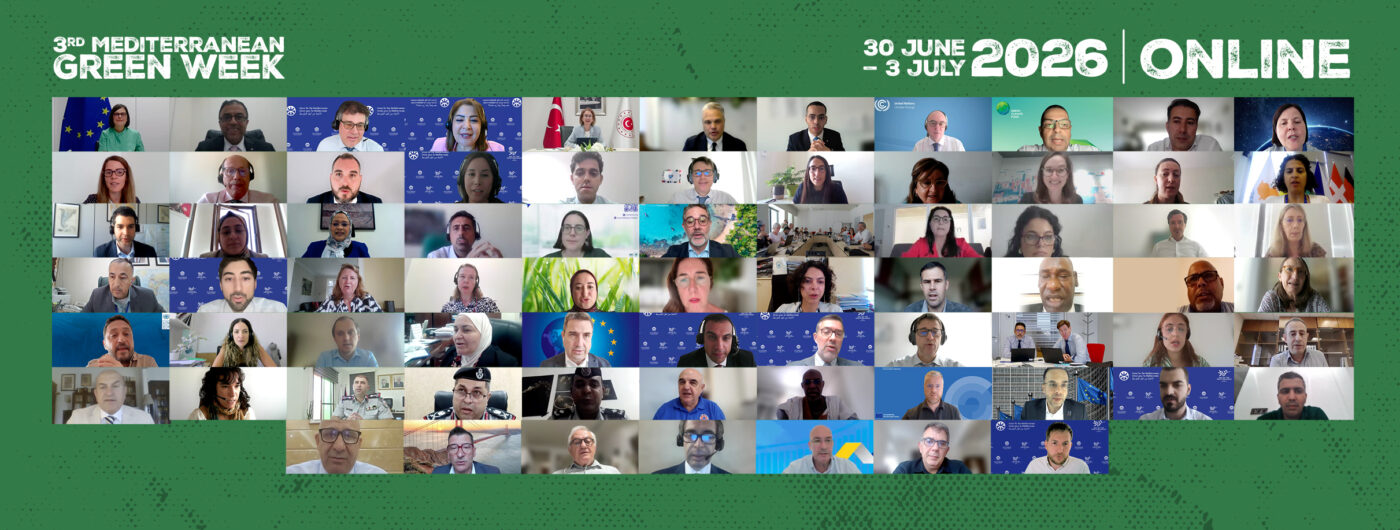
Barcelona, 6 July 2026. The Union for the Mediterranean concluded the 3rd Mediterranean Green Week, held online from 30 June to 3 July 2026, with a regional agenda focused on climate action, energy transition, water resilience, civil protection and disaster risk management. The four-day event comprised four UfM Regional Platform meetings and open public sessions, bringing together UfM Member States, institutional partners, scientific networks, financial institutions and technical organisations.
At a critical moment for the Mediterranean, one of the world’s most climate-vulnerable regions, the week provided a technical and political space to align regional priorities ahead of key Mediterranean and global milestones, including the Mediterranean Pavillion at COP31 Antalya, the UN Water Conference, the Mediterranean Climate Action Plan, the second UfM Ministerial Declaration on Water and the continued implementation of the 2030 UfM Action Plan on Civil Protection and Disaster Risk Management.
The first day launched the consultation process on the Mediterranean Climate Action Plan (2027–2028), a new regional framework intended to turn shared climate priorities into practical cooperation. Discussions were structured around the plan four pillars: climate ambition and implementation; adaptation, resilience and climate risk; climate finance and project pipelines; and enabling systems. Eight Member States took the floor, providing the first substantive inputs to a Plan that will be developed on a shared scientific evidence base with MedECC, the Euro-Mediterranean Climate and Environmental Scientists Network, and validated through 2026.
Member States welcomed Türkiye’s COP31 Presidency, as well as the UfM–Türkiye-led Antalya Mediterranean Climate Dialogue, a series of seven national consultations across the Mediterranean between 13 and 24 July 2026, planned to present its conclusions at a Ministerial Roundtable in Antalya. The discussions also highlighted preparations for the fourth edition of the Mediterranean Pavilion at COP31 in Türkiye.
As part of the 16th Meeting of the UfM Regional Platform, and in preparation for the Second UfM Ministerial Meeting on Water, scheduled to take place on 28 September 2026 in Rome, Italy, participants took note of the final draft Ministerial Declaration validated previously at a technical level by focal points on 25 February 2026.
Participants reviewed implementation of the three strategic frameworks approved in 2025: the Water-Energy-Food-Ecosystems Nexus Strategy, the UfM Recommendations on Water Finance, and the Regional Strategic Framework for the Digitalisation of the Water Sector. Discussions also covered the EU Water Resilience Strategy, the Pact for the Mediterranean, and Mediterranean contributions to the Euro-Mediterranean Water Forum, and the 2026 UN Water Conference.
An afternoon webinar on AI-driven digital water systems gathered more than 100 participants and focused on the use of data, analytics and decision-support tools for water resources management.
Member States agreed during the 7th Meeting of the UfM Regional Platform on Energy to revitalise the platfrom through at least four annual meetings, including dedicated online meetings for the three Working Groups and one in-person annual Platform meeting. They also highlighted the importance of specialised focal points, stronger links with the T-MED Initiative, and statistical cooperation with Eurostat to support harmonised regional energy data. These steps are intended to strengthen evidence-based policymaking and improve regional coordination on the clean energy transition.
The last day was for the UfM Regional Platform on Civil Protection where Member States reviewed the implementation of the UfM Action Plan on Civil Protection and Disaster Risk Management (2025–2030).