• English
  • Français
  • العربية
Follow us
Union for the Mediterranean – UfMUnion for the Mediterranean – UfMUnion for the Mediterranean – UfMUnion for the Mediterranean – UfM
  • Who we are
    • The Union for the Mediterranean is an intergovernmental institution bringing together the European Union Member States and 16 countries from the Southern and Eastern shores of the Mediterranean to promote dialogue and cooperation.

      OVERVIEW   

    • Who we are

      • Member States
      • Meet the team
      • Partners
      • History

      Transparency and accountability

      • Transparency and access to information
      • Investigating fraud, corruption and misconduct
    • Key documents

      UfM Institutional Brochure UfM How we work

      More documents   

  • What we do
    • The UfM seeks to enhance regional cooperation, dialogue and the implementation of concrete projects and initiatives with tangible impact on our citizens to address three strategic objectives: human development, stability and integration.

      OVERVIEW   

    • Inclusive development

      • Economic Development and Employment
      • Higher Education & Research
      • Social & Civil Affairs

      Sustainable development

      • Water, Environment and Blue Economy
      • Transport & Urban Development
      • Energy & Climate Action

      Initiatives that build bridges

      • Day of the Mediterranean
      • Mediterranean Capitals of Culture and Dialogue
    • How we work

      • Policy Frameworks
      • Regional Platforms
      • Projects and Initiatives
  • Work with us
    • The UfM Secretariat is the operational platform of the Union for the Mediterranean. The staff of the UfM is made of more than 17 nationalities working in a multicultural environment that fosters cooperation and intercultural communication and exchange.

    • Work with us

      • Vacancies
      • Secondments
      • Internships
      • Procurement
  • Info centre
    • Find our latest press releases, press invitations, visual identity, key institutional documents, photos and other relevant information


      DOWNLOAD THE UfM VISUAL IDENTITY GUIDELINES AND LOGOS (ZIP FILE)   

    • Info centre

      • Media corner
      • News
      • Agenda
      • Publications and key documents
      • Stories of Euro-Mediterranean Cooperation
    • UfM in the Media

      9 May 2026 – Agence Europe (EN) – The fire season that never ends – by Joan Borrell Mayeur
      View article
      9 May 2026 – Agence Europe (FR) – Une saison des feux qui n’en finit pas – par Joan Borrell Mayeur
      View article
      7 May 2026 – Al-Dustour – حرائق غابات المتوسط على وشك أن تبدأ مجدداً… بلا حدود
      View article
  • Contact

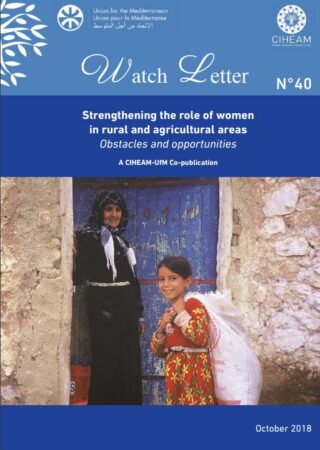
Watch Letter: Strengthening the role of women in rural and agricultural areas

Globally, women make up 40% of the agricultural labor force, both formal and informal, in unpaid and paid work in fields and on farms. Yet, women are also the largest unpaid care workforce, women are less likely to own land – with only 13% of agricultural landowners globally being women1 – and more likely to work on family owned land for free, without access to markets or new technologies. Women spend much of their time on work inside the home, contributing to and running households, with no recognition of this work, and no wages to call their own. While they often are best placed to accurately identify the immediate needs of their families, in many communities, they are not making decisions on how the household income is spent.

As noted in the Secretary General’s report on Rural Women, “rural women and girls are disproportionately affected by poverty, exclusion and the effects of environmental and climate change”2. Thus, women and girls living in rural areas are less likely to absorb shocks, recover from crisis, and be able to create a sustainable future for themselves and their families.

In light of the 2030 agenda, and under the notion of leaving no one behind, we have an obligation to focus on women in rural areas, who, unless they are empowered to become resilient to external (and internal) shocks, will continue to bear the brunt of climate change and inequalities that will hinder our collective prosperity and development.

That is exactly what the Commission on the Status of Women (CSW) had as a priority theme in March 2018, when member states, civil society and UN entities gathered to focus on Challenges and 1 UN Women infographic http://www.unwomen.org/en/digital-library/multimedia/2018/2/infographic-rural-women 2 Challenges and opportunities in achieving gender equality and the empowerment of rural women and girls: Report of the Secretary General, 2018 http://undocs.org/E/CN.6/2018/3 3 http://www.unwomen.org/en/csw/csw62-2018 Leaving No One Behind: Women in Rural Communities Are Key to a Sustainable, Food Secure Future opportunities in achieving gender equality and the empowerment of rural women and girls in the commission´s 62nd session.

Just as in the Secretary General´s report, the Commission, in the agreed conclusions adopted on the last day, noted that the foundations for a sustainable, gender equal, Agenda 2030 are already present, in the Beijing platform for action, CEDAW and other internationally ratified conventions and protocols. The Commission highlighted recommendations for ensuring that Agenda 2030 can be achieved and that women and girls living in rural areas have the rights and tools needed to be part of the solution; for there can be no solution without them. Notably, the Commission outlined three broad areas of action, with specific guidance under each, and in adapting the document made a commitment to the recommendations made.

Authors: Smail Izerrouken & Houria Belouahri; Mohammad Naciri, Regional Director, Regional Director for Arab States, UN Women; Athar Hodali for the Agricultural Development Association – PARC; Szilvia Lehel, Gender, Environment and Development Specialist, Food and Agriculture Organization of the United Nations (FAO); Petya Stavreva, President, United Agrarians, Sofia, Bulgaria, Former Member of the European Parliament; Monia Braham, International Expert in Sustainable Development Policies; Catia Zumpano, chercheur (Sociologue rurale), présidente du Centre de politiques et bioeconomie du CREA (Consiglio per la ricerca in agricoltura e l’analisi dell’economia agraria); Elisabeth Hofmann et Jean Etienne Bidou, Chaire UNESCO sur la formation de professionnel/-les du développement durable; Rosanna Quagliariello, Head of External Relations Office, CIHEAM Bari; François Fatoux, Fondateur de « Crèches durables », expert RSE, Égalité Femmes Hommes; Gaëlle Ferrand et Alejandra Meneses, OECD; HadiFathi Khalil10 and Husam Al Najar11, Islamic University of Gaza; Joachim Benet- GRESCO –Université de Poitiers; BEN EL AHMAR Mustapha, Directeur du CERCAM, Groupe Crédit Agricole du Maroc (GCAM); Nora Bouazzouni, Journaliste; Rosa Llobregat, Policy Advisor at the European Parliament; Elham Abdelaal, Associate Professor, Socioeconomic Dept. Desert Research Center, Cairo, Egypt; Marcela Villarreal, FAO

October 2018
 

PDF  

…Other publications you may like

2030 UfM Action Plan on Civil Protection and Disaster Risk Management
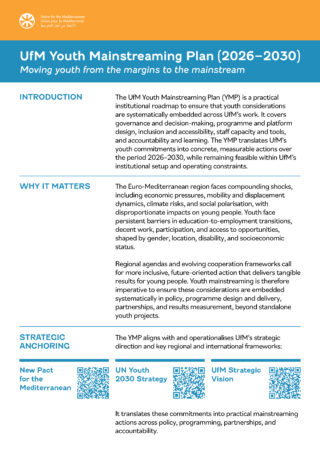
UfM Youth Mainstreaming Plan (2026–2030)
UfM Network of Climate, Women, Peace and Security – Outcome Document
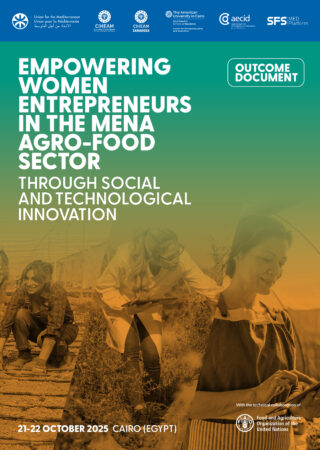
Empowering Women Entrepreneurs in the MENA Agro-Food Sector through Social and Technological Innovation – Outcome Document

Who we are

  • Member States
  • Meet the team
  • Partners
  • History
  • Transparency and accountability
  • Transparency and access to information
  • Investigating fraud, corruption and misconduct

What we do

  • Economic Development & Employment
  • Higher Education & Research
  • Social & Civil Affairs
  • Water, Environment and Blue Economy
  • Transport & Urban Development
  • Energy & Climate Action
  • Day of the Mediterranean
  • Mediterranean Capitals of Culture and Dialogue

How we work

  • Policy Framework
  • Regional Platforms
  • Projects and Initiatives

Work with us

  • Vacancies
  • Secondments
  • Internships
  • Procurement

Info centre

  • Media corner
  • News
  • Agenda
  • Publications and key documents
  • Stories of Euro-Mediterranean Cooperation
  • Photo gallery
  • Video gallery
Co-financed by the European Union
  • Who we are
    • Member States
    • Meet the team
    • Partners
    • History
    • Transparency and accountability
      • Transparency and access to information
      • Investigating fraud, corruption and misconduct
  • What we do
    • Economic Development and Employment
    • Higher Education & Research
    • Social & Civil Affairs
    • Water, Environment and Blue Economy
    • Transport & Urban Development
    • Energy & Climate Action
  • Initiatives that build bridges
    • Day of the Mediterranean
    • Mediterranean Capitals of Culture and Dialogue
  • How we work
    • Policy Framework
    • UfM Regional Platforms
    • Projects and Initiatives
  • Work with us
    • Vacancies
    • Secondments
    • Internships
    • Procurement
    • Roster of experts
  • Info centre
    • Media center
    • News
    • Agenda
    • Publications and key documents
    • Human Stories of the Mediterranean
  • Contact
  • Social media
    • Facebook
    • Twitter
    • Youtube
    • Linkedin
    • Flickr
  • English
  • Français
  • العربية
  • English
  • Français
  • العربية
Union for the Mediterranean – UfM


We are using cookies to give you the best experience on our website.

You can find out more about which cookies we are using or switch them off in .

Powered by  GDPR Cookie Compliance
Cookies Overview

This website uses cookies so that we can provide you with the best user experience possible. Cookie information is stored in your browser and performs functions such as recognising you when you return to our website and helping our team to understand which sections of the website you find most interesting and useful.

Read more

Strictly Necessary Cookies

Strictly Necessary Cookie should be enabled at all times so that we can save your preferences for cookie settings.

3rd Party Cookies

This website uses Google Analytics to collect anonymous information such as the number of visitors to the site, and the most popular pages.

Keeping this cookie enabled helps us to improve our website.