
The Mediterranean connects. Its politics must catch up.
By the UfM Secretary General, Nasser Kamel.
Published in El Mundo (Spain), Al Masry Alyoum (Egypt), Al Rai (Jordan), The Jordan Times (Jordan), Tuniscope (Tunisia), Independent Arabia (PanArab) and Dunya Newspaper (Türkiye).
I have spent eight years at the helm of the Union for the Mediterranean, and several decades as a diplomat. In that time, I have sat across the table from ministers whose countries were living through active conflict, not merely its threat, I have listened to climate scientists warning that the Mediterranean basin is warming 20 per cent faster than the global average, and I have met families displaced not by choice but by the convergence of conflict, environmental pressure and economic collapse. Different conversations, different pressures, but always the same conclusion. No single country can address these challenges alone.
Yet this is precisely the moment when cooperation is under strain. Multilateral institutions are often criticised as slow, distant or ineffective. Some of that criticism is justified. At times, process has taken precedence over results, and commitments have not always translated into tangible change. But the answer to imperfect multilateralism is not to turn away from it. It is to make it work better.
Nowhere is this more evident than in the Mediterranean. Water scarcity and extreme heat are already affecting food systems. Youth unemployment in parts of the region remains persistently high. Migration, energy security and the consequences of conflict continue to impact the stability of all shores. Geography leaves little room for isolation. What happens in one part of the Mediterranean does not remain there.
The broader international picture makes this harder, and we should be honest about why. We are living through a period of deliberate dismantling of multilateral commitments, of development finance, of trade architectures that took generations to build. Major powers are not simply renegotiating the terms of their participation in international institutions; in some cases, they are walking away from them entirely and recasting that retreat as a form of strength. The political argument that nations are better served by acting alone is not just gaining ground. It is being actively promoted by governments that have the most to lose from a world without rules.
A decade ago, this would have seemed like the fringe position. Today it is shaping budgets, breaking alliances and leaving regions like the Mediterranean to absorb the consequences. We should be clear about what this represents: a profound abdication of responsibility at precisely the moment when the scale of shared challenges demands more cooperation, not less. This is not a temporary turbulence that multilateral institutions simply need to weather. It is a structural assault on the idea that countries bear obligations to one another. The Mediterranean, where no government can insulate its citizens from what happens across its many shores, has a particular stake in resisting it.
It is in that context, and precisely because of it, that the work of the Union for the Mediterranean matters. It brings together 43 countries from Europe, North Africa and the Middle East around a shared commitment first set out in the 1995 Barcelona Declaration. The premise was simple but remains valid today. Stability and development are interdependent across the region, and progress requires cooperation that is structured, sustained and practical.
That cooperation is not abstract. Within the Union for the Mediterranean, it takes the form of jointly agreed initiatives that move from political endorsement to implementation on the ground. Through regionally endorsed programmes, tens of thousands of young people and women have gained access to jobs, skills and support for entrepreneurship. Through networks such as MedECC, scientific evidence on climate change is translated into shared policy responses across the region. Through platforms like the Blue Mediterranean Partnership, public and private actors are brought together to finance projects that address urgent environmental pressures. These are not declarations of intent. They are practical outcomes that demonstrate how regional cooperation can deliver.
In November 2025, member states met again in Barcelona, thirty years after the original Declaration, and agreed on a renewed strategic direction. The focus is clear. Greater investment in young people and mobility, closer cooperation on climate, water and energy, and stronger economic ties that underpin long term stability. These priorities reflect the realities the region faces today, and the understanding that shared challenges require shared responses.
At a time of geopolitical tension and uncertainty, maintaining such cooperation is not automatic. It requires political will and sustained engagement. The fact that 43 countries continue to work together within this framework is, in itself, significant. It reflects a recognition that dialogue and partnership remain more effective than fragmentation.
The role of the Union for the Mediterranean is to support that effort. To convene, to connect expertise with policy, and to ensure that cooperation leads to concrete results. The form of multilateralism that the region needs is practical and accountable. It is reflected in projects that deliver water, energy, jobs and knowledge across borders. It is measured not in statements, but in impact.
The Mediterranean has always been a space of exchange and connection. That reality has not changed. What must continue to evolve is how countries choose to act within it. In a complex and interdependent region, cooperation is not an ideal. It is a necessity.
24 April 2026
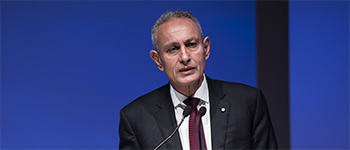
Nasser Kamel
Nasser Kamel is the Secretary General of the Union for the Mediterranean.

