UfM advances a new regional agenda for women’s empowerment at the 11th Regional Forum in Barcelona
- The UfM Regional Platform on Women Empowerment brought together UfM Member States and regional stakeholders to assess progress on gender equality and define next priorities
- The Euromed Civil Society Conference brought the perspectives and recommendations of civil society organisations into the regional debate, while the UfM Stakeholders Dialogue presented regional flagships initiatives.
- A new UfM Regional Agenda on Women Entrepreneurs in Agri-Food Value Chains was launched, alongside the InclusiveNISSA Digital Knowledge Hub on women’s access to financial services and opportunities across the Southern Mediterranean.
- Two regional awards recognised outstanding contributions to women’s empowerment: the Euro-Mediterranean Women Journalists Award and the Women Leading Change Award.
Barcelona, 24 November 2026. The Union for the Mediterranean (UfM) brought together representatives of governments, civil society organisations, women’s networks, international organisations, academia and development partners in Barcelona on 23 and 24 November for a series of meetings dedicated to advancing women’s empowerment across the Euro-Mediterranean region, held within the framework of the 11th UfM Regional Forum.
The meetings of the UfM Regional Platform on Women Empowerment provided an opportunity to assess progress since the 2022 UfM Ministerial Declaration on Strengthening the Role of Women in Society, identify persisting implementation gaps and define priorities for the next phase of regional cooperation. The discussions will contribute to preparations for the sixth UfM Ministerial Conference on Strengthening the Role of Women in Society and help shape the future regional agenda on gender equality.
Addressing the importance of translating political commitments into tangible progress, UfM Secretary General, Fadi Hajali, said: “Resilience and prosperity also depend on ensuring that women and girls play a full part in the transformation that lies ahead. Despite significant legislative and institutional progress in recent years, a substantial gap remains between the reforms adopted and their implementation. Bridging this gap requires promoting women’s economic leadership, eradicating all forms of violence against women and translating regional commitments into effective national policies. To support this work, the UfM is finalising its second Progress Report on Gender Equality, which will provide the basis for an upcoming Ministerial Conference on Strengthening the Role of Women in Society.”
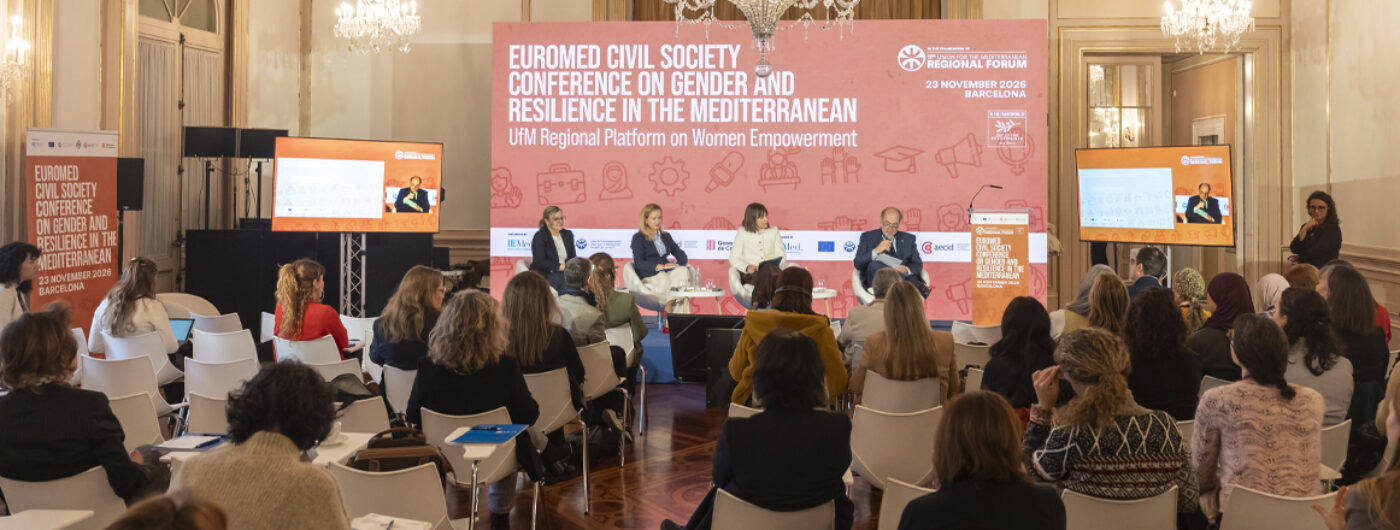
 The programme opened on 23 November with the Euromed Civil Society Conference on Gender, Civil Society and Resilience in the Mediterranean, organised by the European Institute of the Mediterranean (IEMed), in collaboration with the UfM and the European Commission, with the support of the Spanish Agency for International Development Cooperation (AECID) and the Catalan Agency for Development Cooperation. Bringing together civil society organisations, women-led initiatives, researchers and practitioners from across the region, the conference provided a structured space to identify implementation gaps, exchange experiences and formulate recommendations. Its conclusions and policy lab discussions fed into the work of the UfM Regional Platform, reinforcing the role of civil society in shaping future regional commitments.
The UfM Stakeholders Dialogue on Women Empowerment brought together representatives from governments, international organisations, civil society, academia, development partners and the private sector. Discussions focused on achievements and remaining challenges in implementing the 2022 Ministerial Declaration, drawing on the findings of the second UfM Gender Equality Progress Report and the recommendations emerging from the civil society conference. Together, these contributions provided an assessment of progress and helped identify priorities for the next regional agenda.
A key outcome of the dialogue was the advancement of concrete initiatives to strengthen women’s economic participation and leadership. These included the UfM Regional Agenda on Women Entrepreneurs in Agri-Food Value Chains, developed through a regional task force with the support of AECID, PRIMA, FAO and CIHEAM. The agenda proposes recommendations to strengthen women’s entrepreneurship and leadership across Mediterranean food systems.
The programme also featured the launch of the InclusiveNISSA Digital Knowledge Hub on Access to Finance, an EU-funded initiative led by COSPE. The platform aims to improve women’s access to financial services and opportunities across the Southern Mediterranean through knowledge sharing, capacity building and the dissemination of good practices.
The meetings also recognised outstanding contributions to gender equality and women’s empowerment through two regional awards. The first Euro-Mediterranean Women Journalists Award, launched by the UfM together with the Euro-Mediterranean Network of Women Journalists, the Anna Lindh Foundation, IEMed and the International Federation of Journalists, celebrated women journalists whose work promotes gender-sensitive, solution-oriented and cross-border reporting.
The Women Leading Change Award, organised by the UfM and the Catalan Agency for Development Cooperation, recognised initiatives fostering inclusive leadership and tangible opportunities for women. This year’s awardees were EuroMed University of Fez and Notre-Dame University of Beirut, highlighting the contribution of universities to social transformation and gender-responsive governance.
Together, the discussions, civil society recommendations, regional initiatives and awards represent an important contribution to the UfM’s policy dialogue on gender equality. They will help inform the second UfM Gender Equality Progress Report and preparations for the next Ministerial Conference, supporting the translation of regional commitments into concrete action and effective national policies.