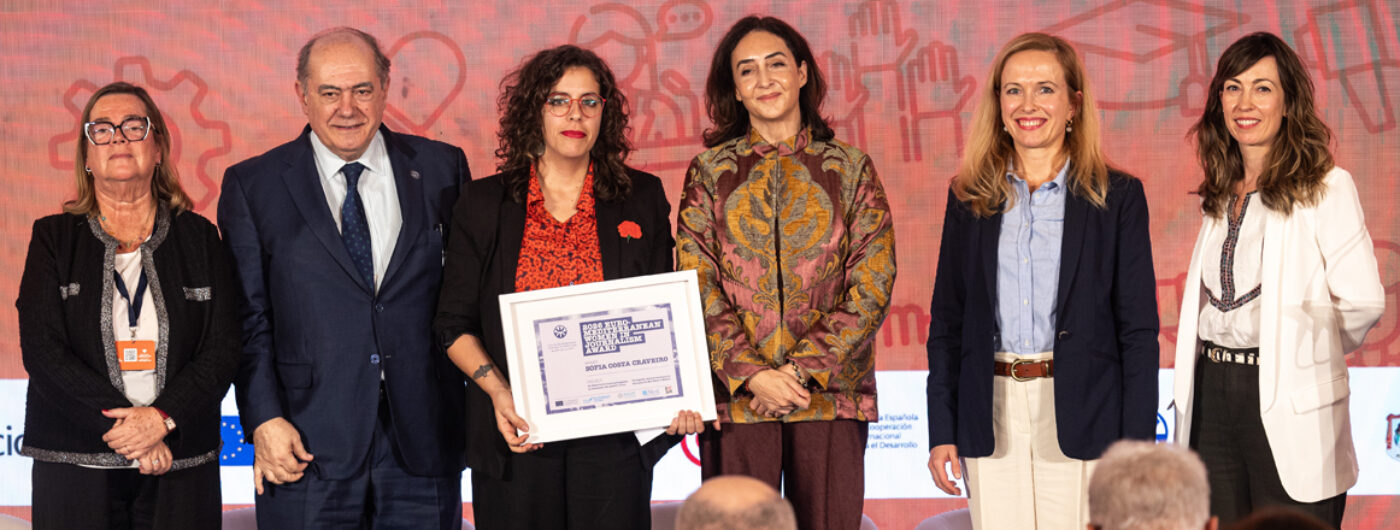
Portuguese journalist Sofia Costa Craveiro wins first Euro-Mediterranean Women in Journalism Award
23 November 2026, Barcelona. Portuguese journalist Sofia Costa Craveiro is the winner of the Union for the Mediterranean’s first edition of the Euro-Mediterranean Women in Journalism Award. Announced today in the framework of the organisation’s 11th Regional Forum and the Day of the Mediterranean, the competition was established by the UfM in partnership with the Euro-Mediterranean Network of Women Journalists (EMNWJ), the Anna Lindh Foundation (ALF), the European Institute of the Mediterranean (IEMed) and the International Federation of Journalists (IFJ), to advance its commitment to strengthening women’s voices in the region through closer engagement with the media.
An independent jury comprising HRH Princess Rym Ali, President of the ALF; Senén Florensa, Executive President of IEMed; and María Ángeles Samperio, Chair of the IFJ Gender Council, selected Sofia Costa Craveiro’s winning article among over 200 submissions from women journalists from more than half of the UfM’s 43 Member States. Published in print and online by Portugal’s newspaper of record, Público, Sofia Costa Craveiro’s work explores the experiences of Portuguese migrant women in Germany during the 1960s and 1970s, addressing the Euro-Mediterranean challenges of gender equality, employment and labour, and mobility and the root causes of migration – three priority areas highlighted in the UfM’s Vision Statement.
 The jury assessed submissions based on their gender-sensitive reporting, solutions-journalism rigour, and regional relevance, praising Sofia Costa Craveiro for her article’s “very rigorous examination of women’s stories that deserve to be known,” its “distinctly female perspective” and its “timely reflection on migration challenges.”
“This Award recognises journalism that brings women’s voices to the forefront and examines our shared regional challenges with rigour and a focus on solutions. I warmly congratulate the winner and thank the jurors for their contribution to this first edition, which also reflects the commitment of UfM Member States to strengthen women’s role and advance gender equality across the Euro-Mediterranean region,” said Petra Kežman, UfM Deputy Secretary General for Human Development.
Accepting the Award, Sofia Costa Craveiro reflected on the role of journalism in challenging dominant narratives: “When I began the investigation that led to the reporting project that brought me here today, I never imagined I would encounter stories so valuable, so powerful, that they would challenge and dismantle the male-centred narrative that continues to dominate our collective imagination. Journalism has this power: the power to surprise us and to make us question what we think we know. That is why it remains so important today. Especially today. And yet journalism is in danger. Memory is in danger. Women are, once again, in danger.”
“Across the Euro-Mediterranean, women journalists are doing exactly this and I want to thank them for all they do. They report from newsrooms and from the field, in big cities and small towns, in many languages and often under difficult conditions. They notice what others walk past. They bring communities into the conversation who were never invited before. In doing so, they shape not only what we talk about, but how we talk about it. They connect us through what we share and have in common and can relate to across borders,” said HRH Princess Rym Ali, President of the ALF.
“At a time when journalism faces major challenges, including disinformation, polarisation, shrinking civic space and increasing pressures on media independence, it is particularly important to support professional journalism that is rigorous, independent and committed to revealing the complexity of the issues shaping our societies. And women should be at the forefront in this battle as their presence and leadership is contributing to more pluralistic, diverse and representative media. Ms. Costa’s award-winning work, with its distinctly female perspective and timely reflection on the challenges of migration, is a testament to this,” said Senén Florensa, executive president of the IEMed.
“For the International Federation of Journalists, which represents more than 600,000 professionals worldwide, it has been an honour to be part of the judging panel for this award. Journalism has the clear aim of presenting reality to society. It is therefore important to highlight the evaluation process and the criteria applied by the jury of which I was a member. The jury emphasised the quality and relevance of the entries submitted, as well as the importance of professional standards, journalistic integrity and gender equality in the media,” said María Ángeles Samperio, Chair of the IFJ Gender Council.