
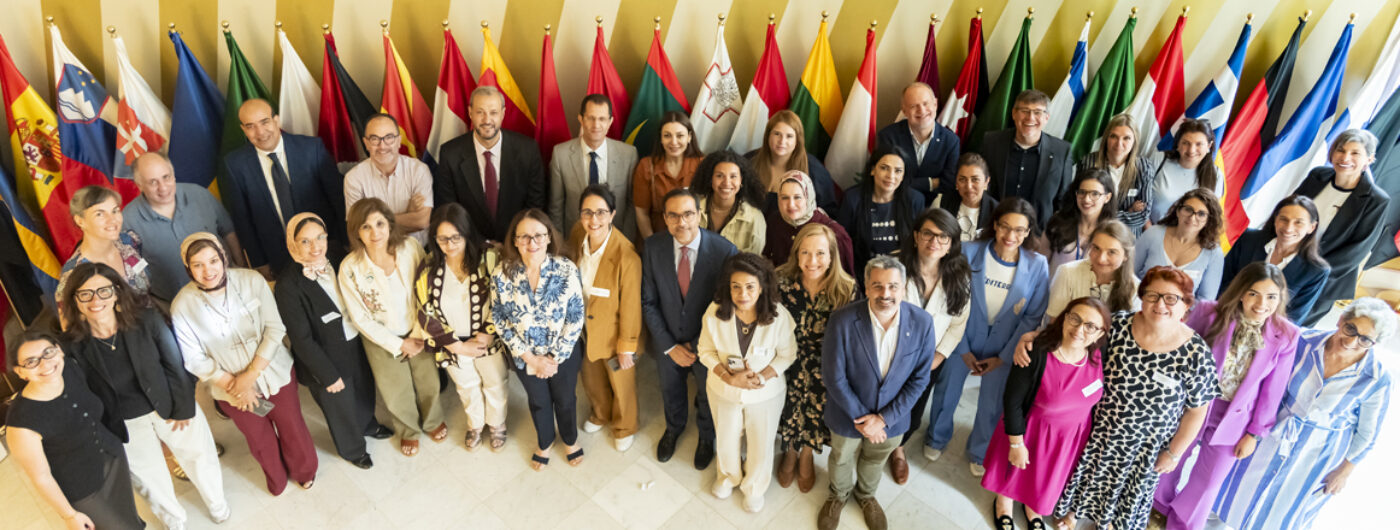
UfM advances gender-sensitive leadership in higher education and local government through specialised training
Barcelona, 11-12 June 2026 – The Capacity Building Programme on Gender-Responsive Leadership was held at the UfM Headquarters on 11-12 June 2026. The event, supported by the Catalan Development Cooperation Agency (ACCD) brought together universities and their municipalities – seven tandems from Morocco, four from Lebanon and two from Syria – with the aim of strengthening knowledge, skills, and practices related to gender equality and inclusive leadership. The training, held in the framework of the project Women Leading Change, was delivered by a consortium led by the Lebanese University and combined expert-led workshops with interactive sessions and institutional exchange.
The programme opened with high-level remarks from the Senior Deputy Secretary General of the UfM, Mariam Diallo, who affirmed that “what we are launching here is not simply a reform programme for a selected group of institutions; it is the beginning of a broader process of transformation; our ambition is to create a genuine snowball effect across the region – the universities and municipalities participating in this programme are pioneers, but also multipliers”.
Opening remarks were also delivered by the Director General for Development Cooperation of the Government of Catalonia, Andrea Costafreda; the Director for the European Union and Mediterranean Processes of the Ministry of Foreign Affairs of Morocco, Allal Ouazzani Touhami; and the Programme Manager for Women Economic Empowerment of DG MENA, European Commission, Anne-France Wittmann. Speakers highlighted the importance of embedding gender equality into leadership structures and public policy frameworks, emphasising the need for coordinated regional efforts to achieve sustainable and inclusive development.
 The first day focused on building foundational understanding and addressing key challenges in academic environments. The initial workshop on gender and leadership, led by Prof. Boutheina Ben Hassine from the University of Sousse, Tunisia, explored the role of leadership in advancing gender equality and examined structural and cultural barriers that limit women’s access to leadership positions. The session encouraged participants to reflect on their own institutional contexts and consider strategies for fostering inclusive leadership practices.
This was followed by a session on preventing and addressing sexual harassment in academic institutions, delivered by Prof. Lilia Othman Challougui from the University of Tunis El Manar. The discussion covered different forms of harassment, institutional responsibilities, and the need for robust prevention and response mechanisms. Participants engaged in dialogue on how to develop effective policies and strengthen accountability systems within their organisations.
An important component of the first day was the visit to the University of Barcelona, where participants were introduced to the institution’s approach to gender-sensitive leadership. Prof. Montserrat Puig Llobet, Vicerector for Equality, Inclusion and Gender, and Prof. Núria Vergés i Bosch, Head of the Equality Unity, shared insights into their equality frameworks, governance structures, and ongoing initiatives. The visit provided an opportunity for participants to exchange experiences and learn from practical examples of policy implementation.
The second day was dedicated to an in-depth workshop on recruitment without gender stereotypes, led by Prof. Isabelle Régner of Aix-Marseille University, in France. Structured in multiple parts, the sessions addressed the impact of unconscious bias in hiring processes and introduced practical tools to promote fair and inclusive recruitment. Through interactive exercises, participants explored ways to redesign recruitment procedures and embed gender-neutral practices in their institutions, contributing to longer-term structural change.
Throughout the programme, participants actively engaged in discussions, group work, and knowledge exchange. The interactive format facilitated the sharing of diverse perspectives and experiences from across the Mediterranean region, enhancing the overall learning experience and fostering collaboration among participants.
The event concluded with closing remarks from the UfM Deputy Secretary General for Human Development, Petra Kežman, who stressed that “our aim is to build strong women empowerment national ecosystems with the active involvement of policymakers and stakeholders – and you are not just implementers, but multipliers, key actors in amplifying impact; we also encourage you to support the UfM in this effort, namely through advocacy initiatives”.
Overall, the programme provided a comprehensive platform for advancing gender-responsive leadership and strengthening institutional capacities. By combining theoretical insights with practical tools and real-world examples, the event contributed to promoting more inclusive, equitable, and accountable academic and organisational environments across the region.

