
• English
  • Français
  • العربية
Follow us
Union for the Mediterranean – UfMUnion for the Mediterranean – UfMUnion for the Mediterranean – UfMUnion for the Mediterranean – UfM
  • Who we are
    • The Union for the Mediterranean is an intergovernmental institution bringing together the European Union Member States and 16 countries from the Southern and Eastern shores of the Mediterranean to promote dialogue and cooperation.

      OVERVIEW   

    • Who we are

      • Member States
      • Meet the team
      • Partners
      • History

      Transparency and accountability

      • Transparency and access to information
      • Investigating fraud, corruption and misconduct
    • Key documents

      UfM Institutional Brochure UfM How we work

      More documents   

  • What we do
    • The UfM seeks to enhance regional cooperation, dialogue and the implementation of concrete projects and initiatives with tangible impact on our citizens to address three strategic objectives: human development, stability and integration.

      OVERVIEW   

    • Inclusive development

      • Economic Development and Employment
      • Higher Education & Research
      • Social & Civil Affairs

      Sustainable development

      • Water, Environment and Blue Economy
      • Transport & Urban Development
      • Energy & Climate Action

      Initiatives that build bridges

      • Day of the Mediterranean
      • Mediterranean Capitals of Culture and Dialogue
    • How we work

      • Policy Frameworks
      • Regional Platforms
      • Projects and Initiatives
  • Work with us
    • The UfM Secretariat is the operational platform of the Union for the Mediterranean. The staff of the UfM is made of more than 17 nationalities working in a multicultural environment that fosters cooperation and intercultural communication and exchange.

    • Work with us

      • Vacancies
      • Secondments
      • Internships
      • Procurement
  • Info centre
    • Find our latest press releases, press invitations, visual identity, key institutional documents, photos and other relevant information


      DOWNLOAD THE UfM VISUAL IDENTITY GUIDELINES AND LOGOS (ZIP FILE)   

    • Info centre

      • Media corner
      • News
      • Agenda
      • Publications and key documents
      • Stories of Euro-Mediterranean Cooperation
    • UfM in the Media

      9 May 2026 – Agence Europe (EN) – The fire season that never ends – by Joan Borrell Mayeur
      View article
      9 May 2026 – Agence Europe (FR) – Une saison des feux qui n’en finit pas – par Joan Borrell Mayeur
      View article
      7 May 2026 – Al-Dustour – حرائق غابات المتوسط على وشك أن تبدأ مجدداً… بلا حدود
      View article
  • Contact

COP29: MedECC Special Reports on Coastal Risks and the WEFE Nexus

Energy & Climate Action Water Environment & Blue Economy

MedECC and UfM: Mediterranean countries’ climate change mitigation and adaptation efforts still insufficient for liveable futures

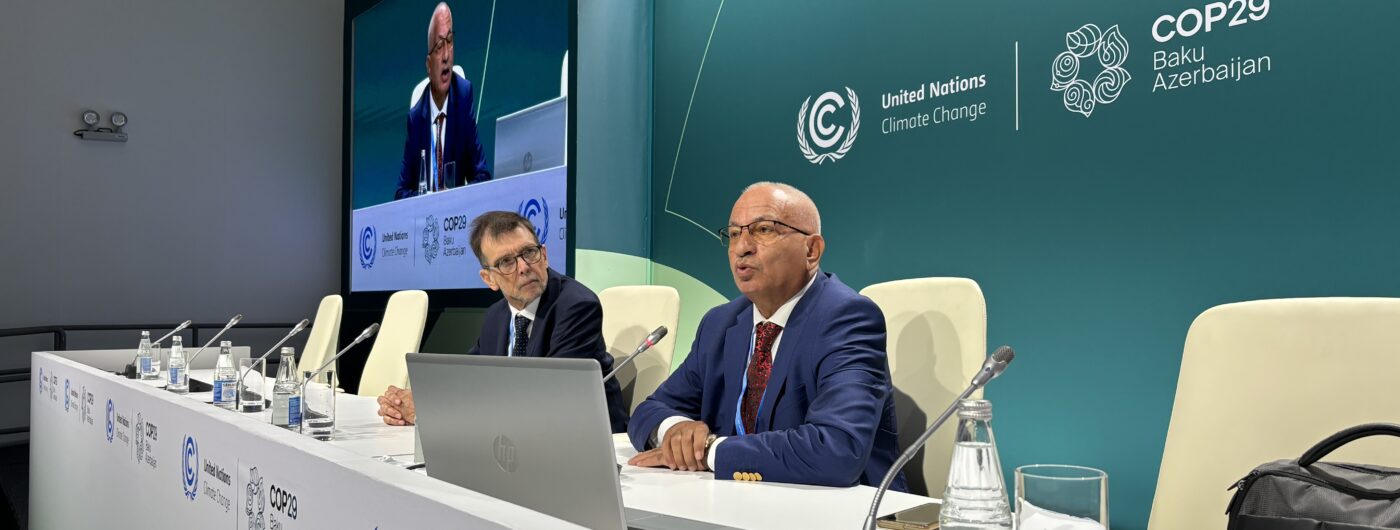
  • Today MedECC, the network of Mediterranean Experts on Climate and Environmental Change, and the Union for the Mediterranean presented the latest scientific findings on the impacts of climate and environmental change on the region’s coastal zones as well as on the Water-Energy-Food-Ecosystems nexus at COP29 in Baku.
  • A third of the Mediterranean region’s population lives in close vicinity to the sea, which is among the world’s regions with the highest probability of compound flooding, and is increasingly exposed to hazards resulting from climate change and environmental degradation.
  • The effects of this phenomenon will be exacerbated in years to come unless urgent measures are taken now. Meeting the Sustainable Development Goals will require cross-border policies that promote innovative solutions, including renewables, in conjunction with less energy-intensive behavioural changes, such as the widespread readoption of the Mediterranean diet.

18 November 2024, COP29. The impacts of human-caused climate change in the Mediterranean, a global warming hotspot, are becoming increasingly apparent. Just under three weeks after devastating floods swept Spain’s Valencia region, MedECC and the UfM presented the network’s latest scientific findings on the dangerous implications of climate change and environmental degradation for the Mediterranean’s coastal zones and WEFE nexus.

Scientists Piero Lionello, from the University of Salento, and Mohamed Abdel Monem, an independent consultant on climate change and rural development, highlighted the pressing need for more efficient adaptation and mitigation measures in the region alongside UfM Project Manager for Energy and Climate Action Ines Duarte.

“The Mediterranean Sea is a source of immense pride for the 22 countries that border its shores, an inextricable part of their identity and heritage,” said UfM Project Manager for Energy and Climate Action Ines Duarte. “But it is time to accept that the Mediterranean as we know it may not be around much longer if our efforts to counter climate change continue to fall short. Given its consequential importance, supporting the green transition has always been one of the Union for the Mediterranean’s greatest priorities.”

Building on the First Mediterranean Assessment Report (MAR1), the first-ever region-wide scientific report on climate change and environmental degradation, the network’s newest studies sound the alarm once again, drawing attention to current and projected hazards while also presenting actions to minimise their effects.

If current trends continue, up to 20 million people could be affected by permanent displacement due to sea-level rise by 2100. Marine heatwaves, which have grown in frequency and duration by 40% and 15% respectively over the past two decades, coupled with environmental degradation in one of the world’s most heavily plastic polluted areas, have a variety of worrying ecological and socioeconomic effects on the Mediterranean. The region also faces notable water demand peaks in the summer, a trend that is expected to intensify in years to come due to climate change, agricultural practices, and the increase in population and tourism in coastal areas.

A mix of legal, policy and economic instruments are available to promote the sustainable blue economy and decouple energy consumption from economic growth. Because the effects of climate change amplify existing socioeconomic and environmental issues, the most successful pathways for action will involve technological, societal and ecosystem-based solutions that take all four interrelated elements of the WEFE nexus into consideration.

Find the press summary of key findings here.

Check: Special Report on Climate and Environmental Coastal Risks in the Mediterranean
Check: Special Report Interlinking climate change with the Water – Energy – Food – Ecosystems (WEFE) nexus in the Mediterranean Basin

Latest news

Time to act on climate change in the Mediterranean is now, UfM warns ahead of World Environment Day
03 / 06 / 2026
Bridging the digital skills gap and boosting smart e-governance solutions: promoting digital transformation through a UfM Conference in Antalya
21 / 05 / 2026
See more

SUBSCRIBE TO OUR NEWSLETTER!


Agenda

UfM Senior Officials Meeting (SOM) June 2026
10 / 06 / 2026
Women Leading Change – Training for Universities and their Municipalities
11 / 06 / 2026
See more

Who we are

  • Member States
  • Meet the team
  • Partners
  • History
  • Transparency and accountability
  • Transparency and access to information
  • Investigating fraud, corruption and misconduct

What we do

  • Economic Development & Employment
  • Higher Education & Research
  • Social & Civil Affairs
  • Water, Environment and Blue Economy
  • Transport & Urban Development
  • Energy & Climate Action
  • Day of the Mediterranean
  • Mediterranean Capitals of Culture and Dialogue

How we work

  • Policy Framework
  • Regional Platforms
  • Projects and Initiatives

Work with us

  • Vacancies
  • Secondments
  • Internships
  • Procurement

Info centre

  • Media corner
  • News
  • Agenda
  • Publications and key documents
  • Stories of Euro-Mediterranean Cooperation
  • Photo gallery
  • Video gallery
Co-financed by the European Union
  • Who we are
    • Member States
    • Meet the team
    • Partners
    • History
    • Transparency and accountability
      • Transparency and access to information
      • Investigating fraud, corruption and misconduct
  • What we do
    • Economic Development and Employment
    • Higher Education & Research
    • Social & Civil Affairs
    • Water, Environment and Blue Economy
    • Transport & Urban Development
    • Energy & Climate Action
  • Initiatives that build bridges
    • Day of the Mediterranean
    • Mediterranean Capitals of Culture and Dialogue
  • How we work
    • Policy Framework
    • UfM Regional Platforms
    • Projects and Initiatives
  • Work with us
    • Vacancies
    • Secondments
    • Internships
    • Procurement
    • Roster of experts
  • Info centre
    • Media center
    • News
    • Agenda
    • Publications and key documents
    • Human Stories of the Mediterranean
  • Contact
  • Social media
    • Facebook
    • Twitter
    • Youtube
    • Linkedin
    • Flickr
  • English
  • Français
  • العربية
  • English
  • Français
  • العربية
Union for the Mediterranean – UfM


We are using cookies to give you the best experience on our website.

You can find out more about which cookies we are using or switch them off in .

Powered by  GDPR Cookie Compliance
Cookies Overview

This website uses cookies so that we can provide you with the best user experience possible. Cookie information is stored in your browser and performs functions such as recognising you when you return to our website and helping our team to understand which sections of the website you find most interesting and useful.

Read more

Strictly Necessary Cookies

Strictly Necessary Cookie should be enabled at all times so that we can save your preferences for cookie settings.

3rd Party Cookies

This website uses Google Analytics to collect anonymous information such as the number of visitors to the site, and the most popular pages.

Keeping this cookie enabled helps us to improve our website.