
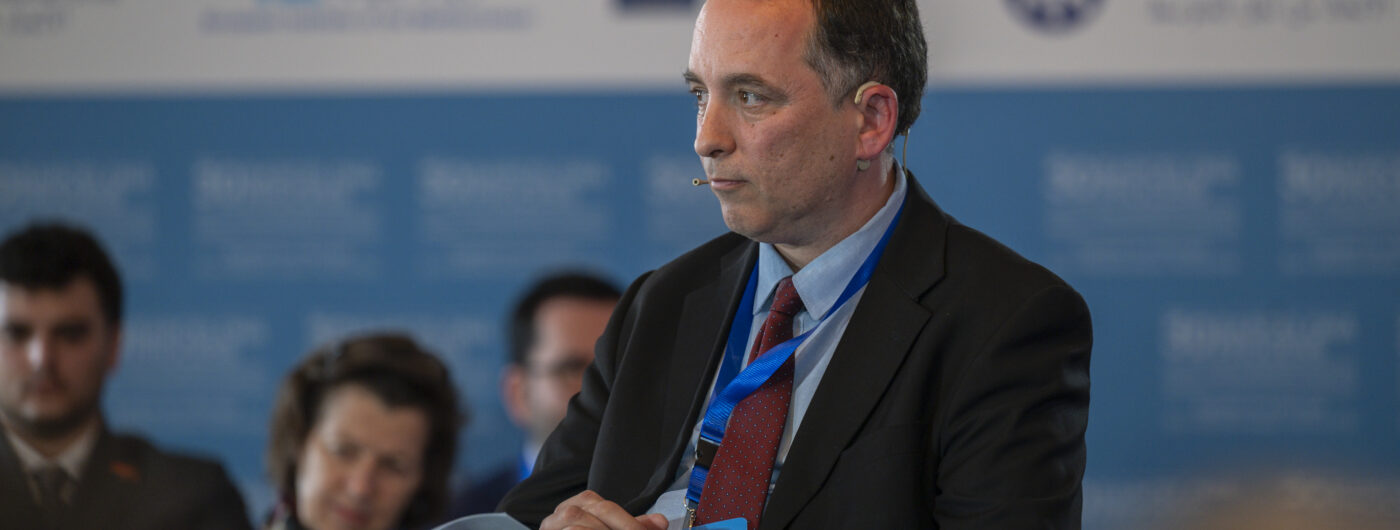
Nimrod Goren on Mediterranean dialogue in times of division: why people – not politics – hold the key
Against the backdrop of the conflict in the Middle East and other critical issues such as alarming climate trends and widening socioeconomic disparities, the Union for the Mediterranean held an inclusive and participatory consultative session. Co-organised with the European Institute of the Mediterranean (IEMed) in the framework of the 30th anniversary of the Barcelona Process, the consultation addressed what the organisation’s future vision, priorities and mandate should be. Nimrod Goren participated in a session where participants discussed what the role of the UfM should be with regards to the post-conflict recovery process in Gaza.
Dr. Goren is Co-Founder of Diplomeds and Founder of Mitvim. He holds a PhD from the Hebrew University of Jerusalem and was a Hubert Humphrey Fellow. He frequently comments in international media on Israeli foreign policy, regional relations, and Mediterranean diplomacy.
Question: You’ve been involved for many years in Euro-Mediterranean cooperation through your professional career and research. In light of your knowledge and experience, what would you suggest enhancing or promoting to improve stability and security at a Euro-Mediterranean level?
Nimrod Goren: If we aim for greater security and stability in the Euro-Mediterranean region, it is essential to adopt a people-centered approach rather than a governmental one. This means prioritizing the real needs of the people in the region. The three main pillars of concern are conflicts, the lack of freedoms, and the impact of climate change.
It is not just about the interests of Brussels, the EU, or the governments in the region. The focus must be on initiatives that truly impact the lives of civilians. When policies and actions genuinely address their needs, the chances of success and meaningful impact increase significantly.
What should be prioritized in the next agenda for EU-Southern neighborhood relations?
The agenda should not follow an EU-centered approach toward the Southern neighborhood, nor should it be dictated by transactional relationships between governments. A give-and-take approach may be easy to implement, with governments prioritizing economic gains or national security, but such engagement should go deeper—it should be about values.
When discussing cooperation between the North and South, we need to ask ourselves what kind of world, community, and neighborhood we want to build and what principles should underpin these relationships. This means moving beyond agreements on easy topics and addressing the fundamental reasons behind the partnership. Again, the focus should be on what is truly best for the people of the region.
Based on your personal experiences, what lessons have you learned about what works—and what doesn’t—when it comes to post-conflict recovery strategies?
Effective post-conflict recovery requires a clear vision of the desired outcome. What is the end goal? Are we merely restoring the pre-war status quo—a situation that may have contributed to the conflict in the first place—or are we striving to transform the region and transition it to a better future?
Having a locally owned vision is critical. Recovery plans should not be imposed by external parties unfamiliar with the region’s needs. Instead, they should emerge from within, supported by the political will of relevant actors. Stability is also essential, providing the necessary conditions for cooperation and joint efforts.
Multinational collaboration is key. Different countries and actors should come together to work towards a shared vision, ensuring that initiatives receive regional buy-in. Successful examples of post-conflict recovery include the reconstruction of Bosnia and Herzegovina after the Yugoslav Wars, where international and local efforts were combined to rebuild institutions, infrastructure, and civil society. Similarly, Rwanda’s post-genocide reconciliation process has shown how local ownership and long-term commitment can drive successful recovery and transformation.
You come from a region deeply affected by conflict. How has this shaped your views on the role of dialogue and cooperation? Does something need to change for institutions like the UfM to make a real difference?
Conflicts highlight the importance of dialogue and cooperation, even in the darkest times. The devastation following the events of October 7 in Israel and the war in Gaza has been deeply personal and has shaped political attitudes and perceptions.
When people withdraw into their own societies and disengage, the chances of understanding the perspectives of the other side diminish. Without engagement, networks and connections between conflicting parties remain limited.
At Diplomeds, we established a Mediterranean Advisory Group in the immediate aftermath of the war. This initiative was driven by a sense of urgency—we live in the region and want a better future. If we do nothing, the situation will not improve.
Engagement does not mean agreement. Discussions may be difficult, but enough people are willing to participate—both at the bilateral Israeli-Palestinian level and at the broader Mediterranean level. These channels of dialogue must be nurtured, as they provide a rare source of optimism during difficult times.
Do you think it’s still possible, in the future, for the peoples of the Mediterranean to trust each other?
Looking at Mediterranean countries before the recent conflicts, there were notable improvements in bilateral relations. Several states made rapprochements and strengthened their diplomatic ties.
However, regional integration remains a challenge, particularly in conflict zones. Trust is difficult to rebuild, and geopolitical tensions add further obstacles.
That said, the Mediterranean identity has unique soft components that bridge Middle Eastern, North African, and European influences. This shared identity fosters commonality and can serve as a foundation for dialogue. Framing discussions within a Mediterranean context—rather than a strictly bilateral one—can open up new opportunities.
For example, when addressing Israeli-Palestinian relations within a Mediterranean setting, we often discover new avenues for engagement that would not emerge in a purely bilateral framework. These opportunities should be explored and leveraged to build trust and cooperation in the region.
Going further
- Open consultation on the UfM future vision and mandate
- Marking 30 years of the Barcelona Process
- Diplomeds – The Council for Mediterranean Diplomacy
Publication date: August 2025

