
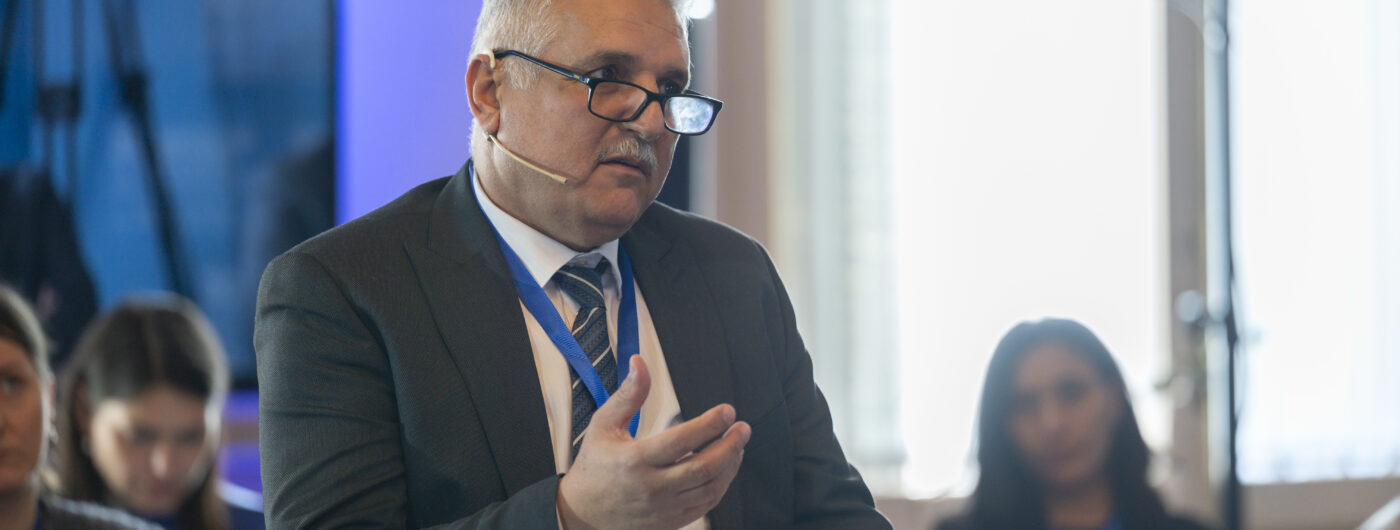
Usama Sadawi on the politics of rebuilding: why trust, justice and inclusion must guide Gaza’s recovery
Against the backdrop of the conflict in the Middle East and other critical issues such as alarming climate trends and widening socioeconomic disparities, the Union for the Mediterranean held an inclusive and participatory consultative session. Co-organised with the European Institute of the Mediterranean (IEMed) in the framework of the 30th anniversary of the Barcelona Process, the consultation addressed what the organisation’s future vision, priorities and mandate should be. Usama Sadawi participated in a session where participants discussed what the role of the UfM should be with regards to the post-conflict recovery process in Gaza.
Mr. Sadawi is a Palestinian engineer and entrepreneur, and former Minister of State for Entrepreneurship and Empowerment. Born in Rafah’s refugee camps, he studied civil engineering at Birzeit University and the Islamic University of Gaza. He previously served as General Manager of the Palestinian Housing Council in Gaza.
Question: You have spent your career working on diplomacy and regional cooperation. Based on your experiences, what lessons have you learned about what works—and what doesn’t—when it comes to post-conflict recovery strategies?
Usama Sadawi: From my experience in post-war reconstruction, I have learned that integration is a key factor. We must coordinate all resources and efforts—local, regional, and international—to ensure a comprehensive approach.
Another crucial element is the inclusion of local communities. Ownership by the people on the ground is essential because they will ultimately be the ones leading the reconstruction efforts.
Currently, the scale of destruction in Gaza is immense – over 80% of the area has been devastated. This requires innovative and unique solutions. One possible approach is land expropriation to enhance infrastructure. The private sector must be involved, along with marginalised communities, to ensure full social inclusion in planning, implementation, monitoring, and evaluation.
Another key consideration is securing international support to guarantee the flow of funds and materials. Since 2007, access to building materials has been restricted by mechanisms such as the Grievance Redress Mechanism (GRM), which is time-consuming and prevents timely reconstruction. According to international experts, it could take up to 90 years to fully rebuild Gaza under these conditions.
Economic recovery is also a fundamental aspect of reconstruction. The process must create jobs, build local capacities, and support the recovery of the private sector. The entire supply chain—including building materials, reconstruction industries, agriculture, and trade—has been dismantled and destroyed during this war. We are not starting from scratch but rather facing enormous challenges, including high pollution levels and a vast amount of debris that must be carefully managed due to unexploded ordnance.
It is essential to bridge immediate relief efforts—such as providing medical aid, shelter, and food security—with long-term reconstruction goals. Focusing solely on short-term needs will lead to the collapse of the entire process. Urban planning plays a vital role in linking relief and development, and community participation is crucial to its success.
Does the recovery process also include psychological support and trauma healing?
Absolutely. The psychological impact on people has been severe. Over 90% of Gaza’s population requires psychosocial support. This can be addressed through targeted programmes and through the reconstruction process itself—for example, by creating open public spaces, providing training opportunities, and building capacity.
The involvement of youth is particularly critical at the beginning of the reconstruction phase. Quick-win initiatives can help young people feel integrated and part of the process, discouraging migration and preventing brain drain.
You come from a region deeply affected by conflict. How has this shaped your views on the role of dialogue and cooperation? Does something need to change for institutions like the UfM to make a difference?
In Palestine, our narrative is one of prolonged struggle. We have seen repeated cycles of violence and instability for over 70 years. I know many people whose homes have been destroyed and rebuilt three times.
True stability can only be achieved through a genuine peace process that leads to a two-state solution, as agreed upon by the international community and outlined in UN resolutions. Without this, the conflict will persist.
The UfM can play a role in building trust between the two sides. The main issue is not negotiation itself but trust-building. For Palestinians, this is about restoring dignity, sovereignty, and access to our natural resources. The economic disparity between Palestinians and Israelis is striking. The GDP of Israel is about ten times that of the West Bank and Gaza, despite them being geographically adjacent and sharing similar living conditions.
A holistic approach is needed—one that addresses the root causes of the conflict rather than focusing solely on negotiations. A real, lasting solution is necessary.
Do you think it is still possible for the people of the Mediterranean to trust each other in the future?
At present, trust is extremely difficult to rebuild. We have tested the strength of international law, humanitarian law, and global institutions. Even the International Criminal Court (ICC) and the International Court of Justice (ICJ) have faced political repercussions from powerful countries.
We need robust mechanisms for conflict resolution and clear guidelines that apply to all. Accountability must be enforced for everyone. Only by ensuring that justice is upheld universally can we hope to restore trust and stability in the region.
Going further

