
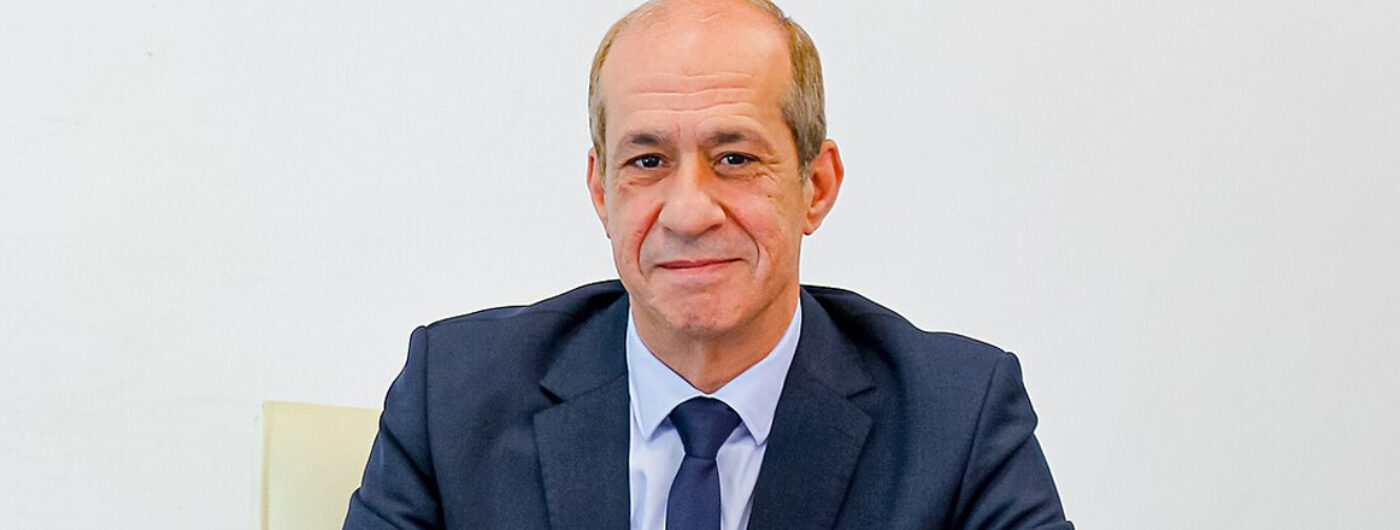
Interview with Professor Mostapha Bousmina, President of the Euro-Mediterranean University of Fez (UEMF)
The Euro-Mediterranean University of Fes (UEMF), a flagship UfM-labelled project, is more than a centre of academic excellence: it is a living embodiment of the region’s diversity and shared destiny. Endorsed by all 43 UfM Member States, the university has quickly established itself as a hub for dialogue, research, and innovation, with students and faculty from over 50 nationalities learning, collaborating, and innovating side by side.
As its President, Professor Mostapha Bousmina, notes, UEMF works to strengthen a Euro-Mediterranean identity that is still in the making—an identity grounded in cooperation, cultural proximity, and the recognition that what unites the peoples of the Mediterranean is stronger than what divides them. This vision is reflected both in the university’s programmes and in its approach to teaching and research.
Curricula are rooted in the realities of the region, with a focus on political integration, sustainable development, and the challenges of climate change, while hands-on projects instil social responsibility in every student. With its eco-campus designed to host 7,000 students, UEMF is not only training competent professionals but also shaping open-minded citizens, capable of driving the Mediterranean towards a more integrated, inclusive, and sustainable future.
We spoke with Professor Mostapha Bousmina, President of the University, to gain insight into the institution’s unique identity, mission, and role in shaping the future of the region.
UEMF promotes a strong Euro-Mediterranean identity. How is this reflected in your academic approach, partnerships, and engagement with major regional challenges?
You are right to speak of a Euro-Mediterranean identity, as it still needs to be fully consolidated. Personally, I feel deeply Mediterranean—in the way I think and interact. But this collective awareness has not yet taken root in the imagination or subconscious of the peoples on both shores of the Mediterranean. UEMF works, humbly, to strengthen this sense of belonging, because the alliance between North and South is essential for our shared future.
This vision is reflected in our diversity: UEMF hosts students and professors from over 50 nationalities, from both shores of the Mediterranean and also from sub-Saharan Africa. Together, they design projects, innovate, and build a shared vision of the future. It’s a real joy to see them collaborating every day.
Our academic programmes are also rooted in this reality. In political science, for instance, students study regional integration, the 5+5 Dialogue, the Union for the Mediterranean, and other cooperation frameworks. Euro-Mediterranean perspectives are embedded in their training.
We also develop curricula focused on climate issues. The region is particularly vulnerable to water stress and climate change. We offer both theoretical and practical training on renewable energies, resilience, and adaptation, engaging students and faculty from both shores. We have even integrated sustainable technologies on our campus, in line with our principles.
Ultimately, we aim to convey a simple idea: what unites us is far stronger than what divides us—culturally, humanly, and even in the face of environmental challenges.
How do you raise your students’ awareness of this shared Mediterranean destiny?
We share much more than borders. Mediterranean peoples laugh at the same jokes, gesture in similar ways, and cook with the same ingredients—rich in vegetables, fruits, and bread. We all have a deep connection to the land.
It’s also the birthplace of philosophy, major religions, romanticism, mathematics, and physical sciences. Of course, there are sometimes tensions, but we have a shared history. It’s time to reimagine the Mediterranean with fresh eyes—almost like a Marshall Plan for education. Because whether we like it or not, we are neighbours. And living together in peace requires better mutual understanding.
Given the region’s complex challenges, how do you prepare students to provide real solutions?
Our educational model is built on seven pillars common to all students, regardless of their field—engineering, medicine, political science, business, etc. One of these pillars is dedicated to social or societal impact projects. Each student undertakes both an individual and a group project, responding to real community needs, locally or elsewhere in the world.
These projects might involve installing solar panels in rural areas or developing water filters for villages in sub-Saharan Africa. The goal is to instil social responsibility in both the university and its students.
Do you have examples of graduates who have made a tangible impact?
Yes, the university actively supports students with innovative ideas. We have two incubators, covering all stages of technological development. One supports early-stage research projects (TRL 1 to 4), and the other focuses on those ready for market (TRL 5 to 9).
One strong example is the startup POGO – People on the Go – which specialises in sustainable urban mobility. The university supported the company from its inception with €100,000 in seed funding. Today, it operates not only in Morocco but is expanding across the African continent, with a valuation in the tens of millions of euros.
We guide them from idea to realisation, helping them refine their business model, develop a robust business plan, and connect with financial partners.
What role can UEMF play in building a more integrated and forward-looking Mediterranean?
Building an integrated, stable, and prosperous Mediterranean depends first and foremost on political will. But universities have a vital role to play: they educate the future citizens and decision-makers by promoting universal values and equipping them with the skills to address regional challenges.
At UEMF, we do this through our academic programmes, research activities, the diversity of our community (with over 50 nationalities), student impact projects, and cross-disciplinary teaching initiatives.
We organise, for example, the Wednesdays of Philosophy and History. Each week, our students explore the shared history of the Mediterranean and, through philosophy, develop critical thinking skills to resist extremist or fanatical rhetoric.
It’s not enough to train competent engineers. We also need to shape open-minded citizens, capable of building rather than destroying. That is our mission: to transmit both knowledge and human values. To offer students a new way of seeing the world, of coexisting, and of respecting nature.
We have inherited an environment and a heritage that we must protect for future generations. In a world faced with rising extremism, isolationism, and environmental degradation, there is an urgent need for an educational model that is more frugal, more humane, and more respectful of the planet.
As our region continues to evolve, institutions like UEMF play a vital role as spaces for dialogue, innovation, and cooperation. The UfM remains firmly committed to supporting educational models that place youth at the heart of a more inclusive and sustainable future.

