
• English
  • Français
  • العربية
Follow us
Union for the Mediterranean – UfMUnion for the Mediterranean – UfMUnion for the Mediterranean – UfMUnion for the Mediterranean – UfM
  • Who we are
    • The Union for the Mediterranean is an intergovernmental institution bringing together the European Union Member States and 16 countries from the Southern and Eastern shores of the Mediterranean to promote dialogue and cooperation.

      OVERVIEW   

    • Who we are

      • Member States
      • Meet the team
      • Partners
      • History

      Transparency and accountability

      • Transparency and access to information
      • Investigating fraud, corruption and misconduct
    • Key documents

      UfM Institutional Brochure UfM How we work

      More documents   

  • What we do
    • The UfM seeks to enhance regional cooperation, dialogue and the implementation of concrete projects and initiatives with tangible impact on our citizens to address three strategic objectives: human development, stability and integration.

      OVERVIEW   

    • Inclusive development

      • Economic Development and Employment
      • Higher Education & Research
      • Social & Civil Affairs

      Sustainable development

      • Water, Environment and Blue Economy
      • Transport & Urban Development
      • Energy & Climate Action

      Initiatives that build bridges

      • Day of the Mediterranean
      • Mediterranean Capitals of Culture and Dialogue
    • How we work

      • Policy Frameworks
      • Regional Platforms
      • Projects and Initiatives
  • Work with us
    • The UfM Secretariat is the operational platform of the Union for the Mediterranean. The staff of the UfM is made of more than 17 nationalities working in a multicultural environment that fosters cooperation and intercultural communication and exchange.

    • Work with us

      • Vacancies
      • Secondments
      • Internships
      • Procurement
  • Info centre
    • Find our latest press releases, press invitations, visual identity, key institutional documents, photos and other relevant information


      DOWNLOAD THE UfM VISUAL IDENTITY GUIDELINES AND LOGOS (ZIP FILE)   

    • Info centre

      • Media corner
      • News
      • Agenda
      • Publications and key documents
      • Stories of Euro-Mediterranean Cooperation
    • UfM in the Media

      9 May 2026 – Agence Europe (EN) – The fire season that never ends – by Joan Borrell Mayeur
      View article
      9 May 2026 – Agence Europe (FR) – Une saison des feux qui n’en finit pas – par Joan Borrell Mayeur
      View article
      7 May 2026 – Al-Dustour – حرائق غابات المتوسط على وشك أن تبدأ مجدداً… بلا حدود
      View article
  • Contact

UfM calls for urgent climate action as Mediterranean Pavilion unifies regional voice and unveils latest scientific findings at COP30

Energy & Climate Action
  • The Mediterranean is a climate hotspot, warming about 20% faster than the global average, and it is among the most plastic‑polluted seas worldwide. One third of the population lives in coastal areas, where sea levels rise by 2.8 mm per year. Without accelerated climate action, up to 20 million people could face permanent displacement by 2100. Latest MedECC findings presented today sharpen these trends.
  • Now in its third edition, the Mediterranean Pavilion has brought a unified regional voice to global negotiations at COP30, turning science into concrete action and mobilising governments, cities, financial institutions, civil society and youth. Over the course of the conference, the Pavilion hosted 22 events with more than 90 experts and practitioners from across the region.
  • Latest scientific findings from the MedECC network presented at the Pavilion confirm that the Mediterranean is warming faster than the global average, with severe consequences for water resources, food systems, biodiversity, public health and coastal communities

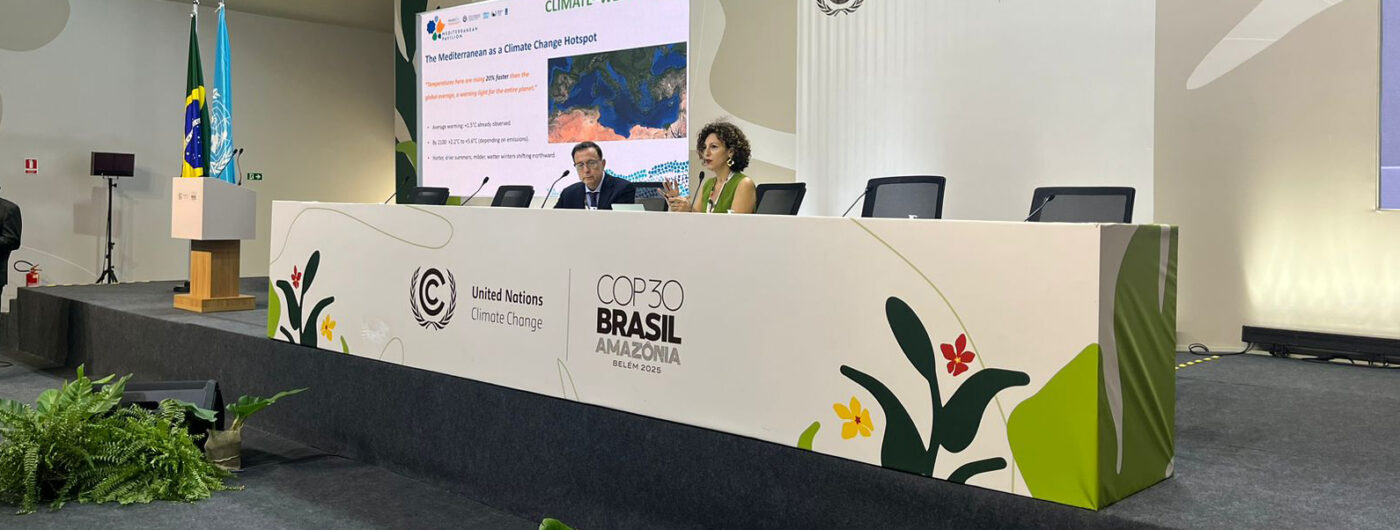
COP 30, Belém, 13 November 2025. During a dedicated press briefing, the Union for the Mediterranean (UfM) and the network of Mediterranean Scientists on Climate and Environmental Change (MedECC) urged immediate, coordinated climate and environmental action, underscoring the Mediterranean Pavilion’s role in rallying a unified Mediterranean voice and elevating a region often overlooked in global negotiations.

The scientific findings, drawn from the latest available research, were presented today by Grammenos Mastrojeni, UfM Senior Deputy Secretary General, and Prof. Magda Bou Dagher Kharrat, Principal Scientist at the European Forest Institute’s Mediterranean Facility (EFIMED) and a member of the MedECC network. Their conclusion reaffirm that the Mediterranean is a global climate hotspot.

COP30 - Mediterranean Pavilion

Average warming in the region has already reached around +1.5°C, with projections ranging from +2.2°C to +5.6°C by 2100 depending on emissions. Precipitation is expected to decline by 10–30%, intensifying water stress across agriculture, energy systems and cities. Biodiversity loss is accelerating on land and at sea, while human pressures exacerbate degradation. Food systems face declining yields in emblematic crops such as olives, grapes and wheat, and shrinking fish stocks increase import dependence. The public health burden is mounting due to more frequent heatwaves, expanding vector‑borne diseases and worsening air quality.

Coastal risks continue to grow. Sea level in the Mediterranean is rising by approximately 2.8 mm per year today, and a one‑metre rise within this century would redraw shorelines, placing cities such as Alexandria, Venice, Barcelona, Tunis and Izmir at heightened risk, with serious implications for infrastructure, tourism and cultural heritage. With about one third of the region’s population living in coastal areas, up to 20 million people could face permanent displacement by 2100 if current trends persist.

The UfM reiterates that safeguarding Mediterranean people, economies and ecosystems requires faster emissions cuts, scaled adaptation, resilient coastal management and circular economy measures to curb pollution—underpinned by strengthened regional cooperation to mobilise finance and share solutions.

Looking ahead, MedECC, with the support of the Union for the Mediterranean, is preparing the Second Mediterranean Assessment Report (MAR2), expected by end of 2026. The report’s findings will inform regional and national policy processes, providing an updated scientific foundation to guide decision-making across the Mediterranean.

The UfM is highlighting practical tools and initiatives designed to accelerate climate action across the region. Through the UfM Energy & Climate Action Youth Delegate Programme, young leaders are bringing forward concrete proposals and taking part in activities at the Pavilion. At the same time, the MedBank Toolkit, expected to become operational by the end of the year, will support public and private project developers in structuring bankable climate and energy projects by providing access to country data, risk assessments, permitting guidance, and financing options—helping build faster, higher-quality project pipelines across the Southern Mediterranean.
Share this:

Latest news

UfM new leadership team meets Commissioner Šuica to advance Pact for the Mediterranean cooperation
05 / 06 / 2026
11th Meeting of the UfM Regional Platform on Trade, Investment and Industry: The 2026 UfM Economic Forum will echo regional trade and investment priorities
04 / 06 / 2026
See more

SUBSCRIBE TO OUR NEWSLETTER!


Agenda

UfM Study Visit on International Trade and Investment Policy
16 / 06 / 2026
Regional Workshop on Digital Trade and E-Commerce in the MENA Region
19 / 10 / 2026
See more

Who we are

  • Member States
  • Meet the team
  • Partners
  • History
  • Transparency and accountability
  • Transparency and access to information
  • Investigating fraud, corruption and misconduct

What we do

  • Economic Development & Employment
  • Higher Education & Research
  • Social & Civil Affairs
  • Water, Environment and Blue Economy
  • Transport & Urban Development
  • Energy & Climate Action
  • Day of the Mediterranean
  • Mediterranean Capitals of Culture and Dialogue

How we work

  • Policy Framework
  • Regional Platforms
  • Projects and Initiatives

Work with us

  • Vacancies
  • Secondments
  • Internships
  • Procurement

Info centre

  • Media corner
  • News
  • Agenda
  • Publications and key documents
  • Stories of Euro-Mediterranean Cooperation
  • Photo gallery
  • Video gallery
Co-financed by the European Union
  • Who we are
    • Member States
    • Meet the team
    • Partners
    • History
    • Transparency and accountability
      • Transparency and access to information
      • Investigating fraud, corruption and misconduct
  • What we do
    • Economic Development and Employment
    • Higher Education & Research
    • Social & Civil Affairs
    • Water, Environment and Blue Economy
    • Transport & Urban Development
    • Energy & Climate Action
  • Initiatives that build bridges
    • Day of the Mediterranean
    • Mediterranean Capitals of Culture and Dialogue
  • How we work
    • Policy Framework
    • UfM Regional Platforms
    • Projects and Initiatives
  • Work with us
    • Vacancies
    • Secondments
    • Internships
    • Procurement
    • Roster of experts
  • Info centre
    • Media center
    • News
    • Agenda
    • Publications and key documents
    • Human Stories of the Mediterranean
  • Contact
  • Social media
    • Facebook
    • Twitter
    • Youtube
    • Linkedin
    • Flickr
  • English
  • Français
  • العربية
  • English
  • Français
  • العربية
Union for the Mediterranean – UfM


We are using cookies to give you the best experience on our website.

You can find out more about which cookies we are using or switch them off in .

Powered by  GDPR Cookie Compliance
Cookies Overview

This website uses cookies so that we can provide you with the best user experience possible. Cookie information is stored in your browser and performs functions such as recognising you when you return to our website and helping our team to understand which sections of the website you find most interesting and useful.

Read more

Strictly Necessary Cookies

Strictly Necessary Cookie should be enabled at all times so that we can save your preferences for cookie settings.

3rd Party Cookies

This website uses Google Analytics to collect anonymous information such as the number of visitors to the site, and the most popular pages.

Keeping this cookie enabled helps us to improve our website.