• English
  • Français
  • العربية
Follow us
Union for the Mediterranean – UfMUnion for the Mediterranean – UfMUnion for the Mediterranean – UfMUnion for the Mediterranean – UfM
  • Who we are
    • The Union for the Mediterranean is an intergovernmental institution bringing together the European Union Member States and 16 countries from the Southern and Eastern shores of the Mediterranean to promote dialogue and cooperation.

      OVERVIEW   

    • Who we are

      • Member States
      • Meet the team
      • Partners
      • History

      Transparency and accountability

      • Transparency and access to information
      • Investigating fraud, corruption and misconduct
    • Key documents

      UfM Institutional Brochure UfM How we work

      More documents   

  • What we do
    • The UfM seeks to enhance regional cooperation, dialogue and the implementation of concrete projects and initiatives with tangible impact on our citizens to address three strategic objectives: human development, stability and integration.

      OVERVIEW   

    • Inclusive development

      • Economic Development and Employment
      • Higher Education & Research
      • Social & Civil Affairs

      Sustainable development

      • Water, Environment and Blue Economy
      • Transport & Urban Development
      • Energy & Climate Action

      Initiatives that build bridges

      • Day of the Mediterranean
      • Mediterranean Capitals of Culture and Dialogue
    • How we work

      • Policy Frameworks
      • Regional Platforms
      • Projects and Initiatives
  • Work with us
    • The UfM Secretariat is the operational platform of the Union for the Mediterranean. The staff of the UfM is made of more than 17 nationalities working in a multicultural environment that fosters cooperation and intercultural communication and exchange.

    • Work with us

      • Vacancies
      • Secondments
      • Internships
      • Procurement
  • Info centre
    • Find our latest press releases, press invitations, visual identity, key institutional documents, photos and other relevant information


      DOWNLOAD THE UfM VISUAL IDENTITY GUIDELINES AND LOGOS (ZIP FILE)   

    • Info centre

      • Media corner
      • News
      • Agenda
      • Publications and key documents
      • Stories of Euro-Mediterranean Cooperation
    • UfM in the Media

      9 May 2026 – Agence Europe (EN) – The fire season that never ends – by Joan Borrell Mayeur
      View article
      9 May 2026 – Agence Europe (FR) – Une saison des feux qui n’en finit pas – par Joan Borrell Mayeur
      View article
      7 May 2026 – Al-Dustour – حرائق غابات المتوسط على وشك أن تبدأ مجدداً… بلا حدود
      View article
  • Contact

Economic integration in Euro-Mediterranean region lagging despite potential for sustainable growth and development, UfM report finds

Economic Development and Employment
  • The 2nd UfM Progress Report on Regional Integration, published in collaboration with the OECD and supported by the German Development Cooperation, was presented today in Barcelona. The data-driven report provides insights on the state of Euro-Mediterranean economic interconnectedness as well as actionable policy recommendations.
  • Although trade flows among UfM Member States accounted for 30% of all global exports in 2022, the Euro-Mediterranean market is still highly fragmented. While foreign direct investment has remained broadly resilient, in many countries it is surpassed by remittances. The region now hosts close to 80% more intra-UfM migrants than in 1990, the majority of which originate from EU countries.
  • Regional integration remains below potential due to persistent challenges to the movement of goods, services, capital, people and technologies. The green transition, however, offers new opportunities, as do enhanced infrastructure connectivity and evolving models for the mobility of people.

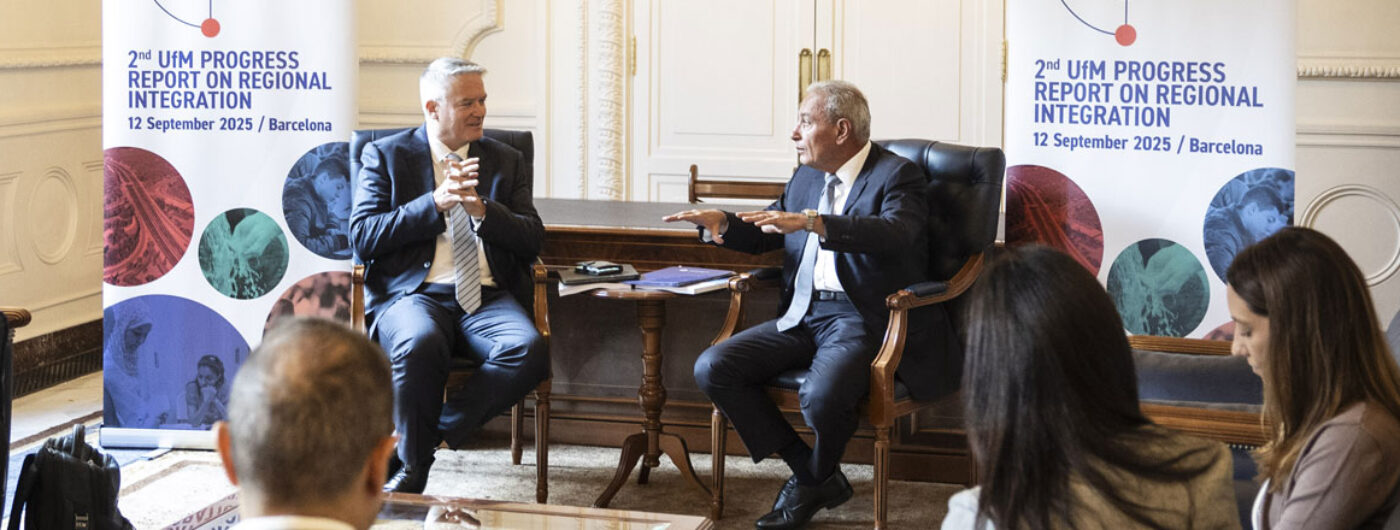
12 September 2025, Barcelona. The 2nd UfM report on the state of economic integration in the Euro-Mediterranean region, developed in partnership with the OECD with the support of the German Development Cooperation (GIZ), was presented today at Barcelona’s Palau Reial palace. Coinciding with the 30th anniversary of the Barcelona Process, it builds on the previous edition and provides key findings and policy recommendations in five domains: trade, finance, infrastructure, movement of people, and higher education and research. The launching ceremony of the report also brought together representatives of different regional integration processes and stakeholders to showcase best practices that can be adapted and replicated in the Euro-Mediterranean region.

The report highlights the complex geopolitical context in which Euro-Mediterranean economic integration processes occur, pointing to the severe repercussions caused by the ongoing conflicts in Ukraine and the Middle East, disrupting supply chains, energy security and prices as well as efforts to foster investment attractiveness and socioeconomic growth and resilience. At the same time, it takes stock of the positive trend of increasing ties between UfM Member States and the Gulf region, now an important source of foreign direct investment especially in MENA countries, as well as Pan-African initiatives.

2nd UfM Progress Report on Regional Integration

Infrastructure connectivity is described as central to boosting not only regional trade and investment, but also R&I collaboration and economic diversification in countries that need it the most. Strengthening transport networks by integrating road, rail and maritime links can optimise routes and promote sustainability in a region responsible for 13.4% of global transport emissions, a 40% increase since 1990. Likewise, cross-Mediterranean renewable energy exchanges, which offer significant potential given the MENA region’s capacity to support the EU’s ambitious climate goals, will depend on expanding infrastructure and its integration into local and regional energy grids.

With intra-UfM migration growing by 6% between 2021 and 2024, the report also notes the growing recognition of the need for improved management of migration patterns. Skills and talent partnership programmes, for example, show promise in this regard as they combine the needs of receiving and sending countries, preventing brain-drain while also alleviating labour market needs. The region now hosts over 34 million intra-UfM migrants, the biggest share of which come from the EU, although those from MENA countries and the Western Balkans are on the rise.

“Regional integration has long been central to the UfM’s mission, and this report acknowledges both the progress achieved and the challenges that remain,” said UfM Secretary General Nasser Kamel. “Global and regional crises continue to reshape our economies, opening our eyes to the importance of moving towards more modernised and sustainable economic models. We must seize this moment to build inclusive economies where young people and women can thrive, guided by a shared commitment to regional integration as a driver of development.”

“Regional integration is key to unlocking the Euro-Mediterranean’s full economic and social potential,” OECD Secretary-General Mathias Cormann said. “By modernising trade agreements, developing capital markets and investing in connectivity and green energy, countries from the Union for the Mediterranean can unlock stronger growth and prosperity. The OECD is committed to supporting policymakers in advancing these priorities with our data, analysis, and evidence-based recommendations.”


Additional resources

  • Summary of key findings
  • Regional Integration in the UfM 2025: Progress Report
Share this:

Latest news

Bridging the digital skills gap and boosting smart e-governance solutions: promoting digital transformation through a UfM Conference in Antalya
21 / 05 / 2026
Call for applications: Research to Business Programme
21 / 05 / 2026
See more

SUBSCRIBE TO OUR NEWSLETTER!


Agenda

11th UfM Regional Platform on Trade, Investment and Industry
03 / 06 / 2026
UfM Senior Officials Meeting (SOM) June 2026
10 / 06 / 2026
See more
Co-financed by the European Union
  • Who we are
    • Member States
    • Meet the team
    • Partners
    • History
    • Transparency and accountability
      • Transparency and access to information
      • Investigating fraud, corruption and misconduct
  • What we do
    • Economic Development and Employment
    • Higher Education & Research
    • Social & Civil Affairs
    • Water, Environment and Blue Economy
    • Transport & Urban Development
    • Energy & Climate Action
  • Initiatives that build bridges
    • Day of the Mediterranean
    • Mediterranean Capitals of Culture and Dialogue
  • How we work
    • Policy Framework
    • UfM Regional Platforms
    • Projects and Initiatives
  • Work with us
    • Vacancies
    • Secondments
    • Internships
    • Procurement
    • Roster of experts
  • Info centre
    • Media center
    • News
    • Agenda
    • Publications and key documents
    • Human Stories of the Mediterranean
  • Contact
  • Social media
    • Facebook
    • Twitter
    • Youtube
    • Linkedin
    • Flickr
  • English
  • Français
  • العربية
  • English
  • Français
  • العربية
Union for the Mediterranean – UfM


We are using cookies to give you the best experience on our website.

You can find out more about which cookies we are using or switch them off in .

Powered by  GDPR Cookie Compliance
Cookies Overview

This website uses cookies so that we can provide you with the best user experience possible. Cookie information is stored in your browser and performs functions such as recognising you when you return to our website and helping our team to understand which sections of the website you find most interesting and useful.

Read more

Strictly Necessary Cookies

Strictly Necessary Cookie should be enabled at all times so that we can save your preferences for cookie settings.

3rd Party Cookies

This website uses Google Analytics to collect anonymous information such as the number of visitors to the site, and the most popular pages.

Keeping this cookie enabled helps us to improve our website.