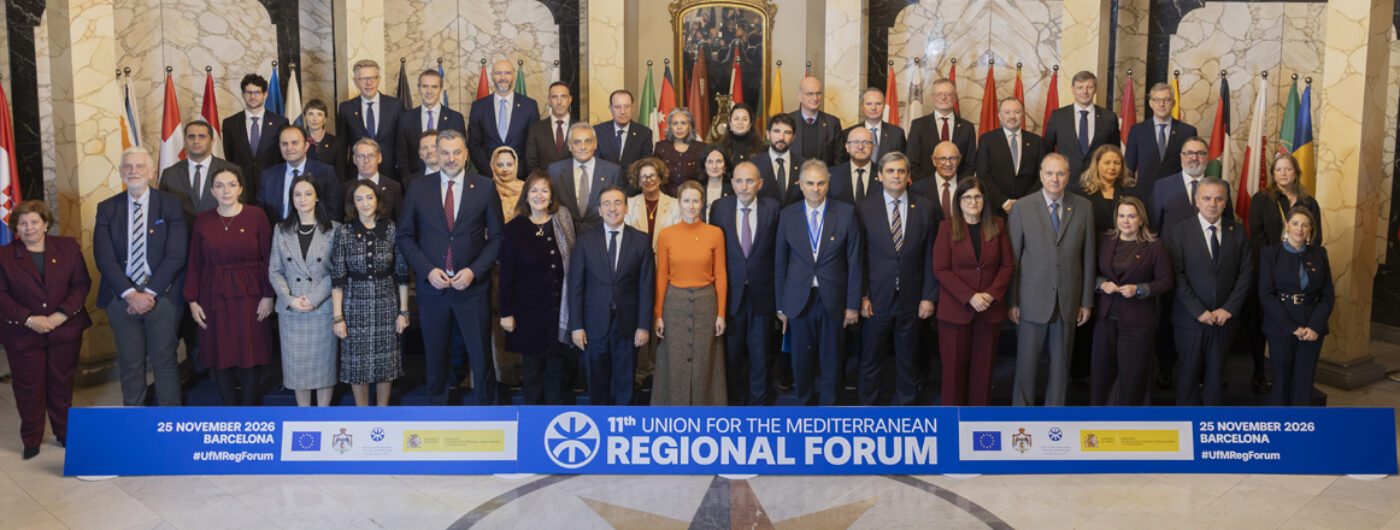
43 Euro-Mediterranean countries renew push for stronger cooperation at 11th UfM Regional Forum in Barcelona
- Representatives of the EU27 and 16 Southern and Eastern Mediterranean UfM countries came together to discuss shared challenges and reaffirm their commitment to working together on solutions.
- The ministerial meeting was co-chaired by Kaja Kallas, High Representative for Foreign Affairs and Security Policy and Vice-President of the European Commission, and Ayman Safadi, Deputy Prime Minister and Minister of Foreign Affairs and Expatriates of Jordan, with the participation of Fadi Hajali, UfM Secretary General ad interim, and Dubravka Šuica, European Commissioner for the Mediterranean. It was hosted by José Manuel Albares, Minister of Foreign Affairs, EU and Cooperation of Spain.
- The 11th UfM Regional Forum took place on the heels of a three-day gathering of more than 250 Euro-Mediterranean cooperation actors to address regional resilience, including civil protection, the role of cities in multi-level cooperation, and advancing gender equality.
25 November 2026, Barcelona. Representatives of the 43 Member States of the Union for the Mediterranean came together today for the organisation’s 11th Regional Forum. Taking place at a time of mounting challenges across the region, the meeting provided them with an opportunity to reinforce political dialogue, assess progress a year after the adoption of the Pact for the Mediterranean and the UfM Vision Statement marking the 30th anniversary of the Barcelona Process, and reflect on how the Euro-Mediterranean partnership can become more effective, inclusive and responsive to the region’s needs.
 Interconnected issues, from conflict to socioeconomic disparities and climate change, continue to affect communities across the Mediterranean, underscoring the importance of bolstering cooperation efforts in order to deliver meaningful results. Despite these difficult circumstances, in the past year the UfM has launched the Rome Initiative on Water to facilitate technical assistance for sustainable water management systems as well as their design and financing. It has spearheaded the Mediterranean Pavilion at COP31, once again giving the region a voice at the UN climate conference, and presented new scientific evidence on environmental migration alongside the Mediterranean Experts on Climate and Environmental Change.
The UfM has also advanced the creation of a Euro-Mediterranean mechanism for disaster prevention, preparedness and response with the 2030 Civil Protection Action Plan, and the establishment of a permanent regional aerial operations and training hub in Paphos, Cyprus. The organisation has been working alongside the EU on the implementation of the Pact’s Mediterranean University initiative and has advanced the regional Employment Action Plan with the launch of a grant scheme to support entrepreneurship and inclusive digital trade, funding projects in Algeria, Egypt, Lebanon, Palestine and Tunisia.
“At a time when our region faces profound cross-border challenges, the need for dialogue and cooperation across the Mediterranean has never been greater. Despite our differences, we share a responsibility for the future of our region. We must therefore continue to come together to translate this commitment into concrete action that delivers tangible benefits for the people, countries and economies along the shores of our shared sea,” said Fadi Hajali, UfM Secretary General ad interim.
A series of UfM Regional Forum side events took place the days prior, with a focus on the contributions of local authorities, civil society, and international and regional organisations to fostering collaboration and resilience. Participants stressed the relevance of multi-level regional cooperation, including the increasingly prominent role of cities as indispensable actors in shaping governance and decisions, and issued a joint declaration on the significance of Euro-Mediterranean mayors in this context.
Also of note were the sessions dedicated to advancing gender equality in the Euro-Mediterranean region that brought together government representatives, civil society organisations, researchers and development partners. The winners of two prizes, the Women Leading Change Award and the Euro-Mediterranean Women in Journalism Award, were announced. Furthermore, the Regional Agenda on Women Entrepreneurs in Agri-Food Value Chains and the InclusiveNISSA Digital Knowledge Hub on Access to Finance were launched. To support this work, the UfM is finalising the 2nd Progress Report on Gender Equality, which will provide the basis for an upcoming Ministerial Conference on Strengthening the Role of Women in Society.
Joint Statement of the UfM Co-Presidency (coming soon)