
• English
  • Français
  • العربية
Follow us
Union for the Mediterranean – UfMUnion for the Mediterranean – UfMUnion for the Mediterranean – UfMUnion for the Mediterranean – UfM
  • Who we are
    • The Union for the Mediterranean is an intergovernmental institution bringing together the European Union Member States and 16 countries from the Southern and Eastern shores of the Mediterranean to promote dialogue and cooperation.

      OVERVIEW   

    • Who we are

      • Member States
      • Meet the team
      • Partners
      • History

      Transparency and accountability

      • Transparency and access to information
      • Investigating fraud, corruption and misconduct
    • Key documents

      UfM Institutional Brochure UfM How we work

      More documents   

  • What we do
    • The UfM seeks to enhance regional cooperation, dialogue and the implementation of concrete projects and initiatives with tangible impact on our citizens to address three strategic objectives: human development, stability and integration.

      OVERVIEW   

    • Inclusive development

      • Economic Development and Employment
      • Higher Education & Research
      • Social & Civil Affairs

      Sustainable development

      • Water, Environment and Blue Economy
      • Transport & Urban Development
      • Energy & Climate Action

      Initiatives that build bridges

      • Day of the Mediterranean
      • Mediterranean Capitals of Culture and Dialogue
    • How we work

      • Policy Frameworks
      • Regional Platforms
      • Projects and Initiatives
  • Work with us
    • The UfM Secretariat is the operational platform of the Union for the Mediterranean. The staff of the UfM is made of more than 17 nationalities working in a multicultural environment that fosters cooperation and intercultural communication and exchange.

    • Work with us

      • Vacancies
      • Secondments
      • Internships
      • Procurement
  • Info centre
    • Find our latest press releases, press invitations, visual identity, key institutional documents, photos and other relevant information


      DOWNLOAD THE UfM VISUAL IDENTITY GUIDELINES AND LOGOS (ZIP FILE)   

    • Info centre

      • Media corner
      • News
      • Agenda
      • Publications and key documents
      • Stories of Euro-Mediterranean Cooperation
    • UfM in the Media

      9 May 2026 – Agence Europe (EN) – The fire season that never ends – by Joan Borrell Mayeur
      View article
      9 May 2026 – Agence Europe (FR) – Une saison des feux qui n’en finit pas – par Joan Borrell Mayeur
      View article
      7 May 2026 – Al-Dustour – حرائق غابات المتوسط على وشك أن تبدأ مجدداً… بلا حدود
      View article
  • Contact

When the craft is born in Syria and flourishes in Jordan

Water Environment & Blue Economy

The below success story from the UfM-labelled Smart DESERT project is a courtesy of the International Union for Conservation of Nature (IUCN). The original article can be consulted here.

As the second-largest host country for refugees, Jordan faces significant economic and environmental pressures. Despite international community interventions aimed at mitigating the impact of Syrian refugees, it remains challenging to align available resources with the necessary needs. This has resulted in increased poverty and rising unemployment rates in Jordan. To address these challenges, the Smart DESERT project, funded by the French Development Agency, was initiated with the goal of catalyzing agricultural development in Jordan’s eastern and northern highlands. The project focuses on economically empowering vulnerable Jordanians and Syrian refugees by increasing their income, generating new job opportunities, and improving working conditions.

Prior to the conflict, Abu-Fawaz enjoyed a stable life characterized by hard work, producing high-quality dairy products that attracted clients from various countries. However, the crisis forced Abu-Fawaz to leave his shop and equipment behind and seek refuge in Jordan. He recalled:

“I used to ship my products to Jordan, where my clients appreciated their quality and ordered them in large quantities. Suddenly, I found myself and my family without financial resources or shelter. I had to find work to provide for them, so I began working in agriculture for a modest wage.”

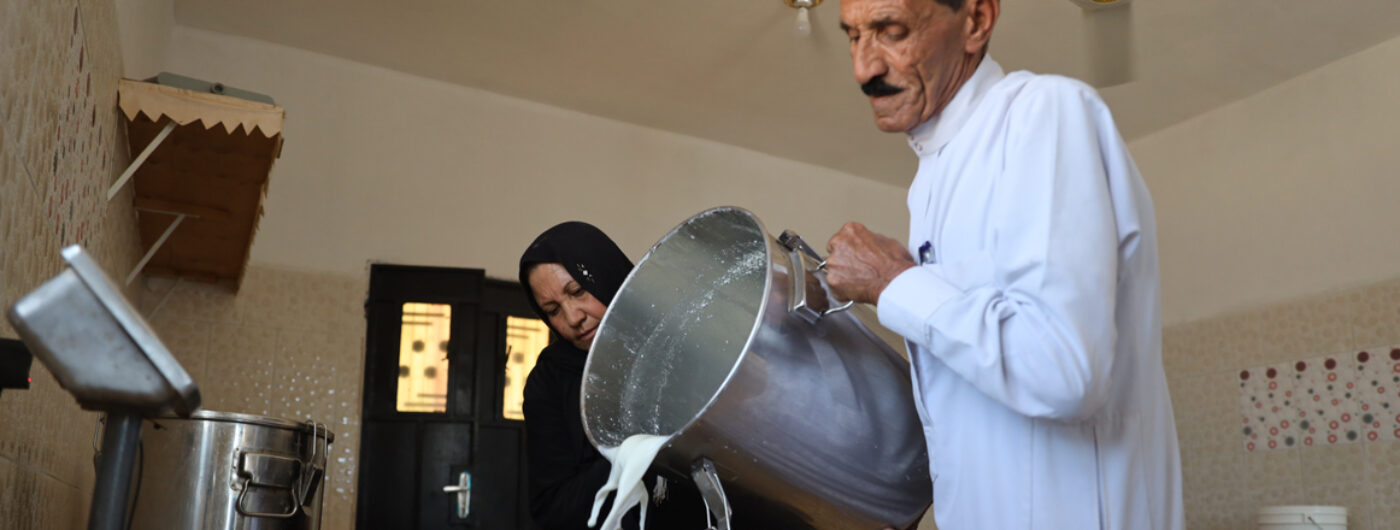
Abu-Fawaz harbored a dream of reopening his dairy shop, a craft he had practiced since childhood. He and his wife started saving small sums of money to purchase milk and produce dairy products. Over time, they managed to resume dairy production using basic equipment and even employed several refugee women who had sought safety in Jordan. Abu-Fawaz’s wife reminisced about their early struggles, saying, “the beginning was very tough, and the work was physically demanding. We, the women, had to work long hours, vigorously shaking and boiling milk to transform it into Labneh and cheese. Afterward, we often experienced physical pain.”

The Smart DESERT project played a pivotal role in supporting Abu-Fawaz and his family. They provided the necessary equipment to enhance production and helped them secure a factory space, allowing for an expansion of their operations. This expansion, in turn, created employment opportunities for eight Syrian women, enabling them to contribute to their families’ well-being in a healthier work environment. Abu-Fawaz’s wife expressed her relief, stating, “now, we can work comfortably. The equipment provided to us has significantly eased our work compared to before. We have an air purifier that eliminates the smell of milk and cheese, a shaking machine that enables us to process larger quantities, and refrigerators for storing greater amounts of milk and cheese. The sanitary basins provided by the project have improved the quality of our products and eliminated the physical exhaustion we used to endure.”

With increased production capacity, Abu-Fawaz’s business was able to employ more female workers and expand its market reach to new governorates. They were delighted to see their products back on the tables of loyal Jordanian customers who had cherished them since their production in Syria.

Looking ahead, Abu-Fawaz aspires to establish a sheep breeding project to secure a steady supply of raw materials for his business. He envisions achieving self-sufficiency for the families working on his project and believes that, with determination, he can surpass his current achievements.   

More on the UfM actions on water, environment and blue economy

  • Learn more about the Smart DESERT project.
  • The Mediterranean region is using about three times more natural resources than its ecosystems can provide. Consult the UfM Environment Agenda to promote a green, circular and socially inclusive economy.
Back to Human Stories Page
Previous Story
Next Story
Co-financed by the European Union
  • Who we are
    • Member States
    • Meet the team
    • Partners
    • History
    • Transparency and accountability
      • Transparency and access to information
      • Investigating fraud, corruption and misconduct
  • What we do
    • Economic Development and Employment
    • Higher Education & Research
    • Social & Civil Affairs
    • Water, Environment and Blue Economy
    • Transport & Urban Development
    • Energy & Climate Action
  • Initiatives that build bridges
    • Day of the Mediterranean
    • Mediterranean Capitals of Culture and Dialogue
  • How we work
    • Policy Framework
    • UfM Regional Platforms
    • Projects and Initiatives
  • Work with us
    • Vacancies
    • Secondments
    • Internships
    • Procurement
    • Roster of experts
  • Info centre
    • Media center
    • News
    • Agenda
    • Publications and key documents
    • Human Stories of the Mediterranean
  • Contact
  • Social media
    • Facebook
    • Twitter
    • Youtube
    • Linkedin
    • Flickr
  • English
  • Français
  • العربية
  • English
  • Français
  • العربية
Union for the Mediterranean – UfM


We are using cookies to give you the best experience on our website.

You can find out more about which cookies we are using or switch them off in .

Powered by  GDPR Cookie Compliance
Cookies Overview

This website uses cookies so that we can provide you with the best user experience possible. Cookie information is stored in your browser and performs functions such as recognising you when you return to our website and helping our team to understand which sections of the website you find most interesting and useful.

Read more

Strictly Necessary Cookies

Strictly Necessary Cookie should be enabled at all times so that we can save your preferences for cookie settings.

3rd Party Cookies

This website uses Google Analytics to collect anonymous information such as the number of visitors to the site, and the most popular pages.

Keeping this cookie enabled helps us to improve our website.